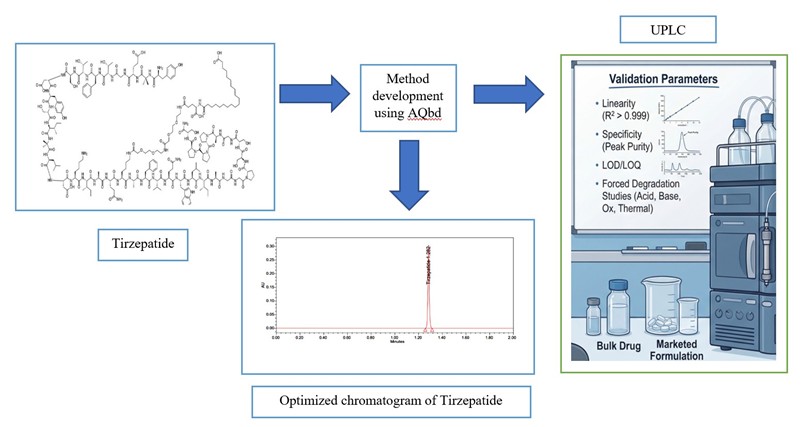
AQbD assisted UPLC method development and validation of tirzepatide in bulk and pharmaceutical dosage form
DOI:
https://doi.org/10.69857/joapr.v14i3.1914Keywords:
Tirzepatide, UPLC, Diabetics, AQbD, ValidationAbstract
Background: Tirzepatide is a USFDA-approved (2023) synthetic drug that primarily targets blood sugar metabolism for chronic weight management, obesity-related conditions, and type 2 diabetes. In this study, we aim to develop a reliable, sensitive UPLC method for estimating Tirzepatide using Analytical Quality by Design (AQbD) to optimize chromatographic conditions. Methodology: The finalized method was developed using the Agilent 1290 Infinity II LC System, with a Phenomenex C18 column (50 x 1.7 mm, 2.1 µm), using a mobile phase of acetonitrile and trifluoroacetic acid buffer (37.07:62.93, v/v) at a flow rate of 0.57 mL/min and a Photo Diode Array detector at 264 nm. Result and Discussion: The method validation showed linearity over the range of 12.5–75 µg/mL (R² = 0.9995). The intraday and interday precision (%RSD) values were 0.603 and 0.791, respectively, confirming the method's reproducibility. Limit of Detection and Limit of Quantification values were calculated from S/N ratios of the prepared samples and were 0.6 and 2, respectively. Accuracy was validated to be 99.3-101.1%. The forced degradation studies were conducted under stress conditions, including acid, alkali, peroxide, reduction, photodegradation, and hydrolysis, with tirzepatide showing degradation percentages of 1.3%, 11.3%, 12.1%, 2.1%, 1.7%, and 2.9%. Conclusion: The developed UPLC method for quantifying tirzepatide was found to be significant, with all evaluated parameters in agreement with ICH guidelines. The proposed method is efficient, straightforward, and dependable, rendering it appropriate for routine quality control of tirzepatide in bulk and pharmaceutical formulations
Downloads

References
Sokary S, Bawadi H. The promise of tirzepatide: A narrative review of metabolic benefits. Prim Care Diabetes, 19, 229–237 (2025) https://doi.org/10.1016/j.pcd.2025.03.008
Galindo RJ, Cheng AYY, Longuet C, et al. Insights into the mechanism of action of tirzepatide: A narrative review. Diabetes Ther, 17, 19–40 (2026) https://doi.org/10.1007/s13300-025-01804-w
Ali R, Sharma AV, Chawla PA. Bumps and humps in the success of tirzepatide as the first GLP-1 and GIP receptor agonist. Health Sci Rev, 4, 100032 (2022) https://doi.org/10.1016/j.hsr.2022.100032
Taha MME, Abdelwahab SI, Oraibi O, et al. Mapping the global research landscape of tirzepatide: A bibliometric analysis of trends, collaborations, and emerging themes in obesity and diabetes management. Naunyn Schmiedebergs Arch Pharmacol, 399, 2577–2591 (2025) https://doi.org/10.1007/s00210-025-04574-1
Bairagi A, Kothrukar R, Chikhale H, et al. AQbD-novel strategy for analytical methods. Future J Pharm Sci, 10, 138 (2024) https://doi.org/10.1186/s43094-024-00706-1
Rao KVU, Shorgar N. Development of a stability-indicating UPLC method for quantification of mirvetuximab soravtansine-gynx in pharmaceutical formulations using quality by design (QbD) principles. J Appl Pharm Res, 13(2), 204–213 (2025) https://doi.org/10.69857/joapr.v13i2.977
Beg S, Haneef J, Rahman M, Peraman R, Taleuzzaman M, Almalki WH. Introduction to analytical quality by design. In: Handbook of Analytical Quality by Design. Academic Press, 1–14 (2021) https://doi.org/10.1016/B978-0-12-820332-3.00009-1
Jadhav S, Wadher S. AQbD-guided development and validation of an innovative extraction procedure and stability-indicating RP-HPLC method for quantification of posaconazole in tablet formulation. Ann Pharm Fr, 82(6), 1088–1102 (2024) https://doi.org/10.1016/j.pharma.2024.07.003
Jonnalagadda R, Rathinam S, Nagappan K, Chandrasekar V. Green HPLC method for simultaneous analysis of three natural antioxidants by analytical quality by design. J AOAC Int, 107(1), 14–21 (2024) https://doi.org/10.1093/jaoacint/qsad105
Vanitha T, Pandreka M, Geetha B, Yamini M, Abhishek G, Gope E, Raghava D, Nageswara K. Advances in high-performance liquid chromatography (HPLC) and ultra-performance liquid chromatography (UPLC). J Pharma Insights Res, 2, 39–46 (2024) https://doi.org/10.69613/t4nhz921
Jani B, Vekariya H. QbD-guided HPTLC method development and validation for quantitative estimation of anticancer drugs. J Appl Pharm Res, 13(5), 190–202 (2025) https://doi.org/10.69857/joapr.v13i5.1465
PNSS S, Adikay S. A QbD-based stability-indicating RP-HPLC method for larotrectinib: degradation kinetics and integrated white, green, and blue analytical assessment. J Appl Pharm Res, 13(4), 143–161 (2025) https://doi.org/10.69857/joapr.v13i4.1436
Choi HI, Jeong HC, Jeong JW, Lee J, Kim DH, Ko KC, Chae YJ, Lee KR. Development and validation of an LC-MS/MS method for tirzepatide, a dual GIP/GLP-1 receptor agonist, in rat plasma for application to a pharmacokinetic study. J Chromatogr B, 1268, 124836 (2026) https://doi.org/10.1016/j.jchromb.2025.124836
Published
How to Cite
Issue
Section
Copyright (c) 2026 Panthagada Sunitha, M. Sivakumar

This work is licensed under a Creative Commons Attribution-NonCommercial 4.0 International License.