Kaempferol-rich Thespesia lampas leaf extract mitigates gentamicin-induced nephrotoxicity via antioxidant and anti-inflammatory mechanisms in wistar rats
DOI:
https://doi.org/10.69857/joapr.v14i3.1885Keywords:
Gentamicin, Nephrotoxicity, Thespesia lampas, Kaempferol, NF-κB signalingAbstract
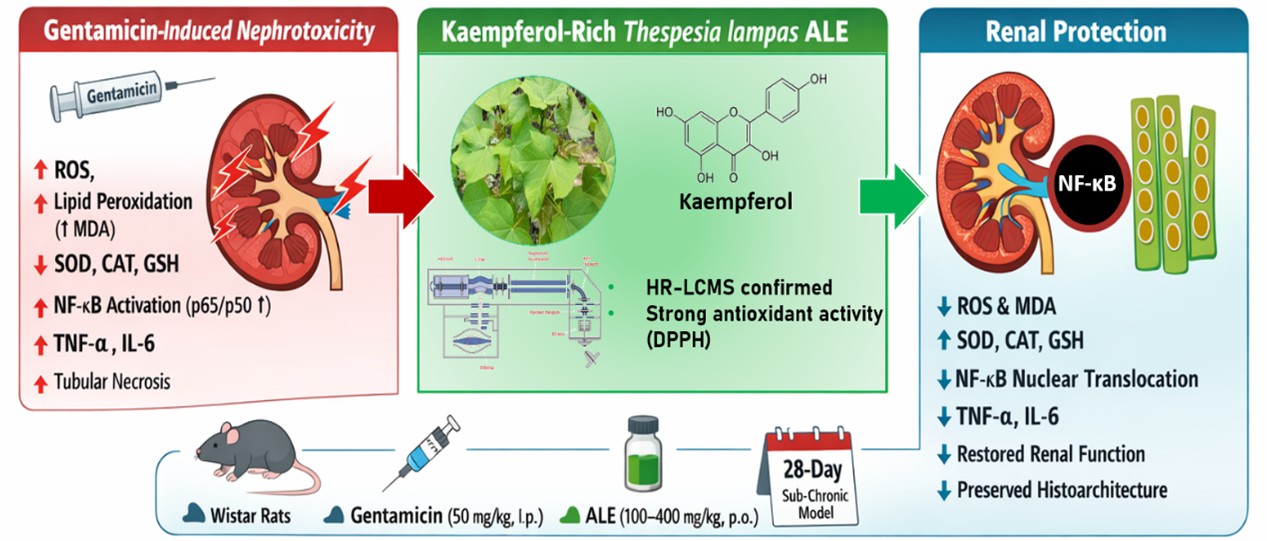
Background: Gentamicin-induced nephrotoxicity (GIN) is a major limitation of aminoglycoside therapy and a common cause of acute kidney injury (AKI). The underlying mechanisms involve excessive oxidative stress and activation of inflammatory signaling pathways, particularly the nuclear factor-κB (NF-κB) pathway. Natural flavonoids such as kaempferol possess strong antioxidant and anti-inflammatory properties. Thespesia lampas, traditionally used in renal disorders, is rich in kaempferol, necessitating scientific validation of its nephroprotective potential. Methodology: ALE was characterized using HR-LCMS, confirming kaempferol as the major flavonoid (20.5 ± 2.8 mg/g extract; 2.05 ± 0.28% w/w). Antioxidant activity was assessed by the DPPH assay, demonstrating potent free radical scavenging (IC₅₀ = 62.4 µg/mL) comparable to rutin standard (IC₅₀ = 48.6 µg/mL). Rats received ALE orally at doses of 100, 200, and 400 mg/kg for 28 days, while nephrotoxicity was induced by gentamicin (50 mg/kg/day, i.p.) during the final 10 days. Renal function markers, oxidative stress parameters, pro-inflammatory cytokines (TNF-α, IL-6), NF-κB (p65/p50) nuclear translocation, and renal histopathology were evaluated. Results and Discussion: Gentamicin caused significant renal dysfunction, oxidative imbalance, elevated inflammatory cytokines, and increased NF-κB activation. ALE treatment produced dose-dependent nephroprotection, with the 400 mg/kg dose markedly restoring renal biomarkers, improving antioxidant defenses, suppressing inflammatory mediators, and ameliorating histopathological damage. Conclusion: Kaempferol-rich Thespesia lampas ALE confers significant protection against gentamicin-induced nephrotoxicity by attenuating oxidative stress and inhibiting NF-κB–mediated inflammation, highlighting its potential as a therapeutic agent for drug-induced renal injury.
Downloads

References
Thy M, Timsit JF, de Montmollin E. Aminoglycosides for the treatment of severe infection due to resistant gram-negative pathogens. Antibiotics, 12(5), 860 (2023) https://doi.org/10.3390/antibiotics12050860
Izzedine H, Guetin V. Drug-induced acute tubulointerstitial nephritis. Oxford Textbook of Clinical Nephrology, 4, 679–686 (2016) https://doi.org/10.1093/med/9780199592548.001.0001
Nagai J, Takano M. Entry of aminoglycosides into renal tubular epithelial cells via endocytosis-dependent and endocytosis-independent pathways. Biochem Pharmacol, 90(4), 331–337 (2014) https://doi.org/10.1016/j.bcp.2014.05.018
Fan M, Lan X, Wang Q, Shan M, Fang X, Zhang Y, et al. Renal function protection and the mechanism of ginsenosides: current progress and future perspectives. Front Pharmacol, 14, 1070738 (2023) https://doi.org/10.3389/fphar.2023.1070738
Kumar S, Saxena J, Srivastava VK, Kaushik S, Singh H, Abo-EL-Sooud K, et al. The interplay of oxidative stress and ROS scavenging: antioxidants as a therapeutic potential in sepsis. Vaccines (Basel), 10(10), 1575 (2022) https://doi.org/10.3390/vaccines10101575
Ju SK, KC MJ, Semotiuk AJ. Indigenous knowledge on medicinal plants used by ethnic communities of South India. Ethnobot Res Appl, 18, 1–12 (2019) https://doi.org/10.32859/era.18.4.1-112
Sharma P, Shri R, Ntie-Kang F, Kumar S. Phytochemical and ethnopharmacological perspectives of Ehretia laevis. Molecules, 26(12), 3489 (2021) https://doi.org/10.3390/molecules26123489
Parthasarathy R, Singh A, Bhowmik D. Pharmacognostical studies on Thespesia populnea leaf. Res J Pharmacogn Phytochem, 8(1), 16–20 (2016) https://doi.org/10.5958/0975-4385.2016.00004.2
Chatepa LE, Mwamatope B, Chikowe I, Masamba KG. Effects of solvent extraction on phytoconstituents and in vitro antioxidant activity of selected medicinal plants from Malawi. BMC Complement Med Ther, 24(1), 317 (2024) https://doi.org/10.1186/s12906-024-04217-2
Gonfa T, Teketle S, Kiros T. Effect of extraction solvent on phytochemical composition and antioxidant activity of Cadaba rotundifolia leaf extracts. Cogent Food Agric, 6(1), 1853867 (2020) https://doi.org/10.1080/23311932.2020.1853867
Pooja KP, Shrishail HC. Phytochemical profiling and antioxidant evaluation of root ethanol extract of Maesa indica (Roxb.) sweet. J Appl Pharm Res, 13(4), 124–131 (2025) https://doi.org/10.69857/joapr.v13i4.1237
Morales G, Paredes A. Antioxidant activities of Lampaya medicinalis extracts and their main chemical constituents. BMC Complement Altern Med, 14, 259 (2014) https://doi.org/10.1186/1472-6882-14-259
Singh N, Mansoori A, Jiwani G, Solanke AU, Kumar R, Kumar A. Evaluation of antioxidant and antimicrobial potential of Thespesia lampas root extracts. J Exp Biol Agric Sci, 9(1), 87–99 (2021) https://doi.org/10.18006/2021.9(1).87.99
da Silva AR, Lopes LQ, Cassanego GB, de Jesus PR, Figueredo KC, Santos RC, et al. Acute toxicity and antimicrobial activity of Baccharis trimera leaf tincture. Biomed J, 41(3), 194–201 (2018) https://doi.org/10.1016/j.bj.2018.03.001
Garg D, Sharma A, Pragi, Kumar V. Evaluation of the hepatoprotective and nephroprotective properties of bael fruit extract against carbon tetrachloride-induced toxicity in rats. J Appl Pharm Res, 12(3), 11–20 (2024) https://doi.org/10.69857/joapr.v12i3.524
Zhang J, Ma L, Hashimoto Y, Wan X, Shan J, Qu Y, et al. (R)-ketamine ameliorates lethal inflammatory responses and multi-organ injury in mice. Life Sci, 284, 119882 (2021) https://doi.org/10.1016/j.lfs.2021.119882
Xingwei X, Xin G, Peng Z, Tao F, Bowen D, Xiaoming K, et al. Low-dose ketamine pretreatment reduces oxidative damage following CO₂ pneumoperitoneum in rats. Clin Investig Med, 37(3), E124–E130 (2014) https://doi.org/10.25011/cim.v37i3.21379
Kumar A, Pragi, Sharma A, Kumar V. Assessment of hepatoprotective and nephroprotective effects of Vitis vinifera leaf extract on carbon tetrachloride induced toxicity in rats. J Appl Pharm Res, 12(1), 82–92 (2024) https://doi.org/10.18231/j.joapr.2024.12.1.82.92
Aurori M, Andrei S, Dreanca AI, Morohoschi AG, Cotul M, Niculae M, et al. Nephroprotective effects of cornelian cherry and rowanberry in gentamicin-induced nephrotoxicity Nutrients, 15(20), 4392 (2023) https://doi.org/10.3390/nu15204392
Gamaan MA, Zaky HS, Ahmed HI. Gentamicin-induced nephrotoxicity: a mechanistic approach. Azhar Int J Pharm Med Sci, 3(2), 11–19 (2023) https://doi.org/10.21608/aijpms.2023.161755.1167
Abdel-Fattah MM, Elgendy AN, Mohamed WR. Xanthenone counteracted gentamicin-induced nephrotoxicity via ACE2/Ang-(1–7) signaling. Life Sci, 275, 119387 (2021) https://doi.org/10.1016/j.lfs.2021.119387
Carrara C, Abbate M, Conti S, Rottoli D, Rizzo P, Marchetti G. Histological examination of the diabetic kidney. Diabetic Nephropathy: Methods and Protocols, 63–87 (2019) https://doi.org/10.1007/978-1-4939-9535-5_5
Gobe G. Identification of apoptosis in kidney tissue sections. Kidney Research: Experimental Protocols, 175–192 (2009) https://doi.org/10.1007/978-1-59745-352-3_13
Tran D, Golick M, Rabinovitz H, Rivlin D, Elgart G, Nordlow B. Hematoxylin and safranin O staining of frozen sections. Dermatol Surg, 26(3), 197–199 (2000) https://doi.org/10.1046/j.1524-4725.2000.09220.x
Effah F, Shaikh SB, Chalupa D, Faizan MI, Elder A, Rahman I. High-resistance coils in e-cigarettes increase heavy metal leaching and oxidant generation in human bronchial epithelial cells. NAM J, 100060 (2025) https://doi.org/10.1016/j.namjnl.2025.100060
Published
How to Cite
Issue
Section
Copyright (c) 2026 Shweta Shamrao Dhavane, Ravindra Bhimraj Laware

This work is licensed under a Creative Commons Attribution-NonCommercial 4.0 International License.