Analytical profiling and antioxidant characterization of flavonoids from himalayan black soybean (Glycine max)
DOI:
https://doi.org/10.69857/joapr.v14i3.2131Keywords:
Antioxidant activity, Black Soybean,, FTIR,, NMR,, HPLC,, TFCAbstract
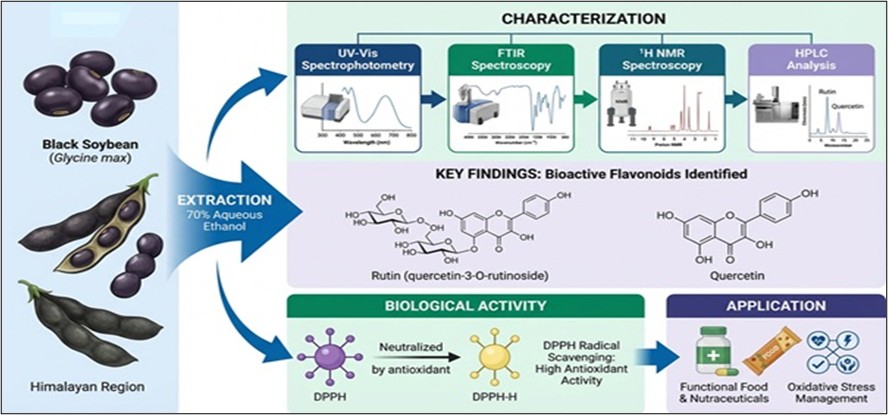
Background: Black soybean is a leguminous crop of great phytochemical interest and importance in traditional systems due to its alleged health-promoting effects. To a great extent, these advantages are attributed to its flavonoid content, a class of polyphenols known for their strong antioxidant properties. This research was part of a significant task: conducting a comprehensive phytochemical characterization of the flavonoid profile in black soybean seeds and assessing their respective antioxidant potential in vitro. Methodology: Flavonoids were extracted from authentic seeds using 70% aqueous ethanol. UV-Vis, FTIR, and 1H NMR spectroscopy were used to elucidate the extract's functional groups and structure. Specific flavonoids (rutin, quercetin) were analyzed quantitatively by use of validated HPLC. In the determination of total flavonoid content, a spectrometric method was used. The DPPH radical-scavenging assay was used to determine antioxidant activity. Results and Discussion: Spectroscopic studies revealed the presence of typical flavone/flavonol skeletons. The HPLC quantification illustrated good method performance. The TFC was 5.91 mg QE/g extract. The extract exhibited high dose-dependent scavenging activity against the DPPH radical. High TFC was strongly correlated with antioxidant activity, confirming the bioactive capacity of black soybean, known for its flavanol-rich flavonoids. Conclusion: The results are scientifically confirmed: black soybean is rich in bioactive flavonoids with high antioxidant capacity and can therefore be used as a functional food ingredient or nutraceutical to treat oxidative stress.
Downloads

References
Sprea RM, Finimundy TC, Calhelha RC, Pires TCSP, Prieto MA, Amaral JS, Barros L. Comprehensive analysis of soybean (Glycine max L.) by-products: Nutritional value, phenolic composition, and bioactive properties. Food Biosci., 62, (2024) https://doi.org/10.1016/j.fbio.2024.105382.
Aghababaei F, Hadidi M. Recent Advances in Potential Health Benefits of Quercetin. Pharmaceuticals, 16, (2023) https://doi.org/10.3390/ph16071020.
Romes NB, Abdul Wahab R, Abdul Hamid M. The role of bioactive phytoconstituents-loaded nanoemulsions for skin improvement: a review. Biotechnology and Biotechnological Equipment, 35, 711–29 (2021) https://doi.org/10.1080/13102818.2021.1915869.
Navin R Sheth AG, Jitendra SP, Yadav S. Determination of Quercetin, a Biomarker in Hepatoprotective Polyherbal Formulation through High Performance Thin Layer Chromatography. J. Chromatogr. Sep. Tech., 06, (2015) https://doi.org/10.4172/2157-7064.1000285.
Chik MW, Affandi MMRMM, Chellammal HSJ, Hazalin NAMN, Singh GKS. Astaxanthin Nanoemulsion and Nanoparticle Formulations and Their Therapeutic Potential: A Review. Advances in Pharmacology and Pharmacy, 13, 342–54 (2025) https://doi.org/10.13189/app.2025.130306.
Cao G, Yu Y, Wang H, Liu J, Zhang X, Yu Y, Li Z, Zhang Y, Yang C. Effects of Oral Administration of Bamboo (Dendrocalamus membranaceus) Leaf Flavonoids on the Antioxidant Capacity, Caecal Microbiota, and Serum Metabolome of Gallus gallus domesticus. Front. Nutr., 9, (2022) https://doi.org/10.3389/fnut.2022.848532.
Christodoulou MC, Orellana Palacios JC, Hesami G, Jafarzadeh S, Lorenzo JM, Domínguez R, Moreno A, Hadidi M. Spectrophotometric Methods for Measurement of Antioxidant Activity in Food and Pharmaceuticals. Antioxidants, 11, (2022) https://doi.org/10.3390/antiox11112213.
Krisanti EA, Kirana DP, Mulia K. Nanoemulsions containing Garcinia mangostana L. pericarp extract for topical applications: Development, characterization, and in vitro percutaneous penetration assay. PLoS One, 16, (2021) https://doi.org/10.1371/journal.pone.0261792.
Uddin MS, Hossain MS, Al Mamun A, Tewari D, Asaduzzaman M, Islam MS, Abdel-Daim MM. Phytochemical analysis and antioxidant profile of methanolic extract of seed, pulp and peel of Baccaurea ramiflora Lour. Asian Pac. J. Trop. Med., 11, 443–50 (2018) https://doi.org/10.4103/1995-7645.237189.
Yuan H, Ma Q, Ye L, Piao G. The traditional medicine and modern medicine from natural products. Molecules, 21, (2016) https://doi.org/10.3390/molecules21050559.
Hoque, N., Choudhury, A. ., Baishya, D. ., & Deka, H. . (2024). Comprehensive review of breast cancer risk factors, diagnosis, screening, and treatment methods. Journal of Applied Pharmaceutical Research, 12(5), 16-27. https://doi.org/10.69857/joapr.v12i5.606
Salunke Mohini WBWP. Phytochemical Investigation of Brown Algae Dictyota Dichotoma Collected from Ramanathapuram District, Tamilnadu. Int. J. Biol. Pharm. Allied Sci., 10, 446–53 (2021) https://doi.org/10.31032/ijbpas/2021/10.12.1039.
Jeevitha, M. P., & Malammanavar, S. G. . (2025). Antimicrobial activity of bioactive compounds extracted from Chara globularis Thuill . Journal of Applied Pharmaceutical Research, 13(5), 216-231. https://doi.org/10.69857/joapr.v13i5.1371
Salunke M, Wakure B, Bhusari S, Wakte P. Green biosynthesis, characterization, and anticancer activity of Sargassum cinctum zinc nanoparticles. Indian J. Biochem. Biophys., 62, 187–95 (2025) https://doi.org/10.56042/ijbb.v62i2.14167.
Chaddha, V., & Gupta, R. . (2025). Preliminary phytochemical screening, FT-IR, and HPTLC analysis, and antioxidant, antimicrobial activities of methanolic extracts of Dalbergia sisso leaves. Journal of Applied Pharmaceutical Research, 13(4), 53-62. https://doi.org/10.69857/joapr.v13i4.967
Kendre N, Salunke M, Wakure B, Wakte P. HR-LCMS based phytochemical analysis and anticancer activity of Triumfetta rhomboidea with molecular docking approach. J. Appl. Pharm. Sci., (2024) https://doi.org/10.7324/JAPS.2024.148412.
Salunke M, Wakure B, Wakte P. HR-LCMS assisted phytochemical screening and an assessment of anticancer activity of Sargassum Squarrossum and Dictyota Dichotoma using in vitro and molecular docking approaches. J. Mol. Struct., 1270, (2022) https://doi.org/10.1016/j.molstruc.2022.133833.
Salunke MA, Wakure BS, Wakte PS. High-resolution liquid chromatography and mass spectrometry (HR-LCMS) assisted phytochemical profiling and an assessment of anticancer activities of Gracilaria foliifera and Turbinaria conoides using in vitro and molecular docking analysis. J. Biomol. Struct. Dyn., 1–16 (2022) https://doi.org/10.1080/07391102.2022.2108495.
Górka B, Wieczorek PP. Simultaneous determination of nine phytohormones in seaweed and algae extracts by HPLC-PDA. J. Chromatogr. B Analyt. Technol. Biomed. Life Sci., 1057, 32–9 (2017) https://doi.org/10.1016/j.jchromb.2017.04.048.
Do QD, Angkawijaya AE, Tran-Nguyen PL, Huynh LH, Soetaredjo FE, Ismadji S, Ju YH. Effect of extraction solvent on total phenol content, total flavonoid content, and antioxidant activity of Limnophila aromatica. J. Food Drug Anal., 22, 296–302 (2014) https://doi.org/10.1016/j.jfda.2013.11.001.
El Shafay S, El-Sheekh M, Bases E, El-Shenody R. Antioxidant, antidiabetic, anti-inflammatory and anticancer potential of some seaweed extracts. Food Science and Technology (Brazil), 42, (2022) https://doi.org/10.1590/fst.20521.
Alghamdi SS, Khan MA, El-Harty EH, Ammar MH, Farooq M, Migdadi HM. Comparative phytochemical profiling of different soybean (Glycine max (L.) Merr) genotypes using GC–MS. Saudi J. Biol. Sci., 25, 15–21 (2018) https://doi.org/10.1016/j.sjbs.2017.10.014.
Choi YM, Yoon H, Lee S, Ko HC, Shin MJ, Lee MC, Hur OS, Ro NY, Desta KT. Isoflavones, anthocyanins, phenolic content, and antioxidant activities of black soybeans (Glycine max (L.) Merrill) as affected by seed weight. Sci. Rep., 10, (2020) https://doi.org/10.1038/s41598-020-76985-4.
Published
How to Cite
Issue
Section
Copyright (c) 2026 Pramod Kumbhar, Chandraprabhu Jangme, Mohini Salunke, Balaji Wakure

This work is licensed under a Creative Commons Attribution-NonCommercial 4.0 International License.