Development and optimization of a mechlorethamine topical formulation utilizing a model drug bridging strategy and quality by design
DOI:
https://doi.org/10.69857/joapr.v14i3.2095Keywords:
Mechlorethamine Topical Formulation, Quality by Design (QbD), Model Drug Bridging, Formulation Design Space, Stability TestingAbstract
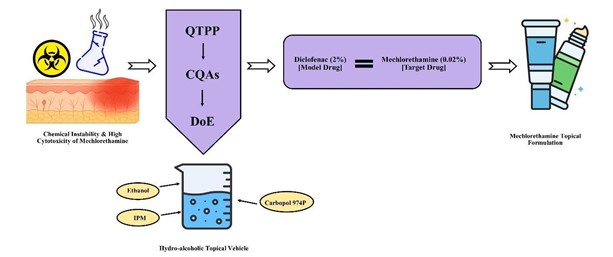
Background: This study aimed to develop a stable, clinically suitable topical mechlorethamine formulation using Quality by Design (QbD) principles to address chemical instability and cytotoxicity. The objectives were to establish a data-driven formulation design space, identify critical material attributes, and apply a surrogate active pharmaceutical ingredient (API) approach to ensure biological performance while enabling safe early-stage optimization. Methodology: A 2³ full factorial Design of Experiments (DOE) was employed to evaluate the effects of ethanol, isopropyl myristate (IPM), and Carbopol 974P on assay concentration, viscosity, and pH. Regression modeling and response surface analysis were used to define the formulation design space. Diclofenac sodium was used as a surrogate API to study matrix behavior prior to the incorporation of mechlorethamine. The optimized formulation was subjected to long-term, refrigerated, and accelerated stability studies. Results and Discussion: Carbopol 974P concentration was identified as the primary factor influencing viscosity, while assay concentration and pH remained stable across the design space. The optimized formulation (73% ethanol, 3% IPM, and 0.12% Carbopol 974P, pH 5.5) met all Quality Target Product Profile criteria. Bridging studies demonstrated comparable physicochemical properties between surrogate and mechlorethamine-loaded formulations, indicating excipient-driven performance. Under ICH stability conditions, the optimized formulation retained 98.3% assay after 3 months at 40°C/75% RH (0.9% loss), with total impurities remaining at 0.19% (NMT 0.5%), stable viscosity (40–60 cps), controlled pH (5.51–5.53), and no physical instability. Conclusion: The QbD-driven approach enabled the development of a stable, reproducible, and biologically effective topical mechlorethamine formulation suitable for scale-up and regulatory advancement.
Downloads

References
Willemze R, Cerroni L, Kempf W, Berti E, Facchetti F, Swerdlow SH, Jaffe ES. The 2018 update of the WHO–EORTC classification for primary cutaneous lymphomas. Blood, 133, 1703–1714 (2019) https://doi.org/10.1182/blood-2018-11-881268
Goldman-Lévy G, Barnhill R, Bastian BC, Kempf W, Elder D, Gerami P, Grayson W, Kazakov D, Massi D, Messina J, de la Fouchardière A, Lazar AJ, Brenn T, Rous B, Field A, Gill A, Hodge JC, Khoury JD, Leite K, Sayed S, Tan PH, Elenitsas R, Calonje E, Duncan LM, Zhiyong L, Moch H, Singh R, Wijesinghe H, Cree I, Lokuhetty D. WHO classification of skin tumours: key updates in the fifth edition. Histopathology., 88, 555–568 (2026) https://doi.org/10.1111/his.15562
Melchers S, Willemze R. The fifth edition of the WHO classification: what is new for cutaneous lymphomas. J. Dtsch. Dermatol. Ges., (2024) https://doi.org/10.1111/ddg.15361
Kempf W, Mitteldorf C. Cutaneous T-cell lymphomas—an update 2021. Hematol. Oncol., 39, 46–51 (2021) https://doi.org/10.1002/hon.2850
Agar NS, Wedgeworth E, Crichton S, Mitchell TJ, Cox M, Ferreira S, Robson A, Calonje E, Stefanato CM, Wain EM, Russell-Jones R, Whittaker SJ. Survival outcomes and prognostic factors in mycosis fungoides/Sezary syndrome: validation of the revised International Society for Cutaneous Lymphomas/European Organisation for Research and Treatment of Cancer staging proposal. J. Clin. Oncol., 28, 4730–4739 (2010) https://doi.org/10.1200/JCO.2009.27.7665
de Coninck EC, Kim YH, Varghese A, Hoppe RT. Clinical characteristics and outcome of patients with extracutaneous mycosis fungoides. J. Clin. Oncol., 19, 779–784 (2001) https://doi.org/10.1200/JCO.2001.19.3.779
Kim YH, Liu HL, Mraz-Gernhard S, Varghese A, Hoppe RT. Long-term outcome of 525 patients with mycosis fungoides and Sezary syndrome: clinical prognostic factors and risk for disease progression. Arch. Dermatol., 139, 857–866 (2003) https://doi.org/10.1001/archderm.139.7.857
van Doorn R, Van Haselen CW, Van Voorst Vader PC, Geerts ML, Heule F, De Rie M, Van Vloten WA, Toonstra J, Vermeer MH, Willemze R. Mycosis fungoides: disease evolution and prognosis of 309 Dutch patients. Arch. Dermatol., 136, 504–510 (2000) https://doi.org/10.1001/archderm.136.4.504
Willemze R, Jaffe ES, Burg G, Cerroni L, Berti E, Swerdlow SH, Ralfkiaer E, Chimenti S, Diaz-Perez JL, Duncan LM, Grange F, Harris NL, Kempf W, Kerl H, Kurrer M, Knobler R, Pimpinelli N, Sander C, Santucci M, Sterry W, Vermeer MH, Wechsler J, Whittaker S, Meijer CJLM. WHO–EORTC classification for cutaneous lymphomas. Blood, 105, 3768–3785 (2005) https://doi.org/10.1182/blood-2004-09-3502
Willemze R, Hodak E, Zinzani PL, Specht L, Ladetto M, ESMO Guidelines Committee. Primary cutaneous lymphomas: ESMO clinical practice guidelines for diagnosis, treatment and follow-up. Ann. Oncol., 29, iv30–iv40 (2018) https://doi.org/10.1093/annonc/mdy133
Scarisbrick JJ, Quaglino P, Prince HM, Papadavid E, Hodak E, Bagot M, Ortiz-Romero PL, Ranki A, Stadler R, Ortiz-Romero PL, Whittaker S, Willemze R. The PROCLIPI international registry of early-stage mycosis fungoides identifies substantial diagnostic delay in most patients. Br. J. Dermatol., 181, 350–357 (2019) https://doi.org/10.1111/bjd.17258
Scarisbrick JJ, Prince HM, Vermeer MH, Quaglino P, Horwitz S, Porcu P, Stadler R, Bagot M, Ortiz-Romero PL, Papadavid E, Hodak E, Ranki A, Whittaker S, Willemze R. Cutaneous lymphoma international consortium study of outcome in advanced stages of mycosis fungoides and Sézary syndrome: effect of specific prognostic markers on survival and development of a prognostic model. J. Clin. Oncol., 33, 3766–3773 (2015) https://doi.org/10.1200/JCO.2015.61.7142
Quaglino P, Maule M, Prince HM, Porcu P, Horwitz S, Bagot M, Ortiz-Romero PL, Papadavid E, Hodak E, Ranki A, Stadler R, Scarisbrick JJ, Whittaker S, Willemze R, Vermeer MH. Treatment of early-stage mycosis fungoides: results from the PROspective Cutaneous Lymphoma International Study (PROCLIPI study). Br. J. Dermatol., 184, 722–730 (2020) https://doi.org/10.1111/bjd.19252
Hodak E, Amitay-Laish I, Atzmony L, Feinmesser M, Prag-Naveh H, Pavlovsky L, Maly A, Talpur R, Duvic M, Quaglino P, Scarisbrick JJ, Whittaker S, Willemze R, Vermeer MH. Should we be imaging lymph nodes at initial diagnosis of early-stage mycosis fungoides? Results from the prospective cutaneous lymphoma international prognostic index (PROCLIPI) international study. Br. J. Dermatol., 184, 524–531 (2020) https://doi.org/10.1111/bjd.19303
Dobos G, Pohrt A, Ram-Wolff C, Lebbé C, Bouaziz JD, Battistella M, Bagot M. Epidemiology of cutaneous T-cell lymphomas: a systematic review and meta-analysis of 16,953 patients. Cancers, 12, 2921 (2020) https://doi.org/10.3390/cancers12102921
Geller S, Pulitzer M, Myskowski PL, Horwitz SM, Moskowitz AJ, Querfeld C, Rook AH, Kim YH. Outcomes and prognostic factors in African American and Black patients with mycosis fungoides/Sézary syndrome: retrospective analysis of 157 patients from a referral cancer center. J. Am. Acad. Dermatol., 83, 430–439 (2020) https://doi.org/10.1016/j.jaad.2019.08.073
Scarisbrick JJ, Prince HM, Vermeer MH, Quaglino P, Horwitz S, Porcu P, Stadler R, Bagot M, Ortiz-Romero PL, Papadavid E, Hodak E, Ranki A, Whittaker S, Willemze R. Prognostic factors, prognostic indices and staging in mycosis fungoides and Sézary syndrome: where are we now? Br. J. Dermatol., 170, 1226–1236 (2014) https://doi.org/10.1111/bjd.12909
Quaglino P, Pimpinelli N, Berti E, Calzavara-Pinton P, Alfonso Lombardo G, Rupoli S, De Matteis A, Novelli M, Zaja F, Bordonaro R, Fierro MT. Time course, clinical pathways, and long-term hazards risk trends of disease progression in patients with classic mycosis fungoides: a multicenter, retrospective follow-up study from the Italian Group of Cutaneous Lymphomas. Cancer, 118, 5830–5839 (2012) https://doi.org/10.1002/cncr.27627
Talpur R, Singh L, Daulat S, Liu P, Seyfer S, Trynosky T, Wei W, Duvic M. Long-term outcomes of 1,263 patients with mycosis fungoides and Sézary syndrome from 1982 to 2009. Clin. Cancer Res., 18, 5051–5060 (2012) https://doi.org/10.1158/1078-0432.CCR-12-0604
Molloy K, Quaglino P, Prince HM, Papadavid E, Hodak E, Bagot M, Ortiz-Romero PL, Ranki A, Stadler R, Scarisbrick JJ, Whittaker S, Willemze R, Vermeer MH. Characteristics associated with significantly worse quality of life in mycosis fungoides/Sézary syndrome from the prospective cutaneous lymphoma international prognostic index (PROCLIPI) study. Br. J. Dermatol., 182, 770–779 (2020) https://doi.org/10.1111/bjd.18089
Scarisbrick JJ, Prince HM, Vermeer MH, Quaglino P, Horwitz S, Porcu P, Stadler R, Bagot M, Ortiz-Romero PL, Papadavid E, Hodak E, Ranki A, Whittaker S, Willemze R. Ethnicity in mycosis fungoides: white patients present at an older age and with more advanced disease. Br. J. Dermatol., 180, 1264–1265 (2019) https://doi.org/10.1111/bjd.17602
Colvin OM. An overview of cyclophosphamide development and clinical applications. Curr. Pharm. Des., 5, 555–560 (1999) https://doi.org/10.2174/1381612805666230110214512
Duvic M, Hymes K, Heald P, Breneman D, Martin AG, Myskowski P, Crowley C, Yocum RC. Bexarotene is effective and safe for treatment of refractory advanced-stage cutaneous T-cell lymphoma: multinational phase II–III trial results. J. Clin. Oncol., 19, 2456–2471 (2001) https://doi.org/10.1200/JCO.2001.19.9.2456
Alberti-Violetti S, Ardigò M, Massone C, Pileri A, Sala R, Teoli M, Grandi V, Quaglino P, Pimpinelli N, Berti E. Effectiveness and tolerability of chlormethine gel for the management of mycosis fungoides: a multicenter real-life evaluation. Front. Oncol., 13, 1298296 (2023) https://doi.org/10.3389/fonc.2023.1298296
Kim EJ, Mangold AR, DeSimone JA, Wong HK, Seminario-Vidal L, Guitart J, Appel J, Geskin L, Lain E, Korman NJ, Zeitouni N, Nikbakht N, Dawes K, Akilov O, Carter J, Shinohara M, Kuzel TM, Piette W, Bhatia N, Musiek A, Pariser D, Kim YH, Elston D, Boh E, Duvic M, Huen A, Pacheco T, Zwerner J, Lee ST, Girardi M, Querfeld C, Bohjanen K, Olsen E, Wood GS, Rumage A, Donini O, Haulenbeek A, Schaber CJ, Straube R, Pullion C, Rook AH, Poligone B. Efficacy and safety of topical hypericin photodynamic therapy for early-stage cutaneous T-cell lymphoma (mycosis fungoides): the FLASH phase 3 randomized clinical trial. JAMA Dermatol., 158, 1031–1039 (2022) https://doi.org/10.1001/jamadermatol.2022.2749
Ardigò M, Nikbakht N, Teoli M, Gleason L, Crisan L, Querfeld C. Chlormethine gel in combination with other therapies for treatment of mycosis fungoides: a review with patient cases. Front. Med., 10, 1308491 (2024) https://doi.org/10.3389/fmed.2023.1308491
Geskin LJ, Angello JT, Bagot M, Guenova E, Nikbakht N, Querfeld C, Scarisbrick JJ. Evaluating response trends of chlormethine/mechlorethamine gel in patients with stage I–IIA mycosis fungoides: analysis of individual patient data from a randomized controlled phase II study to facilitate optimal treatment experiences. Clin. Lymphoma Myeloma Leuk., 24, 40–47 (2024) https://doi.org/10.1016/j.clml.2023.08.020
Chang RK, Raw A, Lionberger R, Yu L. Generic development of topical dermatologic products: formulation development, process development, and testing of topical dermatologic products. AAPS J., 15, 41–52 (2013) https://doi.org/10.1208/s12248-012-9411-0
Srishti SA, Pinky PP, Taylor R, Guess J, Karlik N, Janjic JM. Quality by Design (QbD)-driven development and optimization of tacrolimus-loaded microemulsion for the treatment of skin inflammation. Pharmaceutics, 16, 1487 (2024) https://doi.org/10.3390/pharmaceutics16121487
Mohseni-Motlagh SF, Dolatabadi R, Baniassadi M, Baghani M. Application of the Quality by Design concept (QbD) in the development of hydrogel-based drug delivery systems. Polymers, 15, 4407 (2023) https://doi.org/10.3390/polym15224407
Schäfer-Korting M, Mehnert W, Korting HC. Lipid nanoparticles for improved topical application of drugs for skin diseases. Adv. Drug Deliv. Rev., 59, 427–433 (2007) https://doi.org/10.1016/j.addr.2007.04.006
Ritschel WA, Ye W, Buhse L, Reepmeyer JC. Stability of the nitrogen mustard mechlorethamine in novel formulations for dermatological use. Int. J. Pharm., 362, 140–148 (2008) https://doi.org/10.1016/j.ijpharm.2008.06.016
Michaelson-Richie ED, Ming X, Codreanu SG, Loeber RL, Liebler DC, Campbell C, Tretyakova NY. Mechlorethamine-induced DNA–protein cross-linking in human fibrosarcoma (HT1080) cells. J. Proteome Res., 10, 2785–2796 (2011) https://doi.org/10.1021/pr200042u
Lessin SR, Duvic M, Guitart J, Pandya AG, Strober BE, Olsen EA, Kim YH, Knobler R, Martin AG, Rook AH, Zic J, Pinter-Brown LC, Foss FM, Horwitz SM. Topical chemotherapy in cutaneous T-cell lymphoma: positive results of a randomized, controlled, multicenter trial testing mechlorethamine gel. JAMA Dermatol., 149, 25–32 (2013) https://doi.org/10.1001/2013.jamadermatol.541
Stein J, Fuchs T, Mattern C. Advanced milling and containment technologies for superfine active pharmaceutical ingredients. Chem. Eng. Technol., 33, 1464–1470 (2010) https://doi.org/10.1002/ceat.200900590
Giuliano C, Frizzarin S, Alonzi A, Pagnoni A, Di Meo N, Zalaudek I, Peris K. Chlormethine gel for the treatment of mycosis fungoides cutaneous T-cell lymphoma: in vitro release and permeation testing. Dermatol. Ther. (Heidelb.), 12, 2517–2529 (2022) https://doi.org/10.1007/s13555-022-00813-y
Lionberger RA, Lee SL, Lee L, Raw A, Yu LX. Quality by design: concepts for ANDAs. AAPS J., 10, 268–276 (2008) https://doi.org/10.1208/s12248-008-9026-7
Bhise JJ, Bhusnure OG, Mule ST, Mujewar IN, Gholve SB, Jadhav PU. A review on quality by design approach (QbD) for pharmaceuticals. J. Drug Deliv. Ther., 9, 1137–1146 (2019) https://doi.org/10.22270/jddt.v9i3-s.3014
Zidan AS, Kamal N, Alayoubi A, Seggel M, Ibrahim S, Rahman Z, Khan MA. Effect of isopropyl myristate on transdermal permeation of testosterone from Carbopol gel. J. Pharm. Sci., 106, 1805–1813 (2017) https://doi.org/10.1016/j.xphs.2017.03.016
Suhail M, Wu PC, Minhas MU. Using carbomer-based hydrogels to control the release rate of diclofenac sodium: preparation and in vitro evaluation. Pharmaceuticals, 13, 399 (2020) https://doi.org/10.3390/ph13110399
Chaudhary H, Rohilla A, Rathee P, Kumar V. Optimization and formulation design of Carbopol-loaded piroxicam gel using novel penetration enhancers. Int. J. Biol. Macromol., 55, 246–253 (2013) https://doi.org/10.1016/j.ijbiomac.2013.01.015
Yu LX. Pharmaceutical quality by design: product and process development, understanding, and control. Pharm. Res., 25, 781–791 (2008) https://doi.org/10.1007/s11095-007-9511-1
Namjoshi S, Dabbaghi M, Roberts MS, Grice JE, Mohammed Y. Quality by design: development of the quality target product profile (QTPP) for semisolid topical products. Pharmaceutics, 12, 287 (2020) https://doi.org/10.3390/pharmaceutics12030287
Yu LX, Amidon G, Khan MA, Hoag SW, Polli J, Raju GK, Woodcock J. Understanding pharmaceutical quality by design. AAPS J., 16, 771–783 (2014) https://doi.org/10.1208/s12248-014-9598-3
Chiarentin L, Cardoso C, Miranda M, Vitorino C. Rheology of complex topical formulations: an analytical quality by design approach to method optimization and validation. Pharmaceutics, 15, 1810 (2023) https://doi.org/10.3390/pharmaceutics15071810
Mohammed YH, Namjoshi SN, Jung N, Windbergs M, Benson HAE, Grice JE, Raney SG, Roberts MS. Topical semisolid drug product critical quality attributes with relevance to cutaneous bioavailability and pharmacokinetics: Part I—bioequivalence of acyclovir topical creams. Pharm. Res., 41, 1507–1520 (2024) https://doi.org/10.1007/s11095-024-03736-9
Bushi E, Malaj L, Di Martino P, Mataj G, Myftari B. Formulation of semisolid dosage forms for topical application utilizing quality by design (QbD) approach. Drug Dev. Ind. Pharm., 51, 670–678 (2025) https://doi.org/10.1080/03639045.2025.2498521
Araujo P. Key aspects of analytical method validation and linearity evaluation. J. Chromatogr. B Analyt. Technol. Biomed. Life Sci., 877, 2224–2234 (2009) https://doi.org/10.1016/j.jchromb.2008.09.030
Rao RN, Nagaraju V. An overview of the recent trends in development of HPLC methods for determination of impurities in drugs. J. Pharm. Biomed. Anal., 33, 335–377 (2003) https://doi.org/10.1016/S0731-7085(03)00293-0
Kostrzębska A, Junka A, Brożyna M, Musiał W. The assessment of physicochemical and antimicrobial properties of hydrophilic gels containing tetracycline hydrochloride and various concentrations of ethanol. Pharmaceutics, 16, 830 (2024) https://doi.org/10.3390/pharmaceutics16060830
Blessy M, Patel RD, Prajapati PN, Agrawal YK. Development of forced degradation and stability indicating studies of drugs — a review. J. Pharm. Anal., 4, 159–165 (2014) https://doi.org/10.1016/j.jpha.2013.09.003
Jin X, Alavi SE, Shafiee A, Leite-Silva VR, Khosrotehrani K, Mohammed Y. Metamorphosis of topical semisolid products—understanding the role of rheological properties in drug permeation under the “in use” condition. Pharmaceutics, 15, 1707 (2023) https://doi.org/10.3390/pharmaceutics15061707
Bagmar NA, Hatwar PR, Shelke PG, Bakal RL. A review on topical gels: an emerging drug delivery system. GSC Biol. Pharm. Sci., 28, 285–296 (2024) https://doi.org/10.30574/gscbps.2024.28.2.0311
Zayed MB, Yeoh T, Shah JC, Walsh T. Assessing and predicting physical stability of emulsion-based topical semisolid products: a review. J. Pharm. Sci., 112, 1772–1793 (2023) https://doi.org/10.1016/j.xphs.2023.03.014
Karamkar PG, Agrawal A, Chatap VK. A review article: formulation of topical gel by QbD approach. Adv. Pharmacol. Pharm., 11, 90–101 (2023) https://doi.org/10.13189/app.2023.110202
Fukuda I, Pinto CF, Moreira CS, Saviano A, Lourenço FR. Design of experiments (DoE) applied to pharmaceutical and analytical quality by design (QbD). Braz. J. Pharm. Sci., 54, e01006 (2018) https://doi.org/10.1590/s2175-97902018000001006
Gupta NV, Shanmuganathan S, Kanha S, Sastri T. A 2³ factorial design for formulation and development of doxycycline hydrochloride in situ gel-forming solution for wound-healing application. Int. J. Appl. Pharm., 13, 221–232 (2021) https://doi.org/10.22159/ijap.2021v13i3.39696
Oliveira N, Cádiz-Gurrea MdLL, Silva AM, Macedo C, Rodrigues F, Costa P. Development and optimization of a topical formulation with Castanea sativa shells extract based on the concept “quality by design”. Sustainability, 14, 129 (2022) https://doi.org/10.3390/su14010129
Shiehzadeh F, Mohebi D, Chavoshian O, Daneshmand S. Formulation, characterization, and optimization of a topical gel containing tranexamic acid to prevent superficial bleeding: in vivo and in vitro evaluations. Turk. J. Pharm. Sci., 20, 261–269 (2023) https://doi.org/10.4274/tjps.galenos.2022.60687
Houlleberghs M, Verheyden L, Voorspoels F, Chandran CV, Duerinckx K, Radhakrishnan S, Van den Mooter G. Dispersing carbomers, mixing technology matters! RSC Adv., 12, 7830–7834 (2022) https://doi.org/10.1039/D2RA00176
Manian M, Jain P, Vora D, Banga AK. Formulation and evaluation of the in vitro performance of topical dermatological products containing diclofenac sodium. Pharmaceutics, 14, 1892 (2022) https://doi.org/10.3390/pharmaceutics14091892
Ilić T, Pantelić I, Savić S. The implications of regulatory framework for topical semisolid drug products: from critical quality and performance attributes towards establishing bioequivalence. Pharmaceutics, 13, 710 (2021) https://doi.org/10.3390/pharmaceutics13050710
Shabir GA. Validation of high-performance liquid chromatography methods for pharmaceutical analysis: understanding the differences and similarities between validation requirements of the US Food and Drug Administration, the US Pharmacopeia and the International Conference on Harmonization. J. Chromatogr. A, 987, 57–66 (2003) https://doi.org/10.1016/S0021-9673(02)01536-4
Published
How to Cite
Issue
Section
Copyright (c) 2026 Hemil Shah, Prachi Pandey, Priyal Patel

This work is licensed under a Creative Commons Attribution-NonCommercial 4.0 International License.