Design, synthesis, and in silico evaluation of 1,4 dihydropyridine and 3,4 dihydropyrimidine 2(1H)-ones/thione derivatives
DOI:
https://doi.org/10.69857/joapr.v14i3.2089Keywords:
Anti-hypertension, Anti-anginal,1,4-dihydropyridine, 3,4-dihydropyrimidine 2(1H)-ones/thione, green chemstryAbstract
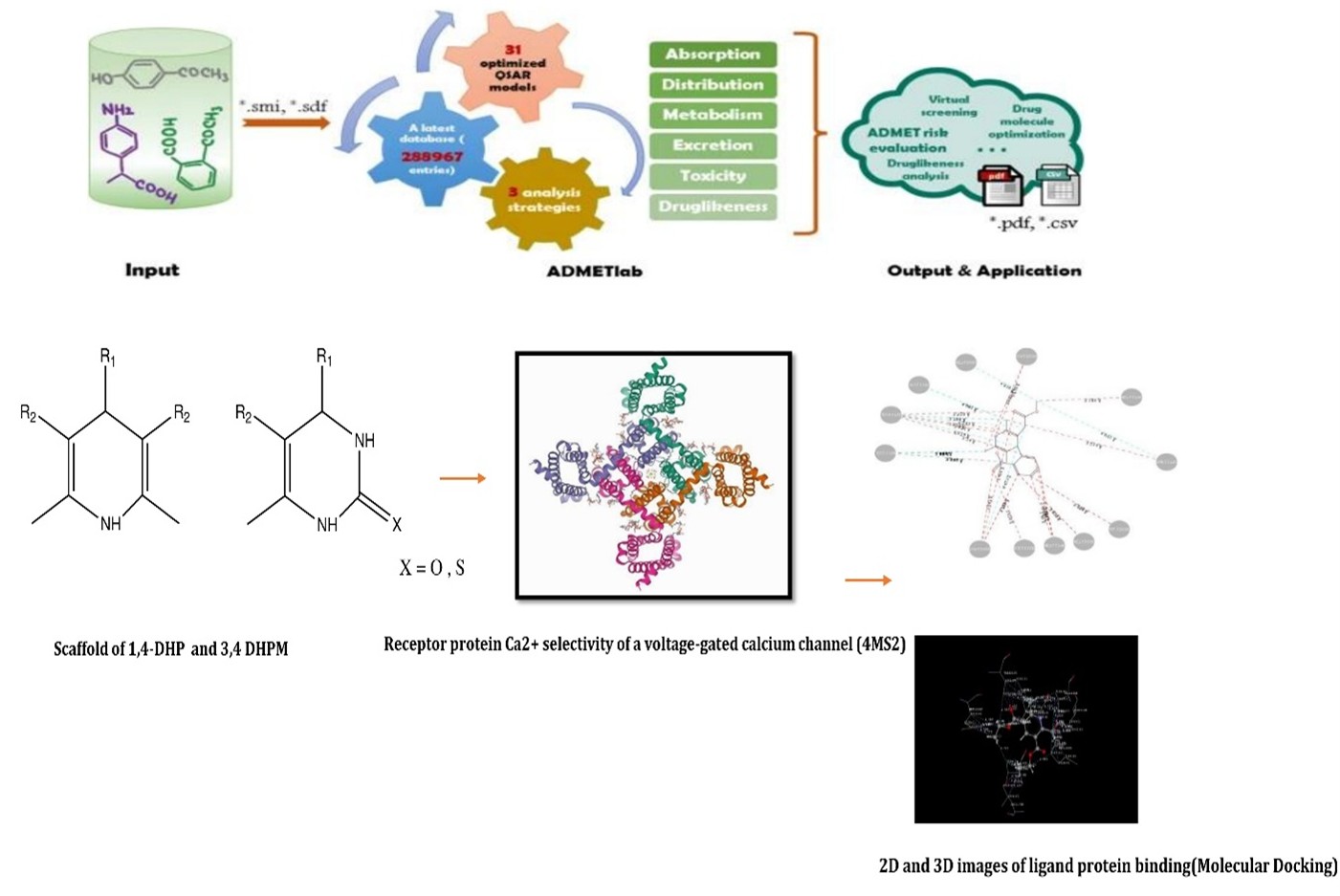
Background: Pyridine and pyrimidine derivatives occupy a central position in medicinal chemistry owing to their broad pharmacological significance. In particular, 1,4-dihydropyridines and 3,4-dihydropyrimidines are known for their anti-hypertensive and anti-anginal activities, encouraging further exploration of their chemical space. Methodology: This study aimed to design and synthesize a novel series of nineteen derivatives (PS-1 to PS-19) based on 1,4-dihydropyridine and 3,4-dihydropyrimidine-2(1H)-ones/thiones, employing a green synthetic strategy. The pharmacological viability of these compounds was assessed through in silico profiling. A catalyst-free "on-water" approach was used for synthesis, aligning with green chemistry principles to ensure eco-friendliness, operational simplicity, and high yield. Structural elucidation of the synthesized compounds was performed using infrared (IR) and proton nuclear magnetic resonance (^1H NMR) spectroscopy. Purity was assessed via thin-layer chromatography (TLC). Pharmacological activity, physicochemical properties, and toxicity profiles were evaluated using PASS Online, Swiss ADME, and Protox-II. Results and Discussion: Among the compounds screened, PS-4 demonstrated the most favorable docking affinity (−49.20), outperforming benchmark calcium channel blockers such as Nifedipine and Felodipine. The developed green synthetic method successfully yielded 19 target compounds with desirable purity and structural fidelity. Three compounds out of 19 showed a strong docking score towards the receptor protein. Conclusion: In silico results revealed favorable pharmacological potential and acceptable toxicity margins for several derivatives, suggesting they are promising candidates for further pharmacodynamic and therapeutic investigations.
Downloads

References
Alexander D. Recent developments in isocyanide based multicomponent reaction in applied chemistry. Chem. Rev., 106(1), 17–89 (2005) https://doi.org/10.1021/cr0505728
Kalinski C, Lemoine H, Schmidt J, Burdack C, Kolb J, Umkehrer M, et al. Multicomponent reactions as a powerful tool for generic drug synthesis. Synthesis, 2008, 4007–4011 (2008) https://doi.org/10.1055/s-0028-1083239
Asif M. Biological potential and chemical properties of pyridine and piperidine fused pyridazine compounds: pyridopyridazine a versatile nucleus. Asian J Chem Pharm Sci., 1(1), 29–35 (2016) https://doi.org/10.18311/ajcps/2016/7693
Dudhe AR, Gunjal SD, Sampath AG, Rawat S. An overview on nitrogen-containing heterocyclic compounds as anticancer agents. Int J Pharm Qual Assur., 14(3), 1296–1301 (2023) https://doi.org/10.25258/ijpqa.14.4.72
Kundu SK. A recent update on the synthesis of dihydropyrimidinones/thiones. AIP Conf Proc., 2388, 040017 (2021) https://doi.org/10.1063/5.0068476
Dikshith TS. Chemical Substances. Handbook of Chemical Safety. CRC Press, 285 (2010)
Bosica G, Cachia F, Nittis RD, Mariotti N. Efficient one-pot synthesis of 3,4-dihydropyrimidin-2(1H)-ones via a three-component Biginelli reaction. Molecules, 26(12), 3753 (2021) https://doi.org/10.3390/molecules26123753
Daina A, Michielin O, Zoete V. SwissADME: a free web tool to evaluate pharmacokinetics, drug-likeness and medicinal chemistry friendliness of small molecules. Sci Rep., 7, 42717 (2017) https://doi.org/10.1038/srep42717
Banerjee P, Ulker OC. Combinative ex vivo studies and in silico models ProTox-II for investigating the toxicity of chemicals used mainly in cosmetic products. Toxicol Mech Methods., 32(7), 542–548 (2022) https://doi.org/10.1080/15376516.2022.2053623
Charli DA, Hwang JS, Rathinam AJ, Dahms HU. Evaluating different web applications to assess the toxicity of plasticizers. Sci Rep., 12, 19684 (2022) https://doi.org/10.1038/s41598-022-18327-0
Takkar P, Singh B. Design, synthesis and in silico evaluation of newer 1,4-dihydropyridine based amlodipine bio-isosteres as promising antihypertensive agents. RSC Adv., 13(48), 34239–34248 (2023) https://doi.org/10.1039/d3ra06387a
Du Z, Su H, Wang W, Ye L, et al. The trRosetta server for fast and accurate protein structure prediction. Nat Protoc., 16(12), 5634–5651 (2021) https://doi.org/10.1038/s41596-021-00628-9
Shaldam MA, Eman MH, Esmat A. 1,4-Dihydropyridine calcium channel blockers: homology modeling of the receptor and assessment of structure activity relationship. Int Sch Res Not., 1–14 (2014) https://doi.org/10.1155/2014/203518
Altaf AA, Shahzad A, Gul Z, Rasool N, Badshah A, Lal B, et al. A review on the medicinal importance of pyridine derivatives. J Drug Des Med Chem., 1(1), 1–11 (2015) https://doi.org/10.11648/j.jddmc.20150101.11
Parthiban A, Makam P. 1,4-Dihydropyridine: synthetic advances, medicinal and insecticidal properties. RSC Adv., 12(45), 29253–29290 (2022) https://doi.org/10.1039/D2RA04589C
Jahed KJ, Mohammad SM. Synthesis of 3,4-dihydropyrimidin-2(1H)-ones and their corresponding 2(1H)thiones using trichloroacetic acid as a catalyst under solvent-free conditions. ISRN Org Chem., 2012, 474626 (2012) https://doi.org/10.5402/2012/474626
Rekunge DS, Ishwari A, Kale GC. An efficient, green solvent-free protocol for the synthesis of 2,4,6-triarylpyridines using reusable heterogeneous activated Fuller’s earth catalyst. Catalysts, 15, 2455–2462 (2018) https://doi.org/10.1007/s13738-018-1434-8
Waghmare AS, Kadam KR. Microwave assisted one-pot three-component synthesis of 3,4-dihydropyrimidin-2(1H)-ones using SFHS as an efficient and reusable catalyst. Rasayan J Chem., 15(1), 668–675 (2022) http://dx.doi.org/10.31788/RJC.2022.1516634
Ganesan M, Sekar J, Kandasamy SP, Srinivasan P. Design, synthesis, spectral characterization, in silico ADMET studies, molecular docking, antimicrobial activity, and anti-breast cancer activity of 5,6-dihydrobenzo[H]quinazolines. J Mol Struct., 1296, 136771 (2023) https://doi.org/10.1016/j.molstruc.2023.136771
Published
How to Cite
Issue
Section
Copyright (c) 2026 Manisha Ashwin Tayde, Suvarna Abhijeet Katti, Anuja Prabhakar Bhosale

This work is licensed under a Creative Commons Attribution-NonCommercial 4.0 International License.