An in silico network pharmacology and molecular dynamics simulations study of engeletin in ischemic stroke with computational prioritisation of NOS2
DOI:
https://doi.org/10.69857/joapr.v14i3.2050Keywords:
Ischemic stroke, Engeletin, Network pharmacology, Molecular docking, Dynamics simulation, NOS2, Relaxin signaling, NeuroprotectionAbstract
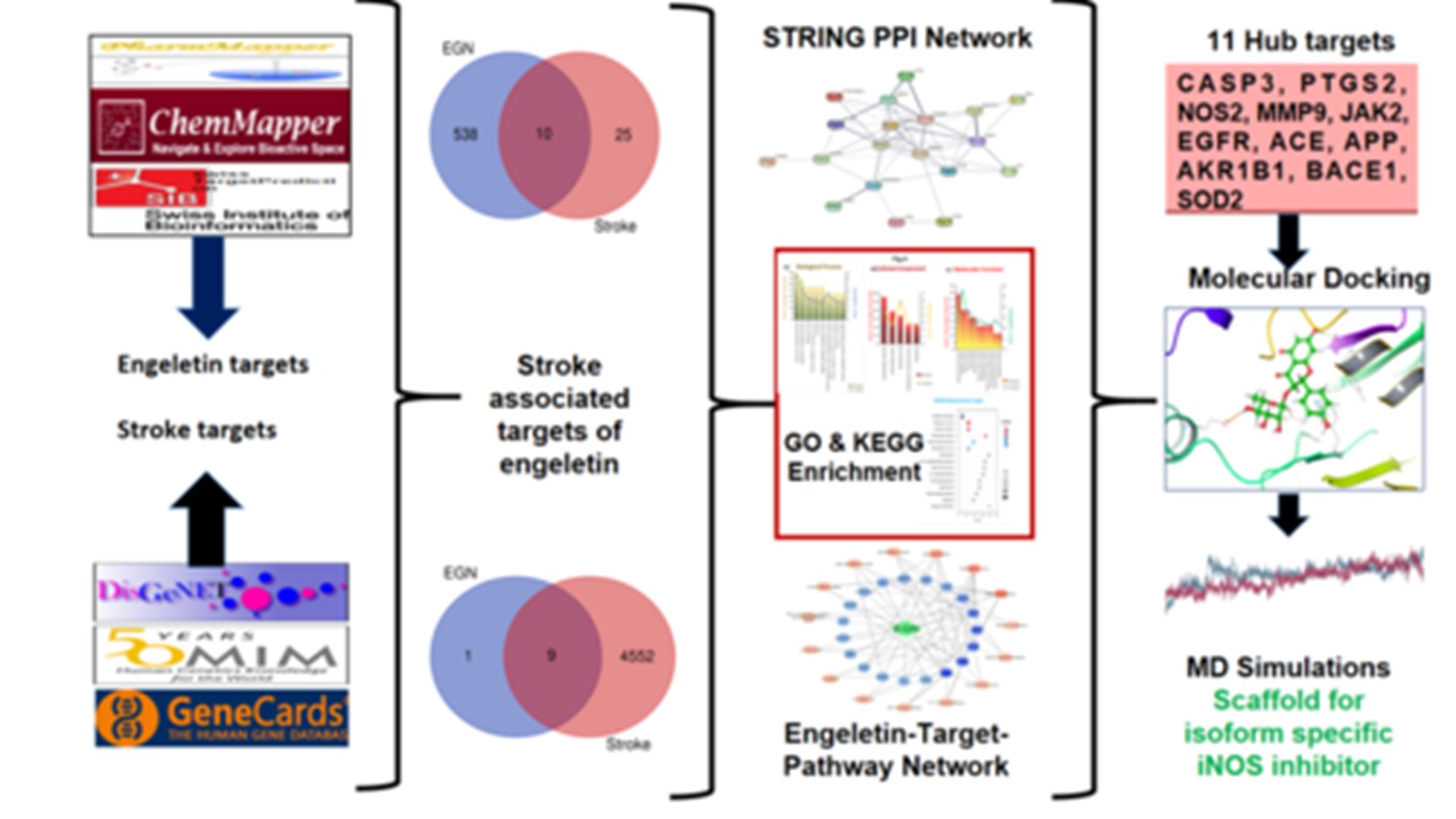
Background: Engeletin, a polyphenolic flavonoid, has demonstrated neuroprotective effects in experimental stroke models. However, the molecular interactome underlying its multitarget actions in ischemic stroke remains insufficiently characterized. Methodology: An integrated in silico workflow was applied to identify stroke-relevant targets of engeletin, combining target prediction, protein–protein interaction analysis, GO and KEGG pathway enrichment, and engeletin–target–pathway network construction. Network topology metrics were used to prioritize targets for downstream structure-based analyses. Docking was performed on short-listed targets, and selected protein–ligand complexes were further evaluated using molecular dynamics (MD) simulations to assess binding stability. In silico ADME profiling was conducted to contextualize translational considerations. Results and Discussion: Nineteen targets were identified through a confidence-driven overlap strategy. Degree-based network filtering short-listed 11 targets for docking. Multi-centrality convergence across protein–protein interaction and engeletin–target–pathway networks prioritized six influential hubs (PTGS2, CASP3, NOS2, MMP9, JAK2, and EGFR) implicated in inflammatory, apoptotic, and vascular regulation. Functional enrichment analyses highlighted interconnected inflammatory–immune, vascular, and metabolic stress pathways, with KEGG pathways interpreted as nominally enriched. Docking and MD analyses differentiated dynamically stable interactions from network-level co-modulated hubs, with engeletin exhibiting the most stable binding to NOS2 (inducible nitric oxide synthase). Conclusion: Integration of network pharmacology with structure-based analyses prioritizes NOS2-centered modulation and relaxin-associated vascular signaling as testable mechanisms for future experimental validation of engeletin in ischemic stroke.
Downloads

References
Panossian A. Trends and pitfalls in the progress of network pharmacology research on natural products. Pharmaceuticals, 18, 538 (2025) https://doi.org/10.3390/ph18040538
Joshi CP, Baldi A, Kumar N, Pradhan J. Harnessing network pharmacology in drug discovery: An integrated approach. Naunyn-Schmiedeberg’s Arch Pharmacol, 398, 4689–703 (2024) https://doi.org/10.1007/s00210-024-03625-3
Zhang P, Zhang D, Zhou W, Wang L, Wang B, Zhang T, Li S. Network pharmacology: Towards the artificial intelligence-based precision traditional Chinese medicine. Briefings in Bioinformatics, 25 (2023) https://doi.org/10.1093/bib/bbad518
Almutairi FM, Ullah A, Althobaiti YS, Irfan HM, Shareef U, Usman H, Ahmed S. A review on therapeutic potential of natural phytocompounds for stroke. Biomedicines, 10, 2566 (2022) https://doi.org/10.3390/biomedicines10102566
Paul S, Candelario-Jalil E. Emerging neuroprotective strategies for the treatment of ischemic stroke: An overview of clinical and preclinical studies. Experimental Neurology, 335, 113518 (2021) https://doi.org/10.1016/j.expneurol.2020.113518
Chen H-S, Qi S-H, Shen J-G. One-compound-multi-target: Combination prospect of natural compounds with thrombolytic therapy in acute ischemic stroke. CN, 15, 134–56 (2017) https://doi.org/10.2174/1570159x14666160620102055
Gomez-Verjan JC, Zepeda-Arzate EA, Santiago-de-la-Cruz JA, Estrella-Parra EA, Rivero-Segura NA. Unraveling the neuroprotective effect of natural bioactive compounds involved in the modulation of ischemic stroke by network pharmacology. Pharmaceuticals, 16, 1376 (2023) https://doi.org/10.3390/ph16101376
Zhong X, Huang R, Chen X, Lei Y. A review on the pharmacological aspects of engeletin as natural compound. DDDT, 17, 3833–43 (2023) https://doi.org/10.2147/dddt.s437703
Liu H, Li S, Xu Y, Wang X, Ren R, Zhu H, Zhang S. Engeletin protects against cerebral ischemia/reperfusion injury by modulating the VEGF/vasohibin and Ang-1/Tie-2 pathways. Braz J Med Biol Res, 54 (2021) https://doi.org/10.1590/1414-431x2020e11028
Xu Y, Zhang J, Gao F, Cheng W, Zhang Y, Wei C, Zhang S, Gao X. Engeletin alleviates cerebral ischemia reperfusion-induced neuroinflammation via the HMGB1/TLR4/NF-κB network. J Cellular Molecular Medi, 27, 1653–63 (2023) https://doi.org/10.1111/jcmm.17758
Dong R, Huang R, Shi X, Xu Z, Mang J. Exploration of the mechanism of luteolin against ischemic stroke based on network pharmacology, molecular docking and experimental verification. Bioengineered, 12, 12274–93 (2021) https://doi.org/10.1080/21655979.2021.2006966.
Zhang Y, Lu T, Luo X, Jin C, Zheng M, Shi D, Song K, Ying Q, Ai Y. Elucidating the mechanism of anti-ischemic stroke action of Irisflorentin: A combined approach using network pharmacology, molecular docking, and in vitro validation. European Journal of Medicinal Chemistry Reports, 16, 100318 (2026) https://doi.org/10.1016/j.ejmcr.2025.100318
Yuan H, Hou Y, Jiao Y, Lu X, Liu L. An integrated network pharmacology, molecular docking, molecular dynamics simulation, and experimental validation study to investigate the potential mechanism of isoliquiritigenin in the treatment of ischemic stroke. CIMB, 47, 627 (2025) https://doi.org/10.3390/cimb47080627
Luo W, Wang J, Fan Y, Yuan M, Xie W, Su Y, Wang X, Zhong Y, Zhang Y, Zhan J, Mao X, Huang X, Long J, Wang X, Tang T, Wang X. Elucidating multifaceted targets of Marein in cerebral ischemia-reperfusion injury. Front. Chem., 13 (2025) https://doi.org/10.3389/fchem.2025.1651873
Xue H, Wen Y, Yang J, Zhang Y, Jin C, Li B, Ai Y, Zheng M, Wen B, Song K. Multi-pathway mechanisms of Engeletin in ischemic stroke: A comprehensive study based on network pharmacology, machine learning, and immune infiltration analysis. IJMS, 26, 11446 (2025) https://doi.org/10.3390/ijms262311446
Liu X, Ouyang S, Yu B, Liu Y, Huang K, Gong J, Zheng S, Li Z, Li H, Jiang H. PharmMapper server: A web server for potential drug target identification using pharmacophore mapping approach. Nucleic Acids Research, 38, W609–14 (2010) https://doi.org/10.1093/nar/gkq300
Gong J, Cai C, Liu X, Ku X, Jiang H, Gao D, Li H. ChemMapper: A versatile web server for exploring pharmacology and chemical structure association based on molecular 3D similarity method. Bioinformatics, 29, 1827–9 (2013) https://doi.org/10.1093/bioinformatics/btt270
Daina A, Michielin O, Zoete V. SwissTargetPrediction: Updated data and new features for efficient prediction of protein targets of small molecules. Nucleic Acids Research, 47, W357–64 (2019) https://doi.org/10.1093/nar/gkz382
Pinero J, Queralt-Rosinach N, Bravo A, Deu-Pons J, Bauer-Mehren A, Baron M, Sanz F, Furlong LI. DisGeNET: A discovery platform for the dynamical exploration of human diseases and their genes. Database, 2015, bav028–bav028 (2015) https://doi.org/10.1093/database/bav028
McKusick VA. Mendelian inheritance in man and its online version, OMIM. The American Journal of Human Genetics, 80, 588–604 (2007) https://doi.org/10.1086/514346
Stelzer G, Rosen N, Plaschkes I, Zimmerman S, Twik M, Fishilevich S, Stein TI, Nudel R, Lieder I, Mazor Y, Kaplan S, Dahary M, Warshawsky D, Guan-Golan Y, Kohn A, Rappaport N, Safran M, Lancet D. The GeneCards suite: From gene data mining to disease genome sequence analyses. CP in Bioinformatics, 54 (2016) https://doi.org/10.1002/cpbi.5
Szklarczyk D, Franceschini A, Wyder S, Forslund K, Heller D, Huerta-Cepas J, Simonovic M, Roth A, Santos A, Tsafou KP, Kuhn M, Bork P, Jensen LJ, von Mering C. STRING v10: Protein–protein interaction networks, integrated over the tree of life. Nucleic Acids Research, 43, D447–52 (2014) https://doi.org/10.1093/nar/gku1003
Shannon P, Markiel A, Ozier O, Baliga NS, Wang JT, Ramage D, Amin N, Schwikowski B, Ideker T. Cytoscape: A software environment for integrated models of biomolecular interaction networks. Genome Res., 13, 2498–504 (2003) https://doi.org/10.1101/gr.1239303
Huang DW, Sherman BT, Lempicki RA. Systematic and integrative analysis of large gene lists using DAVID bioinformatics resources. Nat Protoc, 4, 44–57 (2008) https://doi.org/10.1038/nprot.2008.211
Friesner RA, Murphy RB, Repasky MP, Frye LL, Greenwood JR, Halgren TA, Sanschagrin PC, Mainz DT. Extra precision Glide: Docking and scoring incorporating a model of hydrophobic enclosure for protein–ligand complexes. J. Med. Chem., 49, 6177–96 (2006) https://doi.org/10.1021/jm051256o
Gao W, Yang G, Liu X, Hu K, Pan J, Wang X, Zhao Y, Xu Y. Network pharmacology and experimental verification to investigate the mechanism of isoliquiritigenin for the treatment of Alzheimer’s disease. Sci Rep, 15 (2025) https://doi.org/10.1038/s41598-025-88542-y
Daina A, Michielin O, Zoete V. SwissADME: A free web tool to evaluate pharmacokinetics, drug-likeness and medicinal chemistry friendliness of small molecules. Sci Rep, 7 (2017) https://doi.org/10.1038/srep42717
Nistor M, Schmidt M, Schiffner R. The relaxin peptide family – potential future hope for neuroprotective therapy? A short review. Neural Regen Res, 13, 402 (2018) https://doi.org/10.4103/1673-5374.228713
Zhao T, Zeng J, Zhang R, Pu L, Wang H, Pan L, Jiang Y, Dai X, Sha Y, Han L. Proteomic advance of ischemic stroke: Preclinical, clinical, and intervention. Metab Brain Dis, 38, 2521–46 (2023) https://doi.org/10.1007/s11011-023-01262-y
Radenovic L. Exploring therapeutical targets and innovative treatments for ischemic stroke: A comprehensive review. Explor Neuroprot Ther, 459–84 (2024) https://doi.org/10.37349/ent.2024.00094
Xu G, Dong F, Su L, Tan Z-X, Lei M, Li L, Wen D, Zhang F. The role and therapeutic potential of nuclear factor κB (NF-κB) in ischemic stroke. Biomedicine & Pharmacotherapy, 171, 116140 (2024) https://doi.org/10.1016/j.biopha.2024.116140
Wu J-W, Wang B-X, Shen L-P, Chen Y-L, Du Z-Y, Du S-Q, Lu X-J, Zhao X-D. Investigating the potential therapeutic targeting of the JAK-STAT pathway in cerebrovascular diseases: Opportunities and challenges. Mol Neurobiol, 62, 9338–64 (2025) https://doi.org/10.1007/s12035-025-04834-4
Wierońska JM, Cieślik P, Kalinowski L. Nitric oxide-dependent pathways as critical factors in the consequences and recovery after brain ischemic hypoxia. Biomolecules, 11, 1097 (2021) https://doi.org/10.3390/biom11081097
Wang D, Chen F, Han Z, Yin Z, Ge X, Lei P. Relationship between amyloid-β deposition and blood–brain barrier dysfunction in Alzheimer’s disease. Front. Cell. Neurosci., 15 (2021) https://doi.org/10.3389/fncel.2021.695479
Arias F, Franco-Montalban F, Romero M, Duarte J, Dora Carrión M, Encarnación Camacho M. Bioactive imidamide-based compounds targeted against nitric oxide synthase. Bioorganic Chemistry, 120, 105637 (2022) https://doi.org/10.1016/j.bioorg.2022.105637
Garvey EP, Oplinger JA, Furfine ES, Kiff RJ, Laszlo F, Whittle BJR, Knowles RG. 1400W is a slow, tight binding, and highly selective inhibitor of inducible nitric-oxide synthase in vitro and in vivo. Journal of Biological Chemistry, 272, 4959–63 (1997) https://doi.org/10.1074/jbc.272.8.4959
Proskuryakov SYa, Konoplyannikov AG, Skvortsov VG, Mandrugin AA, Fedoseev VM. Structure and activity of NO synthase inhibitors specific to the L-arginine binding site. Biochemistry (Moscow), 70, 8–23 (2005) https://doi.org/10.1007/s10541-005-0048-9
Ye W, Chen R, Sun W, Huang C, Lin X, Dong Y, Wen C, Wang X. Determination and pharmacokinetics of engeletin in rat plasma by ultra-high performance liquid chromatography with tandem mass spectrometry. Journal of Chromatography B, 1060, 144–9 (2017) https://doi.org/10.1016/j.jchromb.2017.06.018
Zhang X, Fu M, Wang Y, Wu T. Strategies for delivering drugs across the blood-brain barrier for the treatment of neurodegenerative diseases. Front. Drug Deliv., 5 (2025) https://doi.org/10.3389/fddev.2025.1644633
Sun M, Zhao Y, Gu Y, Xu C. Neuroprotective actions of aminoguanidine involve reduced the activation of calpain and caspase-3 in a rat model of stroke. Neurochemistry International, 56, 634–41 (2010) https://doi.org/10.1016/j.neuint.2010.01.009
Pérez-Asensio FJ, Hurtado O, Burguete MC, Moro MA, Salom JB, Lizasoain I, Torregrosa G, Leza JC, Alborch E, Castillo J, Knowles RG, Lorenzo P. Inhibition of iNOS activity by 1400W decreases glutamate release and ameliorates stroke outcome after experimental ischemia. Neurobiology of Disease, 18, 375–84 (2005) https://doi.org/10.1016/j.nbd.2004.10.018
Cinelli MA, Do HT, Miley GP, Silverman RB. Inducible nitric oxide synthase: Regulation, structure, and inhibition. Medicinal Research Reviews, 40, 158–89 (2019) https://doi.org/10.1002/med.21599
Published
How to Cite
Issue
Section
Copyright (c) 2026 Manga Devi Chinta, Santhrani Thakur

This work is licensed under a Creative Commons Attribution-NonCommercial 4.0 International License.