Phytochemical evaluation and in-vitro anti-bacterial and antioxidant effect of extract of Solanum xanthocarpum and Achyranthes aspera
DOI:
https://doi.org/10.69857/joapr.v14i3.2029Keywords:
DPPH Assay, Total Phenolic Content, Streptococcus mutans MTCC 389, Achyranthes aspera, Solanum xanthocarpum, Antibacterial ActivityAbstract
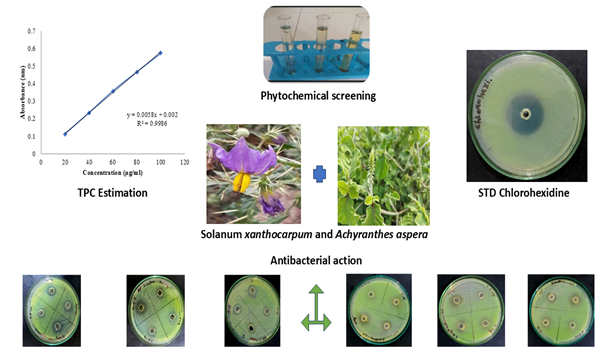
Background: This study investigates the phytochemical composition, antioxidant activity, and antibacterial properties of extracts from Solanum xanthocarpum and Achyranthes aspera. Achyranthes aspera exhibited 65.864 % inhibition with an IC50 value of 31.056 µg/mL, and Solanum xanthocarpum showed 55.385% inhibition with an IC50 value of 51.920 µg/mL. Methodology: The total phenolic content (TPC) and total flavonoid content (TFC) were measured using the Folin-Ciocalteu assay and aluminum chloride colorimetric method, respectively. Antioxidant activities were evaluated using DPPH radical-scavenging and reducing power assays. The antibacterial activity against Streptococcus mutans was determined using the well diffusion method. Result and Discussion: The TPC of Solanum xanthocarpum and Achyranthes aspera extracts were 77.80 mg GAE/g and 98.40 mg GAE/g, respectively, while the TFC were 82.66 mg RE/g and 136.66 mg RE/g. In the DPPH assay, Achyranthes aspera exhibited 65.864 % inhibition with an IC50 value of 31.056 µg/ml, and Solanum xanthocarpum showed 55.385% inhibition with an IC50 value of 51.920 µg/mL. The reducing power assay indicated significant antioxidant potential, especially for Achyranthes aspera. The antibacterial activity against Streptococcus mutans MTCC 389 revealed that Achyranthes aspera exhibited a maximum inhibition zone of 23±1.732 mm. At the same time, Solanum xanthocarpum showed a maximum inhibition zone of 20±1 mm at a concentration of 2 mg/mL. Conclusion: The extracts of Solanum xanthocarpum and Achyranthes aspera demonstrate significant antioxidant and antibacterial activities, highlighting their potential as natural sources of antimicrobial and antioxidant agents. Further research is needed to isolate bioactive components, elucidate their mechanisms of action, and assess their potential cytotoxic effects on human cells.
Downloads

References
Arumuganainar D, Subramaniam G, Kurumathur Vasudevan AK, Kanakasabapathy B. An in vitro evaluation of the antibacterial efficacy of Solanum xanthocarpum extracts on bacteria from dental plaque biofilm. Cureus, 15(9), e45202 (2023) https://doi.org/10.7759/cureus.45202
Iravani S. Green synthesis of metal nanoparticles using plants. Green Chem, 13(10), 2638–2650 (2011) https://doi.org/10.1039/C1GC15386B
Cowan MM. Plant products as antimicrobial agents. Clin Microbiol Rev, 12(4), 564–582 (1999) https://doi.org/10.1128/CMR.12.4.564
El-Saadony MT, et al. Medicinal plants: bioactive compounds, biological activities, and their applications in human health. Front Immunol, 16, 1491777 (2025) https://doi.org/10.3389/fimmu.2025.1491777
Zhang L, Gallo RL. Antimicrobial peptides. Curr Biol, 26(1), R14–R19 (2016) https://doi.org/10.1016/j.cub.2015.11.017
Murray CJL, Ikuta KS, Sharara F, et al. Global burden of bacterial antimicrobial resistance in 2019. Lancet, 399, 629–655 (2022) https://doi.org/10.1016/S0140-6736(21)02724-0
Brown ED, Wright GD. Antibacterial drug discovery in the resistance era. Nature, 529(7586), 336–343 (2016) https://doi.org/10.1038/nature17042
Koo H, Allan RN, Howlin RP, Stoodley P, Hall-Stoodley L. Targeting microbial biofilms. Nat Rev Microbiol, 15(12), 740–755 (2017) https://doi.org/10.1038/nrmicro.2017.99
Urban J, Kareem KY, Matuszewski A, et al. Enhancing broiler chicken health using phytobiotics. Phytochem Rev, 24(2), 2131–2145 (2025) https://doi.org/10.1007/s11101-025-09876-5
Zouine N, El Barnossi A, Moussaid F, et al. Medicinal plant extracts as antibacterial agents. Sci Afr, 23, e02395 (2024) https://doi.org/10.1016/j.sciaf.2024.e02395
Kulis E, Cindrić M, Kovačević I, et al. Antibiotic resistance in oral microbiome. Microorganisms, 13, 45 (2025) https://doi.org/10.3390/microorganisms13010045
Reich E, Schibli A. HPTLC for medicinal plant analysis. J Chromatogr A, 1218, 2683–2691 (2011) https://doi.org/10.1016/j.chroma.2010.12.105
Panche AN, Diwan AD, Chandra SR. Flavonoids: an overview. Anal Chem, 88, 1–12 (2016) https://doi.org/10.1021/acs.analchem.5b03500
Atanasov AG, Zotchev SB, Dirsch VM, Supuran CT. Natural products in drug discovery. Nat Rev Drug Discov, 20(3), 200–216 (2021) https://doi.org/10.1038/s41573-020-00114-z
Truong-Bolduc QC, Yonker LM, Wang Y, et al. NorA efflux pump in Staphylococcus aureus. Antimicrob Agents Chemother, 68(2), e01001-23 (2024) https://doi.org/10.1128/aac.01001-23
Singh A, Bundela AK, Abhilash PC. Underutilized crops of Eastern Uttar Pradesh. Agronomy, 13(9), 2318 (2023) https://doi.org/10.3390/agronomy13092318
Valko M, Leibfritz D, Moncol J, et al. Free radicals and antioxidants. Int J Biochem Cell Biol, 39, 44–84 (2007) https://doi.org/10.1016/j.biocel.2006.07.001
Marsh PD. Microbial ecology of dental plaque. Adv Dent Res, 8(2), 263–271 (1994) https://doi.org/10.1177/08959374940080022001
Hossain MJ, et al. Natural antimicrobial agents. Biomed Pharmacother, 170, 116014 (2024) https://doi.org/10.1016/j.biopha.2024.116014
Blois MS. Antioxidant determinations using free radicals. Nature, 181, 1199–1200 (1958) https://doi.org/10.1038/1811199a0
Parveen B, et al. Natural plant antioxidants. SN Appl Sci, 7 (2025) https://doi.org/10.1007/s42452-025-07464-6
Bouttier-Figueroa DC, Cortez-Valadez M, Flores-Acosta M, Robles-Zepeda RE. Green synthesis of ZnO nanoparticles. Bionanoscience, 14(3), 3385–3400 (2024) https://doi.org/10.1007/s12668-024-01234-5
Gao Z, Chen X, Wang C, et al. Targeting Streptococcus mutans biofilms. Microbiol Res, 127526 (2023) https://doi.org/10.1016/j.micres.2023.127526
Sies H, Jones DP. Reactive oxygen species in physiology. Nat Rev Mol Cell Biol, 24, 363–383 (2023) https://doi.org/10.1038/s41580-023-00583-9
Forman HJ, Zhang H. Targeting oxidative stress in disease. Nat Rev Drug Discov, 20(9), 689–709 (2021) https://doi.org/10.1038/s41573-021-00233-8
Cushnie TPT, Cushnie B, Lamb AJ. Alkaloids and antibacterial activity. Int J Antimicrob Agents, 44(5), 377–386 (2014) https://doi.org/10.1016/j.ijantimicag.2014.06.001
Gyawali R, Ibrahim SA. Natural antimicrobial agents. Food Control, 46, 412–429 (2014) https://doi.org/10.1016/j.foodcont.2014.05.047
Bania J, et al. Male hormonal contraception. J Clin Med, 14(7), 2188 (2025) https://doi.org/10.3390/jcm14072188
Lobo V, et al. Free radicals and functional foods. Pharmacogn Rev, 4(8), 118–126 (2010) https://doi.org/10.4103/0973-7847.70902
Singh S, et al. Medicinal plants for neurodegenerative disorders. J Ethnopharmacol, 284, 114763 (2022) https://doi.org/10.1016/j.jep.2021.114763
Kumar S, et al. Achyranthes aspera review. J Ethnopharmacol, 222, 123–138 (2018) https://doi.org/10.1016/j.jep.2018.04.040
Woo S, Lee JH, Lee J, et al. Plant-derived antibacterial compounds. Pharmaceuticals, 16, 1125 (2023) https://doi.org/10.3390/ph16081125
Pérez-Flores JG, et al. Plant antimicrobial compounds. Appl Sci, 15(7), 3516 (2025) https://doi.org/10.3390/app15073516
Marsh PD, Head DA, Devine DA. Oral biofilm ecology. Caries Res, 49(1), 46–54 (2015) https://doi.org/10.1159/000377732
Hickl J, Lang S, Hiergeist A, et al. Plant extracts as antibiofilm agents. Front Oral Health, 5, 1469174 (2024) https://doi.org/10.3389/froh.2024.1469174
Sajem AL, Gosai K. Traditional medicinal plants of Assam. J Ethnopharmacol, 111, 41–50 (2007) https://doi.org/10.1016/j.jep.2006.10.019
Sultana S, Hossain ML, Sostaric T, Lim LY, Foster KJ, Locher C. HPTLC flavonoid analysis. Molecules, 29(21), 5161 (2024) https://doi.org/10.3390/molecules29215161
Yatsyshina V, Nizov E, Novikov A, Shishov A. Deep eutectic solvents in flavonoid quantification. J Mol Liq, 433, 127943 (2025) https://doi.org/10.1016/j.molliq.2025.127943
Kumar R, Shikha D, Sinha SK. DPPH radical scavenging assay. Ceram Int, 50(8), 13967–13973 (2024) https://doi.org/10.1016/j.ceramint.2023.12.215
Blair JMA, Webber MA, Baylay AJ, Ogbolu DO, Piddock LJV. Mechanisms of antibiotic resistance. Nat Rev Microbiol, 13(1), 42–51 (2015) https://doi.org/10.1038/nrmicro3380
Published
How to Cite
Issue
Section
Copyright (c) 2026 Kanchan Mathur, Reena Gupta

This work is licensed under a Creative Commons Attribution-NonCommercial 4.0 International License.