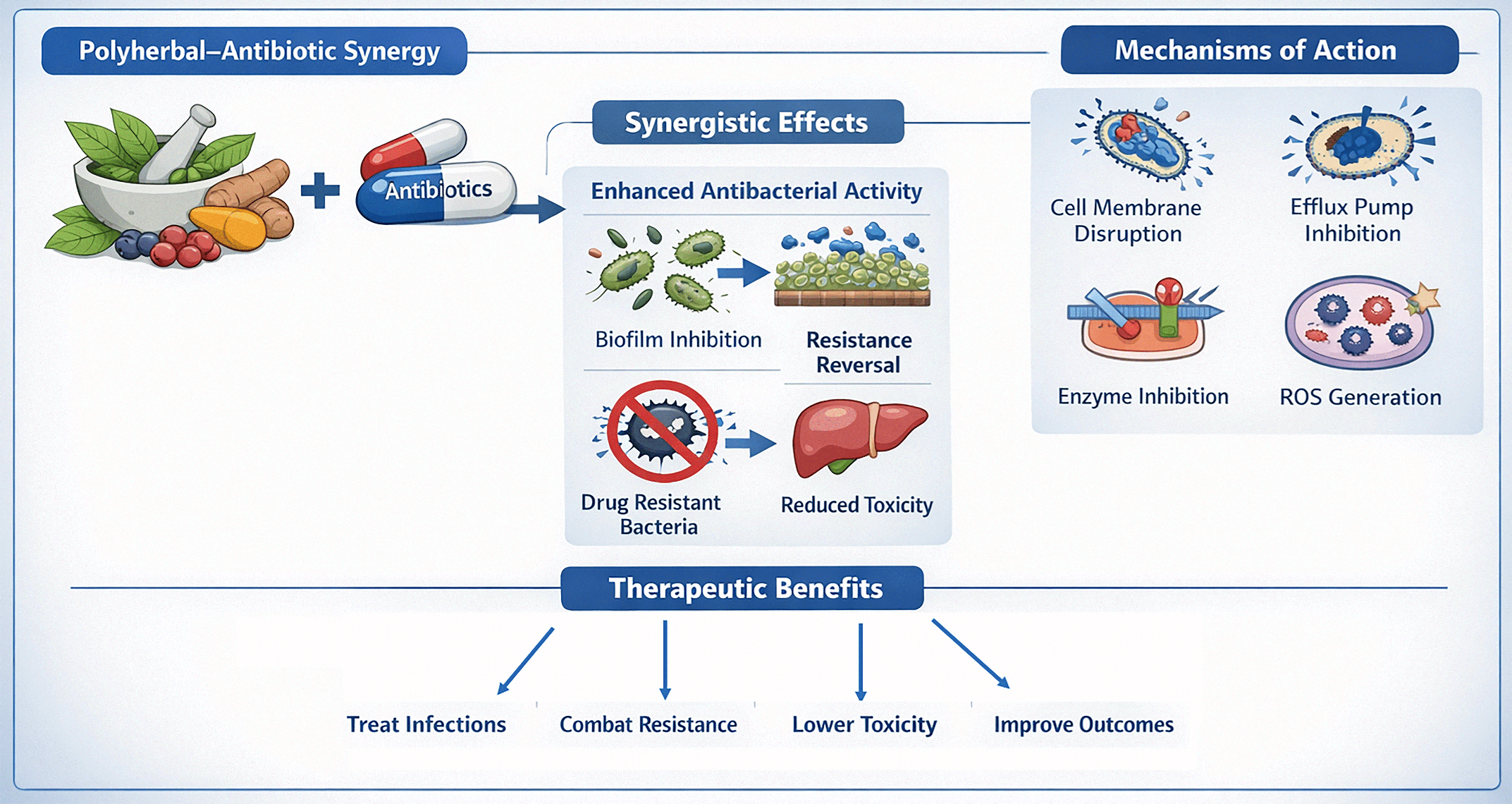
Polyherbal–antibiotic synergy: a review on mechanistic insights into polyphenols, flavonoids, alkaloids, and terpenoids for enhancing antimicrobial efficacy
DOI:
https://doi.org/10.69857/joapr.v14i3.2028Keywords:
Polyherbal formulations, Antibiotic synergy, Antimicrobial resistance, Phytochemicals, Herb–drug interactions, Nanotechnology in therapeuticsAbstract
Background: Antimicrobial resistance (AMR) is one of the most important threats to global public health, accelerating as conventional antibiotics lose efficacy. Pathogens such as Staphylococcus aureus, Pseudomonas aeruginosa, Escherichia coli, and Klebsiella pneumoniae use a variety of resistance mechanisms, including enzymatic drug degradation, efflux pump activation, and biofilm formation. The declining pipeline of newly approved antibiotics highlights the need for alternative and adjunctive therapeutic strategies. Methodology: This review critically summarizes studies that analyze polyherbal–antibiotic combinations and their synergistic antimicrobial effects. A systematic review of recent literature on the role of phytochemicals, including alkaloids, flavonoids, terpenoids, tannins, and polyphenolic compounds, in potentiating antibiotic efficacy and reducing antibiotic resistance was conducted. Results and Discussion: Integrative synergetic interactions were strongly evidenced between antibiotics and plant-derived phytochemicals. Epigallocatechin gallate (EGCG) synergizes with β-lactam for common resistant strains, and berberine inhibits efflux pumps to enhance antibiotic activity. A wide range of flavonoids and polyphenolic extracts have been reported to exhibit antimicrobial activity, with mechanisms involving membrane disruption, biofilm inhibition, and interference with quorum-sensing pathways, thereby promoting multifaceted action. Conclusion: Synergy between polyherbal treatment and antibiotics is an innovative approach to combat AMR and should be prioritized. This approach highlights various leads for future antimicrobial therapeutics by combining traditional ethnopharmacological knowledge with innovative pharmaceutical paradigms.
Downloads

References
Mussarat S, Adnan M, Begum S, Ur Rehman S, Hashem A, Abd Allah EF. Antimicrobial screening of polyherbal formulations traditionally used against gastrointestinal diseases. Saudi J Biol Sci, 28(12), 6829–6843 (2021) https://doi.org/10.1016/j.sjbs.2021.07.053
Musale P, Mankar SD. A review on polyherbal formulation used in the treatment of gastric acidity. Res J Pharmacogn Phytochem, 15(2), 173–178 (2023) https://doi.org/10.52711/0975-4385.2023.00027
Atta S, Waseem D, Fatima H, Naz I, Rasheed F, Kanwal N. Antibacterial potential and synergistic interaction between natural polyphenolic extracts and synthetic antibiotic on clinical isolates. Saudi J Biol Sci, 30(3), 103576 (2023) https://doi.org/10.1016/j.sjbs.2023.103576
Mandrika I, Kumar S, Zandersone B, Eranezhath SS, Petrovska R, Liduma I, Jezupovs A, Pirags V, Tracevska T. Antibacterial and anti-inflammatory potential of polyherbal formulation used in chronic wound healing. Evid Based Complement Alternat Med, 2021, 9991454 (2021) https://doi.org/10.1155/2021/9991454
Askar MA, Thangjam NM, Kumar A. A review on pharmacological importance of polyherbal formulation. Res J Pharm Technol, 18(4), 1925–1930 (2025) https://doi.org/10.52711/0974-360X.2025.00275
Aladejana EB, Adelabu OA, Aladejana AE, Ndlovu SI. Antimicrobial properties of alternative medicines used in the management of infections in diabetic patients: a comprehensive review. Pharmacol Res Mod Chin Med, 11, 100432 (2024) https://doi.org/10.1016/j.prmcm.2024.100432
Samdavid Thanapaul RJR, Nambur CK, Giriraj K. Development of multi-herbal formulation with enhanced antimicrobial, antioxidant, cytotoxic, and anti-aging properties. J Indian Chem Soc, 101(11), 101402 (2024) https://doi.org/10.1016/j.jics.2024.101402
Patel VR, Saini S, Dwivedi J, Gupta AK, Shrivastava AK, Misra A. Exploring the concept and scope of polyherbal formulations: a comprehensive review. Int J Herb Med, 13(2), 9–16 (2025) https://doi.org/10.22271/flora.2025.v13.i2a.973
Aladejana EB. Biological properties of polyherbal formulations: a review of their antimicrobial, anti-inflammatory, antioxidant, and toxicological activities. Pharmacogn J, 15(5), 933–963 (2023) https://doi.org/10.5530/pj.2023.15.178
Mekala K, Shaheedha SM. The effectiveness of polyherbal formulations in regenerating wounds and profiling their therapeutic properties tracked via high-throughput methods in conjunction with in silico molecular docking. Phytomedicine Plus, 6(1), 100950 (2026) https://doi.org/10.1016/j.phyplu.2025.100950
Vijaya PS, Bethur SS, Somanna P, Sampath R. Comparative evaluation of antimicrobial effect, calcium ion release, and pH change using herbal combinations of nanoparticle calcium hydroxide: an in vitro study. Int J Clin Pediatr Dent, 18(9), 1103–1109 (2025) https://doi.org/10.5005/jp-journals-10005-3275
Atanasov AG, Zotchev SB, Dirsch VM, Supuran CT. Natural products in drug discovery: advances and opportunities. Nat Rev Drug Discov, 20(3), 200–216 (2021) https://doi.org/10.1038/s41573-020-00114-z
D’Archivio M, Filesi C, Varì R, Scazzocchio B, Masella R. Bioavailability of polyphenols: status and controversies. Int J Mol Sci, 11(4), 1321–1342 (2010) https://doi.org/10.3390/ijms11041321
Ghosh S, Solanki R, Bhatia D, Sankaranarayanan S. Nanomaterials for delivery of medicinal plant extracts and phytochemicals: potential applications and future perspectives. Plant Nano Biol, 12, 100161 (2025) https://doi.org/10.1016/j.plana.2025.100161
Mostafa MAH, Khojah HMJ. Nanoparticle-based delivery systems for phytochemicals in cancer therapy: molecular mechanisms, clinical evidence, and emerging trends. Drug Dev Ind Pharm, 51(9), 1105–1121 (2025) https://doi.org/10.1080/03639045.2025.2483425
Manna S, Maity P, Sarkar P, Sen O, Jana S, Nandi G, Sahu R, Das P. Nanotechnology in phytochemical-based cancer therapy: a comprehensive review of plant-derived nanoformulations. Pharmacol Res Nat Prod, 10, 100484 (2026) https://doi.org/10.1016/j.prenap.2025.100484
Omran Z, Bader A, Porta A, Vandamme T, Anton N, Alehaideb Z, El-Said H, Faidah H, Essa A, Vassallo A, Halwani M. Evaluation of antimicrobial activity of Triphala constituents and nanoformulation. Evid Based Complement Alternat Med, 2020, 6976973 (2020) https://doi.org/10.1155/2020/6976973
Tiwana G, Cock IE, Cheesman MJ. Phytochemical analysis and antimicrobial activity of Terminalia bellirica and Terminalia chebula fruit extracts against gastrointestinal pathogens: enhancing antibiotic efficacy. Microorganisms, 12(12), 2664 (2024) https://doi.org/10.3390/microorganisms12122664
Kumar V, Singh A, Sharma N, Saini R, Kumar H, El-Shazly M, Dev K. Combating bacterial antibiotic resistance with phytocompounds: current trends and future perspectives. Med Drug Discov, 28, 100228 (2025) https://doi.org/10.1016/j.medidd.2025.100228
Periferakis AT, Adalis GM, Periferakis A, Troumpata L, Periferakis K, Dragosloveanu CDM, Caruntu A, Savulescu-Fiedler I, Dragosloveanu S, Scheau AE, Badarau IA, Scheau C, Caruntu C. The multifaceted antimicrobial profile of piperine in infectious disease management: current perspectives and potential. Pharmaceuticals, 18(10), 1581 (2025) https://doi.org/10.3390/ph18101581
Kumar RCS, Jayaraman A, Venkatachalapathy R, Alagukumar S, Das C, Teng-Umnuay P. Deciphering the molecular mechanisms of Dashamoola in inflammatory bowel disease: a systems biology approach integrating network pharmacology, molecular simulations, and DFT analysis. Food Biosci, 68, 106667 (2025) https://doi.org/10.1016/j.fbio.2025.106667
Abraham B, Reshmitha TR, Navami MM, George L, Venugopalan VV, Nisha P. Phytochemical rich extract from the spent material generated from industrial Dashamoola preparation with antioxidant, antidiabetic, and anti-inflammatory potential. Ind Crops Prod, 151, 112451 (2020) https://doi.org/10.1016/j.indcrop.2020.112451
Li M, Tian F, Guo J, Li X, Ma L, Jiang M, Zhao J. Therapeutic potential of Coptis chinensis for arthritis with underlying mechanisms. Front Pharmacol, 14, 1243820 (2023) https://doi.org/10.3389/fphar.2023.1243820
Erhan SE, Pârvu AE, Ciorîță A, Putri AA, Villagrana Molina AJ, Pârvu M, Moț AC. Chemical composition and anti-inflammatory effect of Phellodendron amurense stem bark extract. Not Bot Horti Agrobot Cluj Napoca, 51(3), 13306 (2023) https://doi.org/10.15835/nbha51313306
Qi Z, Xu D, Wang Q, Liu L, Liu W, Wang J. Huang-Lian-Jie-Du decoction ameliorates sepsis through dynamic regulation of immune response and gut microbiota-metabolite axis. Microb Pathog, 199, 107246 (2025) https://doi.org/10.1016/j.micpath.2024.107246
Ghosh B, Bose A, Parmanik A, Ch S, Paul M, Biswas S, Rath G, Bhattacharya D. Facile fabrication of Nishamalaki churna mediated silver nanoparticles with antibacterial application. Heliyon, 9(8), e18788 (2023) https://doi.org/10.1016/j.heliyon.2023.e18788
Balkrishna A, Rana M, Mishra RK, Singh S, Arya V. Therapeutic potential of Nishamalaki churna in diabetes management: a phytochemical and mechanistic review. Curr Indian Sci, 3, 8 pages (2025) https://doi.org/10.2174/012210299X387275250717043914
Sharma S, Kumari K, Sethuraman G, Abdelwahab MM, Sivaperumal Yadav S, Nandini V. An Ayurvedic medication (Chyawanprash) as a prophylaxis for non-communicable disease and communicable disease: a protocol for systematic review and meta-analysis. Cureus, 15(10), e47555 (2023) https://doi.org/10.7759/cureus.47555
Sharma R, Martins N, Kuca K, Chaudhary A, Kabra A, Rao MM, Prajapati PK. Chyawanprash: a traditional Indian bioactive health supplement. Biomolecules, 9(5), 161 (2019) https://doi.org/10.3390/biom9050161
Balkrishna A, Tomer M, Manik M, Srivastava J, Dev R, Haldar S, Varshney A. Chyawanprash, an ancient Indian Ayurvedic medicinal food, regulates immune response in zebrafish model of inflammation by moderating inflammatory biomarkers. Front Pharmacol, 12, 751576 (2021) https://doi.org/10.3389/fphar.2021.751576
Nazir A, Nazir A, Zuhair V, Aman S, Sadiq SUR, Hasan AH, Tariq M, Rehman LU, Mustapha MJ, Bulimbe DB. The global challenge of antimicrobial resistance: mechanisms, case studies, and mitigation approaches. Health Sci Rep, 8(7), e71077 (2025) https://doi.org/10.1002/hsr2.71077
Devi NS, Mythili R, Cherian T, Dineshkumar R, Sivaraman GK, Jayakumar R, Prathaban M, Duraimurugan M, Chandrasekar V, Peijnenburg WJGM. Overview of antimicrobial resistance and mechanisms: the relative status of the past and current. Microbe, 3, 100083 (2024) https://doi.org/10.1016/j.microb.2024.100083
Halawa EM, Fadel M, Al-Rabia MW, Behairy A, Nouh NA, Abdo M, Olga R, Fericean L, Atwa AM, El-Nablaway M, Abdeen A. Antibiotic action and resistance: updated review of mechanisms, spread, influencing factors, and alternative approaches for combating resistance. Front Pharmacol, 14, 1305294 (2024) https://doi.org/10.3389/fphar.2023.1305294
Elshobary ME, Badawy NK, Ashraf Y, Zatioun AA, Masriya HH, Ammar MM, Mohamed NA, Mourad S, Assy AM. Combating antibiotic resistance: mechanisms, multidrug-resistant pathogens, and novel therapeutic approaches: an updated review. Pharmaceuticals, 18(3), 402 (2025) https://doi.org/10.3390/ph18030402
Kerek Á, Román I, Szabó Á, Kovács D, Kardos G, Kovács L, Jerzsele Á. Antibiotic resistance genes in Escherichia coli: literature review. Crit Rev Microbiol, 1–35 (2025) https://doi.org/10.1080/1040841X.2025.2492156
Muteeb G, Kazi RNA, Aatif M, Azhar A, El Oirdi M, Farhan M. Antimicrobial resistance: linking molecular mechanisms to public health impact. SLAS Discov, 33, 100232 (2025) https://doi.org/10.1016/j.slasd.2025.100232
Teng J, Imani S, Zhou A, Zhao Y, Du L, Deng S, Li J, Wang Q. Combatting resistance: understanding multi-drug resistant pathogens in intensive care units. Biomed Pharmacother, 167, 115564 (2023) https://doi.org/10.1016/j.biopha.2023.115564
Urban-Chmiel R, Marek A, Stępień-Pyśniak D, Wieczorek K, Dec M, Nowaczek A, Osek J. Antibiotic resistance in bacteria: a review. Antibiotics, 11(8), 1079 (2022) https://doi.org/10.3390/antibiotics11081079
Marino A, Maniaci A, Lentini M, Ronsivalle S, Nunnari G, Cocuzza S, Parisi FM, Cacopardo B, Lavalle S, La Via L. The global burden of multidrug-resistant bacteria. Epidemiologia, 6(2), 21 (2025) https://doi.org/10.3390/epidemiologia6020021
Bharadwaj A, Rastogi A, Pandey S, Gupta S, Sohal JS. Multidrug-resistant bacteria: their mechanism of action and prophylaxis. J Immunol Res, 2022, 5419874 (2022) https://doi.org/10.1155/2022/5419874
Mallik S, Dash S, Mishra S, Mohanty RB, Sahoo S, Patra A, Sahoo S, Mishra R, Mohanty JN. Threat of multidrug resistant bacteria: the role of genomic solutions and a call to action. Gene Rep, 41, 102298 (2025) https://doi.org/10.1016/j.genrep.2025.102298
Almutairy B. Extensively and multidrug-resistant bacterial strains: case studies of antibiotics resistance. Front Microbiol, 15, 1381511 (2024) https://doi.org/10.3389/fmicb.2024.1381511
Salam MA, Al-Amin MY, Salam MT, Pawar JS, Akhter N, Rabaan AA, Alqumber MAA. Antimicrobial resistance: a growing serious threat for global public health. Healthcare, 11(13), 1946 (2023) https://doi.org/10.3390/healthcare11131946
Mapeka T, Sandasi M, Ncube E, Viljoen A, van Vuuren S. Enhancing the antimicrobial efficacy of common herbs and spices through an optimized polyherbal approach. S Afr J Bot, 164, 91–99 (2024) https://doi.org/10.1016/j.sajb.2023.11.030
Jamil S, Harun MGD, Biswas MS, Abdulrahim A, Chaudhary N, Adepoju VA, Khan HTA, Adebayo UO. The global impact of bacterial antimicrobial resistance: addressing gaps and future strategies. Public Health Chall, 5, e70229 (2026) https://doi.org/10.1002/puh2.70229
Ahmed SK, Hussein S, Qurbani K, Ibrahim RH, Fareeq A, Mahmood KA, Mohamed MG. Antimicrobial resistance: impacts, challenges, and future prospects. J Med Surg Public Health, 2, 100081 (2024) https://doi.org/10.1016/j.glmedi.2024.100081
Minarini LADR, de Andrade LN, De Gregorio E, Grosso F, Naas T, Zarrilli R, Camargo ILBCC. Antimicrobial resistance as a global public health problem: how can we address it? Front Public Health, 8, 612844 (2020) https://doi.org/10.3389/fpubh.2020.612844
Deori C, Sonowal T, Das M. Antimicrobial resistance: a looming threat to public health and global well-being. Indian J Community Fam Med, 10(1), 18–25 (2024) https://doi.org/10.4103/ijcfm.ijcfm_1_24
Hu L, Luo Y, Yang J, Cheng C. Botanical flavonoids: efficacy, absorption, metabolism and advanced pharmaceutical technology for improving bioavailability. Molecules, 30(5), 1184 (2025) https://doi.org/10.3390/molecules30051184
Bruna T, Maldonado-Bravo F, Jara P, Caro N. Silver nanoparticles and their antibacterial applications. Int J Mol Sci, 22(13), 7202 (2021) https://doi.org/10.3390/ijms22137202
Panda V, Vaswani L, S S, et al. Evaluation of the wound healing effect of Nishamalaki, an Ayurvedic formulation comprising Curcuma longa and Phyllanthus emblica in aging rats. Clin Phytosci, 10, 3 (2024) https://doi.org/10.1186/s40816-024-00367-w
Alipour Noghabi S, Ghamari Kargar P, Bagherzade G, Beyzaei H. Comparative study of antioxidant and antimicrobial activity of berberine-derived Schiff bases, nitro-berberine and amino-berberine. Heliyon, 9(12), e22783 (2023) https://doi.org/10.1016/j.heliyon.2023.e22783
Barati M, Modarresi Chahardehi A. Alkaloids: the potential of their antimicrobial activities of medicinal plants. In: de Oliveira MS, de Aguiar Andrade EH, Kumar R, Mali SN, editors. Medicinal Plants: Chemical, Biochemical, and Pharmacological Approaches. IntechOpen (2023) https://doi.org/10.5772/intechopen.112364
Jan R, Khan M, Asaf S, Lubna, Asif S, Kim KM. Bioactivity and therapeutic potential of kaempferol and quercetin: new insights for plant and human health. Plants, 11(19), 2623 (2022) https://doi.org/10.3390/plants11192623
Thawabteh AM, Ghanem AW, AbuMadi S, Thaher D, Jaghama W, Karaman R, Scrano L, Bufo SA. Antibacterial and antifungal activity of monomeric alkaloids. Toxins, 16(11), 489 (2024) https://doi.org/10.3390/toxins16110489
Wink M. Potential of DNA intercalating alkaloids and other plant secondary metabolites against SARS-CoV-2 causing COVID-19. Diversity, 12(5), 175 (2020) https://doi.org/10.3390/d12050175
Zhang Z, Cao M, Shang Z, Xu J, Chen X, Zhu Z, Wang W, Wei X, Zhou X, Bai Y, Zhang J. Research progress on the antibacterial activity of natural flavonoids. Antibiotics, 14(4), 334 (2025) https://doi.org/10.3390/antibiotics14040334
Liu Y, Zhu J, Liu Z, Zhi Y, Mei C, Wang H. Flavonoids as promising natural compounds for combating bacterial infections. Int J Mol Sci, 26(6), 2455 (2025) https://doi.org/10.3390/ijms26062455
Cosme F, Aires A, Pinto T, Oliveira I, Vilela A, Gonçalves B. A comprehensive review of bioactive tannins in foods and beverages: functional properties, health benefits, and sensory qualities. Molecules, 30(4), 800 (2025) https://doi.org/10.3390/molecules30040800
Huang J, Zaynab M, Sharif Y, Khan J, Al-Yahyai R, Sadder M, Ali M, Alarab SR, Li S. Tannins as antimicrobial agents: understanding toxic effects on pathogens. Toxicon, 247, 107812 (2024) https://doi.org/10.1016/j.toxicon.2024.107812
Konuk HB, Ergüden B. Phenolic –OH group is crucial for the antifungal activity of terpenoids via disruption of cell membrane integrity. Folia Microbiol, 65, 775–783 (2020) https://doi.org/10.1007/s12223-020-00787-4
Álvarez-Martínez FJ, Barrajón-Catalán E, Micol V. Tackling antibiotic resistance with compounds of natural origin: a comprehensive review. Biomedicines, 8(10), 405 (2020) https://doi.org/10.3390/biomedicines8100405
Oliveira I, Santos-Buelga C, Aquino Y, Barros L, Heleno SA. New frontiers in the exploration of phenolic compounds and other bioactives as natural preservatives. Food Biosci, 68, 106571 (2025) https://doi.org/10.1016/j.fbio.2025.106571
Živanović N, Lesjak M, Simin N, Srai SKS. Beyond mortality: exploring the influence of plant phenolics on modulating ferroptosis—a systematic review. Antioxidants, 13(3), 334 (2024) https://doi.org/10.3390/antiox13030334
Wang X, Liu M, Yu C, Li J, Zhou X. Biofilm formation: mechanistic insights and therapeutic targets. Mol Biomed, 4(1), 49 (2023) https://doi.org/10.1186/s43556-023-00164-w
Hemmati J, Nazari M, Abolhasani FS, et al. In vitro investigation of the relationship between quorum-sensing system genes, biofilm-forming ability, and drug resistance in clinical isolates of Pseudomonas aeruginosa. BMC Microbiol, 24, 99 (2024) https://doi.org/10.1186/s12866-024-03249-w
Nithyanand P, Boya BR, Lee JH, Lee J. Polymicrobial biofilms: interkingdom interactions, resistance and therapeutic strategies. Microb Biotechnol, 18(8), e70218 (2025) https://doi.org/10.1111/1751-7915.70218
Dawan J, Li Y, Lu F, He X, Ahn J. Role of efflux pump-mediated antibiotic resistance in quorum sensing-regulated biofilm formation by Salmonella Typhimurium. Pathogens, 11(2), 147 (2022) https://doi.org/10.3390/pathogens11020147
Dakal TC, Dhakar R, Ahuja M, Gadi BR, Sharma NK. Mechanistic basis of multidrug resistance: current status, challenges, and potential solutions. J Med Surg Public Health, 8, 100224 (2026) https://doi.org/10.1016/j.glmedi.2025.100224
El-Saadony MT, Saad AM, Mohammed DM, Korma SA, Alshahrani MY, Ahmed AE, Ibrahim EH, Salem HM, Alkafaas SS, Saif AM, Elkafas SS, Fahmy MA, Abd El-Mageed TA, Abady MM, Assal HY, El-Tarabily MK, Mathew BT, AbuQamar SF, El-Tarabily KA, Ibrahim SA. Medicinal plants: bioactive compounds, biological activities, combating multidrug-resistant microorganisms, and human health benefits – a comprehensive review. Front Immunol, 16, 1491777 (2025) https://doi.org/10.3389/fimmu.2025.1491777
Zeraatpisheh A, Moradi M, Arshadi M, et al. The in vitro evaluation of synergistic effects of ciprofloxacin and berberine hydrochloride against Pseudomonas aeruginosa. BMC Microbiol, 25, 487 (2025) https://doi.org/10.1186/s12866-025-04223-w
Yang J, Zhang L, He X, Gou X, Zong Z, Luo Y. In vitro and in vivo enhancement effect of glabridin on the antibacterial activity of colistin against multidrug resistant Escherichia coli strains. Phytomedicine, 130, 155732 (2024) https://doi.org/10.1016/j.phymed.2024.155732
Ahmad Z, Rauf A, Orhan IE, Mubarak MS, Akram Z, Islam MR, Imran M, Edis Z, Kondapavuluri BK, Thangavelu L, Thiruvengadam M. Antioxidant potential of polyphenolic compounds, sources, extraction, purification and characterization techniques: a focused review. Food Sci Nutr, 13(12), e71259 (2025) https://doi.org/10.1002/fsn3.71259
Hadidi M, Liñán-Atero R, Tarahi M, Christodoulou MC, Aghababaei F. The potential health benefits of gallic acid: therapeutic and food applications. Antioxidants, 13(8), 1001 (2024) https://doi.org/10.3390/antiox13081001
Hazime N, Belguesmia Y, Kempf I, Barras A, Drider D, Boukherroub R. Enhancing colistin activity against colistin-resistant Escherichia coli through combination with alginate nanoparticles and small molecules. Pharmaceuticals, 15(6), 682 (2022) https://doi.org/10.3390/ph15060682
Rouvier F, Brunel JM, Pagès JM, Vergalli J. Efflux-mediated resistance in Enterobacteriaceae: recent advances and ongoing challenges to inhibit bacterial efflux pumps. Antibiotics, 14(8), 778 (2025) https://doi.org/10.3390/antibiotics14080778
Liu Q, Tang Y, Jiang S, Yu X, Zhu H, Xie X, Ning X. Mechanisms of action of berberine hydrochloride in planktonic cells and biofilms of Pseudomonas aeruginosa. Microb Pathog, 193, 106774 (2024) https://doi.org/10.1016/j.micpath.2024.106774
Manso T, Lores M, de Miguel T. Antimicrobial activity of polyphenols and natural polyphenolic extracts on clinical isolates. Antibiotics, 11(1), 46 (2022) https://doi.org/10.3390/antibiotics11010046
Duda-Madej A, Viscardi S, Niezgódka P, Szewczyk W, Wińska K. The impact of plant-derived polyphenols on combating efflux-mediated antibiotic resistance. Int J Mol Sci, 26(9), 4030 (2025) https://doi.org/10.3390/ijms26094030
Luo Y, Yang H, Tao G. Systematic review on fingerprinting development to determine adulteration of Chinese herbal medicines. Phytomedicine, 129, 155667 (2024) https://doi.org/10.1016/j.phymed.2024.155667
Mungwari CP, King’ondu CK, Sigauke P, Obadele BA. Conventional and modern techniques for bioactive compounds recovery from plants: review. Sci Afr, 27, e02509 (2025) https://doi.org/10.1016/j.sciaf.2024.e02509
Awlqadr FH, Majeed KR, Altemimi AB, Hassan AM, Qadir SA, Saeed MN, Faraj AM, Salih TH, Abd Al‐Manhel AJ, Najm MAA, Tsakali E, Van Impe JFM, Abd El-Maksoud AA, Abedelmaksoud TG. Nanotechnology-based herbal medicine: preparation, synthesis, and applications in food and medicine. J Agric Food Res, 19, 101661 (2025) https://doi.org/10.1016/j.jafr.2025.101661
Noviana E, Indrayanto G, Rohman A. Advances in fingerprint analysis for standardization and quality control of herbal medicines. Front Pharmacol, 13, 853023 (2022) https://doi.org/10.3389/fphar.2022.853023
Gökbulut A. High performance thin layer chromatography (HPTLC) for the investigation of medicinal plants. Curr Anal Chem, 17(9), 1252–1259 (2021) https://doi.org/10.2174/1573411016999200602124813
Cobzac SCA, Olah NK, Casoni D. Application of HPTLC multiwavelength imaging and color scale fingerprinting approach combined with multivariate chemometric methods for medicinal plant clustering according to their species. Molecules, 26(23), 7225 (2021) https://doi.org/10.3390/molecules26237225
Feng N, Song Y, Li Y, Cheng X, Yu Q, Shi J, Gao H, Xie J, Zhang Q, Chen Y, Tang C, Zhang Y. Versatile platforms based on HPTLC: multimodal and green solutions for food and herbal quality assurance. Trends Food Sci Technol, 165, 105310 (2025) https://doi.org/10.1016/j.tifs.2025.105310
Vijayakumar V, Rathinam T, Rajmohan SR, Elumalai K. Formulation and evaluation of phytosomes loaded polyherbal gel for pharyngitis. J Young Pharm, 17(1), 176–186 (2025) https://doi.org/10.5530/jyp.20251325
Sánchez-Tito M, Tay LY, Zea-Gamboa F, Cartagena-Cutipa R, Flores-Gómez A, Spigno-Paco B, Salinas BRM, Calcina JEZ, Díaz IEC. Development and evaluation of the antibacterial properties of an experimental herbal gel against cariogenic bacteria. Clin Exp Dent Res, 11(1), e70076 (2025) https://doi.org/10.1002/cre2.70076
Gaur PK, Mishra R, Kaushik R, Verma KK, Kumar N, Lata K. Polyherbal antiacne gel: in vitro antibacterial activity and efficacy evaluation against Cutibacterium acnes. Assay Drug Dev Technol, 22(7), 373–386 (2024) https://doi.org/10.1089/adt.2024.031
Asiri A, Bokahri BT, Sadaf, Eisa AA, Aljohani HM, Nofal W, Kausar T, Najm MZ. Curcumin, EGCG and apigenin in cervical cancer: mechanistic insights and therapeutic potential. Front Pharmacol, 16, 1592395 (2025) https://doi.org/10.3389/fphar.2025.1592395
Rombolà L, Scuteri D, Marilisa S, Watanabe C, Morrone LA, Bagetta G, Corasaniti MT. Pharmacokinetic interactions between herbal medicines and drugs: their mechanisms and clinical relevance. Life, 10(7), 106 (2020) https://doi.org/10.3390/life10070106
Pandeya PR, Lamichhane R, Lamichhane G, Lee KH, Jung HJ. Toxicological evaluation of a polyherbal formulation (18KHT01) and validation of UPLC-DAD method for quality control. Biomed Res Int, 2024, 1767618 (2024) https://doi.org/10.1155/2024/1767618
Su S, Kang PM. Recent advances in nanocarrier-assisted therapeutics delivery systems. Pharmaceutics, 12(9), 837 (2020) https://doi.org/10.3390/pharmaceutics12090837
Patra M, Gupta AK, Kumar D, Kumar B. Antimicrobial resistance: a rising global threat to public health. Infect Drug Resist, 18, 5419–5437 (2025) https://doi.org/10.2147/IDR.S530557
Parvin N, Aslam M, Joo SW, Mandal TK. Nano-phytomedicine: harnessing plant-derived phytochemicals in nanocarriers for targeted human health applications. Molecules, 30(15), 3177 (2025) https://doi.org/10.3390/molecules30153177
Published
How to Cite
Issue
Section
Copyright (c) 2026 Neelakshi Sharma, Bipul Nath, Trishna Das, Manas Jyoti Kapil, Amaryllis Langbang

This work is licensed under a Creative Commons Attribution-NonCommercial 4.0 International License.