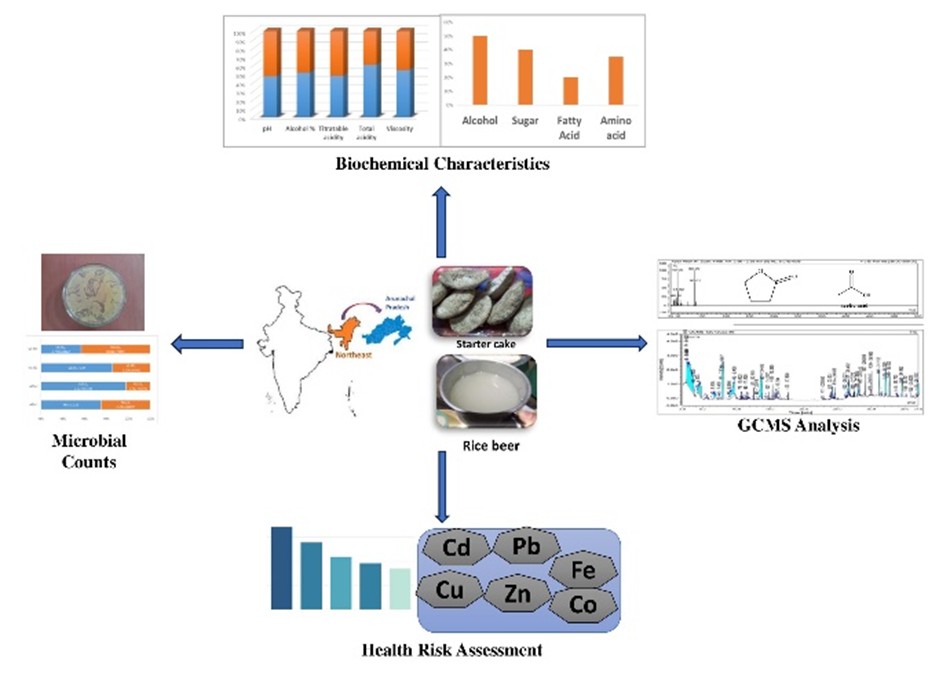
Biochemical characterization, GC-MS metabolite profiling, and heavy metals assessment of Rokshi: safety assessment and nutritional potential of a traditional fermented rice beverage of Monpa tribe
DOI:
https://doi.org/10.69857/joapr.v14i3.2015Keywords:
Traditionally fermented beverage, Rokshi, Monpa tribe, Antioxidant activity, Keywords: Anthelmintic activity, Stemona Tuberosa, Quinic acid, GC-MS analysis, Heavy metalsAbstract
Background: Rokshi is a traditional fermented rice beverage widely consumed by the Monpa tribe of Arunachal Pradesh, a Northeastern State in India, with cultural, nutritional, and biochemical significance. Methodology: Standard analytical methods were employed to determine pH, alcohol content, total acidity, viscosity, and antioxidant properties. Microbial count was assessed using the plate count method. Metabolite profiling and heavy metals analysis were conducted using GC-MS and ICP-OES, respectively. Results and Discussion: Rokshi were reported to be acidic and rich in metabolically important compounds. One-month-old Rokshi beverage showed increased alcohol content (7.54% v/v) as compared to fresh Rokshi beverage (2.59% v/v), with a pH of 4.10 (fresh), which decreased to 3.09 during storage. Total acidity increased from 0.58% to 0.78% after one month of storage. Total flavonoid and phenolic content were 0.205 mg QE/mL and 0.928 mg GAE/mL, respectively, with moderate antioxidant activity. Microbial load decreased in the starter culture (2.15 log CFU/mL) to 0.55 log CFU/mL in the final product. GC-MS analysis identified 28 metabolites, predominantly amino acids, sugars, organic acids, and alcohol. Heavy metals (Cd, Pb, Cr, Mn, Fe, Zn, Ni) were also detected, within the maximum permissible limit, and TTHQ values (<1) indicated no significant non-carcinogenic risk at 250 mL/day consumption. Conclusion: The current study showed that Rokshi holds promise for its nutritional and biochemical properties and has moderate antioxidant potential. The presence of a few biogenic amines and trace contaminants emphasizes the need for purification and further toxicological validation to ensure consumer safety and promote nutraceutical applications for commercial use as a functional fermented beverage.
Downloads

References
Taveira IC, Nogueira KMV, Oliveira DLG, Silva RN. Fermentation: humanity’s oldest biotechnological tool. Front Young Minds, 9 (2021) https://doi.org/10.3389/frym.2021.568656
Koay M, Fan H, Wong C. An overview of fermentation in rice winemaking. Canrea J Food Technol Nutr Culinary J, 5(1), 12–37 (2022) https://doi.org/10.20956/canrea.v5i1.629
Salanță LC, Coldea TE, Ignat MV, Pop CR, Tofană M, Mudura E, Borșa A, Pasqualone A, Zhao H. Non-alcoholic and craft beer production and challenges. Processes, 8(11), 1382 (2020) https://doi.org/10.3390/pr8111382
Rios-Corripio G, Hernández-Carranza P, Ruiz-López I, Guerrero-Beltrán JÁ, Ochoa-Velasco CE. Health benefits of fermented alcoholic beverages. In: Bioactive Compounds in Fermented Foods, 265–299 (2021) https://doi.org/10.1201/9780429027413-14
Deka AK, Handique P, Deka DC. Ethnic food beverages with heavy metal contents: parameters for associated risk to human health, North-East India. Toxicol Rep, 8, 1220–1225 (2021) https://doi.org/10.1016/j.toxrep.2021.06.013
Handique P, Deka AK, Deka DC. Antioxidant properties and phenolic contents of traditional rice-based alcoholic beverages of Assam, India. Natl Acad Sci Lett, 43(6), 501–503 (2020) https://doi.org/10.1007/s40009-020-00903-5
Deka DC. Traditional rice-based alcoholic beverages in India. Ref Ser Phytochem, 889–921 (2025) https://doi.org/10.1007/978-3-031-38663-3_140
Devika HR, Harsha KM, Kalpana R, Shet KG, Rashmi D. Development of a fermented probiotic beverage inoculated with kefir grain. Asian J Dairy Food Res (2024) https://doi.org/10.18805/ajdfr.dr-2155
Lange KW, Nakamura Y. Amazake (Japanese fermented rice beverage) and its potential health benefits. Food Sci Hum Wellness, 14(1), 9250076 (2025) https://doi.org/10.26599/FSHW.2024.9250076
Latif A, Shehzad A, Niazi S, Zahid A, Ashraf W, Iqbal MW, Rehman A, Riaz T, Aadil RM, Khan IM, Özogul F, Rocha JM, Esatbeyoglu T, Korma SA. Probiotics: mechanism of action, health benefits and their application in food industries. Front Microbiol, 14, 1216674 (2023) https://doi.org/10.3389/fmicb.2023.1216674
Peng B, Huang H, Xu J, Xin Y, Hu L, Wen L, Li L, Chen J, Han Y, Li C. Rice wine fermentation: unveiling key factors shaping quality, flavor, and technological evolution. Foods, 14(14), 2544 (2025) https://doi.org/10.3390/foods14142544
Dobrowolska-Iwanek J, Zagrodzki P, Galanty A, Fołta M, Kryczyk-Kozioł J, Szlósarczyk M, Rubio PS, de Carvalho IS, Paśko P. Determination of essential minerals and trace elements in edible sprouts from different botanical families—application of chemometric analysis. Foods, 11(3), 371 (2022) https://doi.org/10.3390/foods11030371
Balali-Mood M, Naseri K, Tahergorabi Z, Khazdair MR, Sadeghi M. Toxic mechanisms of five heavy metals: mercury, lead, chromium, cadmium, and arsenic. Front Pharmacol, 12 (2021) https://doi.org/10.3389/fphar.2021.643972
Rai AK, Appaiah KAA. Bioactive compounds in fermented foods. Bioactive Compounds in Fermented Foods (2021) https://doi.org/10.1201/9780429027413
Najman K, Ponikowska P, Sadowska A, Hallmann E, Wasiak-Zys G, Świderski F, Buczak K. Physicochemical properties and nutritional relevance of rice beverages available on the market. Appl Sci, 14(19) (2024) https://doi.org/10.3390/app14199150
Muzaifa M, Abubakar Y, Safrida N, Nilda C, Sapitri M. Alcohol content and chemical characteristics of fermented beverages in Aceh Province, Indonesia. IOP Conf Ser Earth Environ Sci, 1241(1), 012095 (2023) https://doi.org/10.1088/1755-1315/1241/1/012095
Cuamatzin-García L, Rodríguez-Rugarcía P, El-Kassis EG, Galicia G, Meza-Jiménez ML, Baños-Lara MDR, Zaragoza-Maldonado DS, Pérez-Armendáriz B. Traditional fermented foods and beverages from around the world and their health benefits. Microorganisms, 10, 1151 (2022) https://doi.org/10.3390/microorganisms10061151
Ofoedu CE, You L, Osuji CM, Iwouno JO, Kabuo NO, Ojukwu M, Agunwah IM, Chacha JS, Muobike OP, Agunbiade AO, Sardo G, Bono G, Okpala COR, Korzeniowska M. Hydrogen peroxide effects on natural-sourced polysaccharides: free radical formation/production, degradation process, and reaction mechanism—A critical synopsis. Foods, 10(4), 699 (2021) https://doi.org/10.3390/foods10040699
Lorencová E, Salek RN, Černošková I, Buňka F. Evaluation of force-carbonated Czech-type lager beer quality during storage in relation to the applied type of packaging. Food Control, 106, 106706 (2019) https://doi.org/10.1016/j.foodcont.2019.106706
Loying R, Kalita J, Manna P. Rice-based alcoholic fermented beverages of North-East India: insight into ethnic preparation, microbial intervention, ethnobotany, and health benefits. J Food Biochem, e7769743 (2024) https://doi.org/10.1155/2024/7769743
Canaviri-Paz P, Oscarsson E, Kjellström A, Olsson H, Jois C, Håkansson Å. Effects on microbiota composition after consumption of quinoa beverage fermented by a novel xylose-metabolizing Lactiplantibacillus plantarum strain. Nutrients, 13(10), 3318 (2021) https://doi.org/10.3390/nu13103318
da Silva Vale A, Venturim BC, da Silva Rocha ARF, Martin JGP, Maske BL, Balla G, De Dea Lindner J, Soccol CR, de Melo Pereira GV. Exploring microbial diversity of non-dairy fermented beverages with a focus on functional probiotic microorganisms. Fermentation, 9(6), 496 (2023) https://doi.org/10.3390/fermentation9060496
Bian M, Fang Y, Yang S, Yuan T, Zhou X, Xu Q, Jiang D, Han B. Dynamic changes in physicochemical properties, amino acid content, and flavour-related substances during fortified fermentation of rice wine with Saccharomycopsis fibuligera. J Food Process Preserv, 5581068 (2024) https://doi.org/10.1155/2024/5581068
Coelho E, Lemos M, Genisheva Z, Domingues L, Vilanova M, Oliveira JM. Validation of a LLME/GC-MS methodology for quantification of volatile compounds in fermented beverages. Molecules, 25(3), 621 (2020) https://doi.org/10.3390/molecules25030621
Bhattacharya B, Deka DC. Metal contents in traditional alcoholic rice beers prepared by Rabha and Sonowal Kachari tribes of Assam, India. Asian J Chem, 36(1), 201–205 (2024) https://doi.org/10.14233/AJCHEM.2024.30782
Ariaya Hymete TE. Health risk assessment of heavy metals in locally produced beer to the population in Ethiopia. OMICS J Radiol, 6(6) (2014) https://doi.org/10.4172/1948-593X.1000114
Debebe A, Chandravanshi BS, Redi-Abshiro M. Assessment of essential and non-essential metals in Ethiopian traditional fermented alcoholic beverages. Bull Chem Soc Ethiop, 31(1), 17–30 (2017) https://doi.org/10.4314/bcse.v31i1.2
Ramić E, Žero S, Memić M. Determination, estimation of dietary intake and target hazard quotients of heavy metals in wines from the Bosnia and Herzegovina market. Kem Ind, 73, 457–466 (2024) https://doi.org/10.15255/KUI.2024.006
Scutarasu EC, Trincă LC. Heavy metals in foods and beverages: global situation, health risks and reduction methods. Foods, 12(18), 3340 (2023) https://doi.org/10.3390/foods12183340
Cottet C, Ramirez-Tapias YA, Delgado JF, de la Osa O, Salvay AG, Peltzer MA. Biobased materials from microbial biomass and its derivatives. Materials, 13(6), 1263 (2020) https://doi.org/10.3390/ma13061263
Singh A, Tiwari A, Singh N. Physico-chemical analysis of developed rice beer from Oryza sativa. Asian Food Sci J, 22(5), 28–34 (2023) https://doi.org/10.9734/afsj/2023/v22i5634
Koyama M, Kitamura Y. Development of a new rice beverage by improving the physical stability of rice slurry. J Food Eng, 131, 89–95 (2014) https://doi.org/10.1016/j.jfoodeng.2014.01.030
Cabrera-Vique C, Teissedre PL, Cabanis MT, Cabanis JC. Determination and levels of chromium in French wine and grapes by graphite furnace atomic absorption spectrometry. J Agric Food Chem, 45(5), 1808–1811 (1997) https://doi.org/10.1021/jf960691b
Mishra S, Mithul Aravind S, Charpe P, Ajlouni S, Ranadheera CS, Chakkaravarthi S. Traditional rice-based fermented products: insight into their probiotic diversity and probable health benefits. Food Biosci, 50, 102082 (2022) https://doi.org/10.1016/j.fbio.2022.102082
Sarma Bora M, Devi U, Bharadwaj N, Sharma P, Kalita S, Baruah S, Das AK, Sarma KP. Pollution and health risk assessment of toxic metals in solid waste dumping site soil and its impact on groundwater: a case study. Int J Environ Anal Chem, 103(3), 612–632 (2023) https://doi.org/10.1080/03067319.2020.1862813
Tang Z, Wang Q, Zhao Z, Shen N, Qin Y, Lin W, Xiao Y, Yuan M, Chen H, Chen H, Bu T, Li Q, Huang L. Evaluation of fermentation properties, antioxidant capacity in vitro and in vivo, and metabolic profile of a fermented beverage made from apple and cantaloupe. LWT, 179, 114661 (2023) https://doi.org/10.1016/j.lwt.2023.114661
Lekjing S, Venkatachalam K. Quality changes of HomChaiya rice beer during storage at two alternative temperatures. J Biosci Bioeng, 133(4), 369–374 (2022) https://doi.org/10.1016/j.jbiosc.2021.12.011
Published
How to Cite
Issue
Section
Copyright (c) 2026 Rosamund Jyrwa, Ananta Choudhury, Andian Ari Anggraeni

This work is licensed under a Creative Commons Attribution-NonCommercial 4.0 International License.