Formulation and evaluation of SPAN-60-based valacyclovir proniosomal gel for ocular delivery
DOI:
https://doi.org/10.69857/joapr.v14i3.1949Keywords:
Ocular, Proniosomes, Valacyclovir, Franz diffusion, kinetics.Abstract
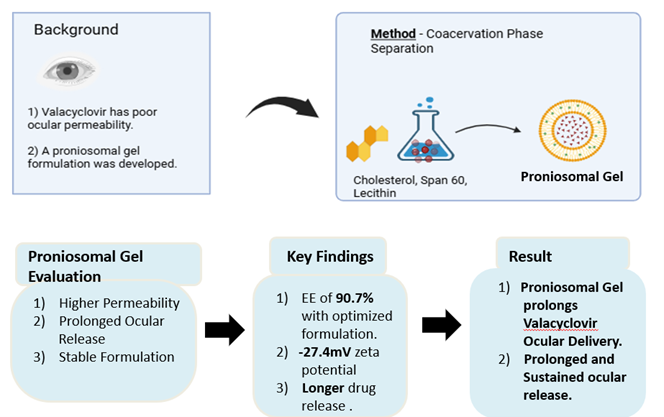
Background: Ocular administration is a challenging route of drug delivery due to the eye's distinct anatomy and physiology. Valacyclovir is commonly prescribed to treat viral ophthalmological conditions. However, its poor permeability limits its effectiveness in ocular viral infections. In this study, valacyclovir proniosomal gels (F1-F14) have been prepared for ocular permeation. Methodology: The VCV proniosomal gel was prepared using varying ratios of cholesterol, Span 60, and lecithin via coacervation-phase separation. The prepared proniosomal gels were characterized for particle size and shape, viscosity, drug entrapment efficiency (EE%), surface morphology, zeta potential, and in vitro drug release. Result and Discussion: Data from experimentation indicate that all formulations prepared were found to have high entrapped efficiency (%), with the highest value being (90.70%) for F7. The final formulation showed a ZP of -27.40 ± 2 mV, a PDI of 0.231, and a vesicle size of 64.31 nm, indicating uniformly dispersed, nanosized vesicles well-suited for ocular drug delivery and exhibiting greater colloidal stability. Conclusion: The results from all fourteen formulations of in vitro drug release demonstrated that they all released their drug in a sustained manner for at least 10 hours following release. The patterns of drug release from the in vitro tests fitted into the Korsmeyer–Peppas model of drug release kinetics. Overall, the results show that using VCV in a proniosomal form enables prolonged, enhanced corneal permeation.
Downloads

References
Ahmed S, Amin MM, Sayed S. Ocular drug delivery: a comprehensive review. AAPS PharmSciTech, 24, 66 (2023) https://doi.org/10.1208/s12249-023-02516-9
Batur E, Özdemir S, Durgun ME, Özsoy Y. Vesicular drug delivery systems: promising approaches in ocular drug delivery. Pharmaceuticals, 17, 511 (2024) https://doi.org/10.3390/ph17040511
Matole V, Shirure P, Bedadurge A, Kadare M, Thore M. A brief review on ocular drug delivery system. Asian Journal of Pharmaceutical Research, 11, 67–70 (2021) https://doi.org/10.5958/2231-5691.2021.00014.9
Gaudana R, Ananthula HK, Parenky A, Mitra AK. Ocular drug delivery. AAPS Journal, 12, 348–360 (2010) https://doi.org/10.1208/s12248-010-9183-3
Panchal S, Abdul Ahad H, Srinivas H, Ramachandra GB, Gangadharaiah M, Srinivas S. Breaking barriers in ocular drug delivery: unveiling the role of ocular inserts as controlled release systems. Research Journal of Pharmacy and Dosage Forms Technology, 16, 245–250 (2024) https://doi.org/10.52711/0975-4377.2024.00039
Patidar S, Vengurlekar S, Jain SK. Development and validation of analytical method of raltegravir, an antiviral drug. Asian Journal of Pharmaceutical Analysis, 14, 21–25 (2024) https://doi.org/10.52711/2231-5675.2024.00005
Verma S, Nainwal N, Kikon NY, Ali A, Jakhmola V. Hopes and hurdles of nanogels in the treatment of ocular diseases. Journal of Applied Pharmaceutical Science, 14, 001–012 (2024) https://doi.org/10.7324/JAPS.2023.153962
Venkatesh A, Patel R, Goyal S, Rajaratnam T, Sharma A, Hossain P. Ocular manifestations of emerging viral diseases. Eye, 35, 1117–1139 (2021) https://doi.org/10.1038/s41433-020-01376-y
Shifali A, Kumar P, Pandit V. Recent trends in ocular drug delivery system: a review. Asian Journal of Research in Pharmaceutical Science, 11, 71–80 (2021) https://doi.org/10.5958/2231-5659.2021.00012.6
Kumar R, Sinha VR. Lipid nanocarrier: an efficient approach towards ocular delivery of hydrophilic drug (Valacyclovir). AAPS PharmSciTech, 18, 884–894 (2017) https://doi.org/10.1208/s12249-016-0575-2
El Emam GA, Girgis GNS, El Sokkary MMA, El Azeem Soliman OA, Abd El Gawad AEGH. Ocular inserts of voriconazole loaded proniosomal gels: formulation, evaluation and microbiological studies. International Journal of Nanomedicine, 15, 7825–7840 (2020) https://doi.org/10.2147/IJN.S268208
Ajrin M, Anjum F. Proniosome: a promising approach for vesicular drug delivery. Turkish Journal of Pharmaceutical Sciences, 19, 462–475 (2022) https://doi.org/10.4274/tjps.galenos.2021.53533
Mittal S, Chaudhary A, Chaudhary A, Kumar A. Proniosomes: the effective and efficient drug carrier system. Therapeutic Delivery, 11, 125–137 (2020) https://doi.org/10.4155/TDE-2019-0065
Jangam RP, Thombre AN, Gaikwad NP. A review: proniosomes as a novel drug delivery system. Asian Journal of Pharmaceutical Technology, 7, 166–174 (2017) https://doi.org/10.5958/2231-5713.2017.00027.7
Banu S, Farheen SA. Ocular drug delivery system: a novel approach. Asian Journal of Research in Pharmaceutical Science, 9, 97–102 (2019) https://doi.org/10.5958/2231-5659.2019.00015.8
Kandpal N, Dhuliya R, Padiyar N, Singh A, Khaudiyal S, Ale Y, Jakhmola V, Nainwal N. Innovative niosomal in situ gel: elevating ocular drug delivery synergies. J. Appl. Pharm. Sci., 14, 001–017 (2024) https://doi.org/10.7324/JAPS.2024.191581
Aboali FA, Habib DA, Elbedaiwy HM, Farid RM. Curcumin loaded proniosomal gel as a biofriendly alternative for treatment of ocular inflammation: in vitro and in vivo assessment. Int. J. Pharm., 589, 119835 (2020) https://doi.org/10.1016/j.ijpharm.2020.119835
Baghel Chauhan S, Naved T, Parvez N. Formulation development and evaluation of proniosomal gel of ethinylestradiol and levonorgestrel for antifertility treatment. Asian J. Pharm. Clin. Res., 12, 312–318 (2019) https://doi.org/10.22159/ajpcr.2019.v12i2.29546
Kumari P, Ghosh B, Biswas S. Nanocarriers for drug delivery: recent advances and challenges. J. Drug Deliv. Sci. Technol., 82, 104339 (2023) https://doi.org/10.1016/j.jddst.2023.104339
Abdelbary GA, Amin MM, Zakaria MY. Ocular ketoconazole loaded proniosomal gels: formulation, ex vivo corneal permeation and in vivo studies. Drug Deliv., 24, 309–319 (2017) https://doi.org/10.1080/10717544.2016.1247928
Gairola N, Gogoi H, Dubey J, Khatiyaan JS, Chaudhary H, et al. Role of intrinsic and supplemented antioxidants in follicular fluid: a shield against oxidative stress in oocyte health and embryo development. Journal of Applied Pharmaceutical Research, 13(3), 94–104 (2025) https://doi.org/10.69857/joapr.v13i3.1036
Kandpal N, Ale Y, Semwal YC, Padiyar N, Jakhmola V, Farswan AS, et al. Proniosomes: a provesicular system in ocular drug delivery. J. Adv. Biotechnol. Exp. Ther., 6, 622–637 (2023) https://doi.org/10.5455/jabet.2023.d169
Schuster AK, Harder BC, Schlichtenbrede FC, Jarczok MN, Tesarz J. Valacyclovir versus acyclovir for the treatment of herpes zoster ophthalmicus in immunocompetent patients. Cochrane Database Syst. Rev., CD010611 (2016) https://doi.org/10.1002/14651858.CD010611
Taylor SR, Hamilton R, Hooper CY, Joshi L, Morarji J, Gupta N, et al. Valacyclovir in the treatment of acute retinal necrosis. BMC Ophthalmol., 12, 48 (2012) https://doi.org/10.1186/1471-2415-12-48
Pandey M, Choudhury H, Abdul-Aziz A, Bhattamisra SK, Gorain B, Su JST, et al. Advancement on sustained antiviral ocular drug delivery for herpes simplex virus keratitis: recent update on potential investigation. Pharmaceutics, 13, 1–38 (2021) https://doi.org/10.3390/pharmaceutics13010001
Kapanigowda UG, Nagaraja SH, Ramaiah B, Boggarapu PR, Subramanian R. Enhanced trans-corneal permeability of valacyclovir by polymethacrylic acid copolymers based ocular microspheres: in vivo evaluation of estimated pharmacokinetic/pharmacodynamic indices and simulation of aqueous humor drug concentration-time profile. J. Pharm. Innov., 11, 82–91 (2016) https://doi.org/10.1007/s12247-015-9243-9
Tuwar SM, Hanabaratti RM. Kinetics and mechanistic investigations on antiviral drug-valacyclovir hydrochloride by heptavalent alkaline permanganate. J. Chem. Sci., 133, 1–12 (2021) https://doi.org/10.1007/s12039-021-01969-4
Kumar Sarella PN, Kumari Vendi V, Vipparthi AK, Valluri S, Vegi S. Advances in proniosomes: harnessing nanotechnology for enhanced drug delivery. Asian J. Res. Pharm. Sci., 14, 279–286 (2024) https://doi.org/10.52711/2231-5659.2024.00046
Chalikwar S, Moravakar K, Bhairav B. Stability indicating method development and validation for estimation of valacyclovir in pharmaceutical preparation. Asian J. Pharm. Anal., 14, 53–59 (2024) https://doi.org/10.52711/2231-5675.2024.00010
Afarid M, Mahmoodi S, Baghban R. Recent achievements in nano based technologies for ocular disease diagnosis and treatment: review and update. J. Nanobiotechnol., 20, 1–36 (2022) https://doi.org/10.1186/s12951-022-01567-7
Ramya Kuber B, Soundarya J. Method development and validation for the estimation of class 2 residual solvents in valacyclovir by HS-GC. Res. J. Pharm. Technol., 15, 5388–5392 (2022) https://doi.org/10.52711/0974-360X.2022.00908
Lokapur JS, Goudanavar PS, Lokapur AJ, Acharya A, Murtale SA. Formulation and evaluation of timolol maleate proniosomal gel for ocular drug delivery. Int. J. Pharm. Investig., 12, 386–390 (2022) https://doi.org/10.5530/ijpi.2022.3.65
Sharma V, Mittal C, Shekhedwal S, Chaudhary V, Kumar S. Niosomes: an extensive analysis of its structure, preparation, and uses in drug delivery. Journal of Applied Pharmaceutical Research, 13(3), 36–44 (2025) https://doi.org/10.69857/joapr.v13i3.1000
Nemr AA, El Mahrouk GM, Badie HA. Development and evaluation of proniosomes to enhance the transdermal delivery of cilostazole and to ensure the safety of its application. Drug Dev. Ind. Pharm., 47, 403–415 (2021) https://doi.org/10.1080/03639045.2021.1890111
Emad Eldeeb A, Salah S, Ghorab M. Proniosomal gel derived niosomes: an approach to sustain and improve the ocular delivery of brimonidine tartrate; formulation, in vitro characterization and in vivo pharmacodynamic study. Drug Deliv., 26, 509–521 (2019) https://doi.org/10.1080/10717544.2019.1609622
Kandpal N, Ale Y, Kajal K, Chamoli S, Butola M. Formulation and evaluation of moxifloxacin-loaded proniosomal gel for ocular delivery. Journal of Applied Pharmaceutical Research, 13(5), 245–253 (2025) https://doi.org/10.69857/joapr.v13i5.1052
Teaima MH, Yasser M, El Nabarawi MA, Helal DA. Proniosomal telmisartan tablets: formulation, in vitro evaluation and in vivo comparative pharmacokinetic study in rabbits. Drug Des. Devel. Ther., 14, 1319–1331 (2020) https://doi.org/10.2147/DDDT.S245013
Khatoon M, Shah KU, Din FU, Shah SU, Rehman AU, Dilawar N, et al. Proniosomes derived niosomes: recent advancements in drug delivery and targeting. Drug Deliv., 24, 56–69 (2017) https://doi.org/10.1080/10717544.2017.1384520
Parmar N, Sharma R, Patel J, Khan S, Patel R. Formulation and evaluation studies of valacyclovir topical gel for antiviral activity. Int. J. Pharm. Sci. Med., 7, 97–118 (2022) https://doi.org/10.52666/ijpsm.2022.07.10.009
Viswanath V, Tulasi P. Formulation, optimization and characterization of betaxolol hydrochloride proniosomes using 3² factorial design. Int. J. Res. Pharm. Sci. Technol., 1, 89–97 (2020) https://doi.org/10.30574/ijrpst.2020.1.3.0050
Fouda NH, Abdelrehim RT, Hegazy DA, Habib BA. Sustained ocular delivery of dorzolamide HCl via proniosomal gel formulation: in vitro characterization, statistical optimization and in vivo pharmacodynamic evaluation in rabbits. Drug Deliv., 25, 1340–1349 (2018) https://doi.org/10.1080/10717544.2018.1477861
Khan I, Needham R, Yousaf S, Houacine C, Islam Y, Bnyan R, et al. Impact of phospholipids, surfactants and cholesterol selection on the performance of transfersome vesicles using medical nebulizers for pulmonary drug delivery. J. Drug Deliv. Sci. Technol., 66, 102822 (2021) https://doi.org/10.1016/j.jddst.2021.102822
Published
How to Cite
Issue
Section
Copyright (c) 2026 Nyanbeni Y Kikon, Shalu Verma, Nidhi Gairola, Alka Singh, Tarun Parashar

This work is licensed under a Creative Commons Attribution-NonCommercial 4.0 International License.