Development and evaluation of a Cassia tora-based herbal antacid suspension
DOI:
https://doi.org/10.69857/joapr.v14i3.1870Keywords:
herbal antacid, suspension, acid neutralizing capacity, stability, Cassia toraAbstract
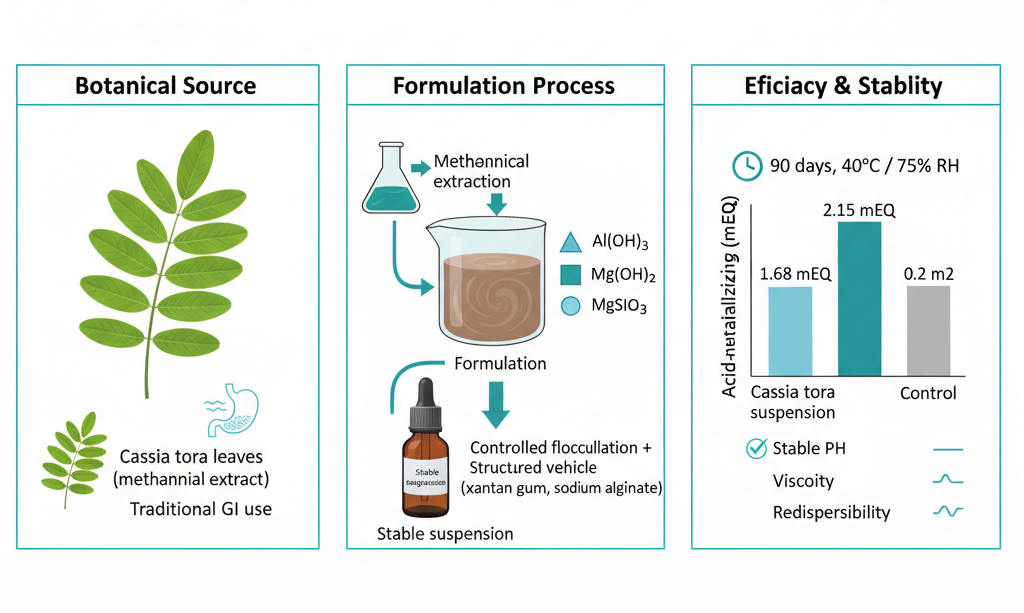
Background: Synthetic antacids are frequently used to manage gastric hyperacidity; however, their potential for long-term adverse effects has catalyzed significant interest in developing safer herbal-based therapeutic alternatives. Cassia tora, traditionally used for gastrointestinal disorders, contains gastroprotective flavonoids, anthraquinones, and tannins. Methodology: To develop and evaluate a Cassia tora-based herbal antacid suspension, assessing its physicochemical stability, microbial safety, phytochemical profile, and acid-neutralizing capacity against a marketed antacid. A methanolic Cassia tora extract was formulated into a suspension with aluminium hydroxide, magnesium hydroxide, and magnesium trisilicate, using controlled flocculation and a structured vehicle. The evaluations included physicochemical properties (pH, viscosity, redispersibility), microbial safety, phytochemical screening, and a 90-day accelerated stability study (ICH guidelines). The acid-neutralizing capacity (ANC) was determined via back titration and compared to that of the marketed antacid and the control. Results and Discussion: The suspension demonstrated acceptable stability over 90 days, with minimal changes in pH (8.86→8.82) and viscosity (1780→1738 cP), and retained easy redispersibility. The microbial counts remained within the pharmacopeial limits. Phytochemical screening confirmed the presence of flavonoids, tannins, and saponins. The ANC was 1.68 mEq, comparable to that of a marketed antacid (2.15 mEq) and significantly superior to that of the control (0.02 mEq). Conclusion: A stable, efficacious Cassia tora-based herbal antacid suspension was successfully developed, exhibiting physicochemical stability, microbial safety, and an ANC comparable to that of commercial formulations. This supports its potential as a natural adjunct, though further in vivo and clinical studies are needed to confirm therapeutic applicability.
Downloads

References
Garg V, Narang P, Taneja R. Antacids revisited: review on contemporary facts and relevance for self-management. J Int Med Res., 50, 1–22 (2022) https://doi.org/10.1177/03000605221086457
Nawabjohn MS, Sivaprakasam P, Anandasadagopan SK, Begum AA, Pandurangan AK. Green synthesis and characterisation of silver nanoparticles using Cassia tora seed extract and investigation of antibacterial potential. Appl Biochem Biotechnol., 194, 464–478 (2021) https://doi.org/10.1007/s12010-021-03651-4
Öcal F, Dayi B. Effect of antacid gastric syrups on surface properties of dental restorative materials: an in vitro analysis of roughness and microhardness. BMC Oral Health., 25, 1–14 (2025) https://doi.org/10.1186/s12903-025-05516-2
Begg M, Tarhuni M, Fotso MN, Gonzalez NA, Sanivarapu RR, Osman U, et al. Comparing the safety and efficacy of proton pump inhibitors and histamine-2 receptor antagonists in the management of patients with peptic ulcer disease: a systematic review. Cureus., 15, e44341 (2023) https://doi.org/10.7759/cureus.44341
Castellana C, Pecere S, Furnari M, Telese A, Matteo MV, Haidry R, Eusebi LH. Side effects of long-term use of proton pump inhibitors: practical considerations. Pol Arch Intern Med., 131, 1–15 (2021) https://doi.org/10.20452/pamw.15997
Kim SY, Lee KJ. Potential risks associated with long-term use of proton pump inhibitors and the maintenance treatment modality for patients with mild gastroesophageal reflux disease. J Neurogastroenterol Motil., 30, 407–420 (2024) https://doi.org/10.5056/jnm24059
Namikawa K, Björnsson ES. Rebound acid hypersecretion after withdrawal of long-term proton pump inhibitor (PPI) treatment—are PPIs addictive? Int J Mol Sci., 25, 5459 (2024) https://doi.org/10.3390/ijms25105459
Madisch A, Pace F, Menzel D, Funk P, Stracke B, Schön C, et al. Prospective uncontrolled clinical study shows rapid and long lasting relief of heartburn and acid related gastric discomfort with Refluthin. Sci Rep., 15, 15896 (2025) https://doi.org/10.1038/s41598-025-85896-w
Alecci U, Bonina F, Bonina A, Rizza L, Inferrera S, Mannucci C, Calapai G. Efficacy and safety of a natural remedy for the treatment of gastroesophageal reflux: a double-blinded randomized-controlled study. Evid Based Complement Alternat Med., 2016, 2581461 (2016) https://doi.org/10.1155/2016/2581461
Kumar RS, Narasingappa RB, Joshi CG, Girish TK, Rao UJP, Danagoudar A. Evaluation of Cassia tora Linn. against oxidative stress-induced DNA and cell membrane damage. J Pharm Bioallied Sci., 9, 33–43 (2017) https://doi.org/10.4103/0975-7406.206255
YR SK, Mahajon B, Srikanth N, Acharya R. Cassia tora Linn.—a pharmacological review. Int J Curr Sci Res Rev., 5, 1774–1777 (2022) https://doi.org/10.47191/ijcsrr/V5-i5-46
Kumar V, Roy BK. Population authentication of the traditional medicinal plant Cassia tora L. based on ISSR markers and FTIR analysis. Sci Rep., 8, 10714 (2018) https://doi.org/10.1038/s41598-018-29114-1
Cherrada N, Chemsa AE, Gheraissa N, Laib I, Gueboudji Z, El‐Shazly M, et al. Gastroprotective efficacy of North African medicinal plants: a review on their therapeutic potential for peptic ulcers. Food Sci Nutr., 12, 8793–8824 (2024) https://doi.org/10.1002/fsn3.4536
Lee SK, Keng JW, Yon JAL, Mai CW, Lim HC, Chow SC, et al. Phytochemical analysis and biological activities of flavonoids and anthraquinones from Cassia alata (Linnaeus) Roxburgh and their implications for atopic dermatitis management. Plants, 14, 362–379 (2025) https://doi.org/10.3390/plants14030362
Ramya S, Loganathan T, Chandran M, Priyanka R, Kavipriya K, Grace Lydial Pushpalatha G, et al. Phytochemical screening, GCMS, FTIR profile of bioactive natural products in the methanolic extracts of Cuminum cyminum seeds and oil. J Drug Deliv Ther., 12, 110–118 (2022) https://doi.org/10.22270/jddt.v12i2-s.5280
Chaddha V, Gupta R. Preliminary phytochemical screening, FT-IR, and HPTLC analysis, and antioxidant, antimicrobial activities of methanolic extracts of Dalbergia sisso leaves. J Appl Pharm Res., 13, 967 (2025) https://doi.org/10.69857/joapr.v13i4.967
Awasthi VK, Mahdi F, Chander R, Khanna AK, Saxena JK, Singh R, et al. Hypolipidemic activity of Cassia tora seeds in hyperlipidemic rats. Indian J Clin Biochem., 30, 78–83 (2015) https://doi.org/10.1007/s12291-013-0394-7
Chaurasia U, Soni V, Sahu RK. In vitro antioxidant effects of hydroalcoholic extract of Cassia tora aerial part using different models. J Appl Pharm Res., 12(2), 79–87 (2024) https://doi.org/10.18231/j.joapr.2024.12.2.79.87
Hussen EM, Endalew SA. In vitro antioxidant and free-radical scavenging activities of polar leaf extracts of Vernonia amygdalina. BMC Complement Med Ther., 23, 1–22 (2023) https://doi.org/10.1186/s12906-023-03923-y
Wang B, Yang X, Fang Y, Zhou X, Jiang R, Han X, et al. Amorphization activates biocompatible MgAl-layered double hydroxide for efficient multiple free radical scavenging. Adv Funct Mater., 34, (2024) https://doi.org/10.1002/adfm.202404828
Devhare LD, Gokhale N. Antioxidant and antiulcer property of different solvent extracts of Cassia tora Linn. Res J Pharm Technol., 15, 1109–1113 (2022) https://doi.org/10.52711/0974-360X.2022.00185
Højgaard L, Nielsen AM, Rune S. Peptic ulcer pathophysiology: acid, bicarbonate, and mucosal function. Scand J Gastroenterol., 31(Suppl 216), 10–15 (1996) https://doi.org/10.3109/00365529609094555
Devhare LD, Gokhale N. In silico anti-ulcerative activity evaluation of some bioactive compound from Cassia tora and Butea monosperma through molecular docking approach. Int J Pharm Sci Res., 14, 1000–1008 (2023) https://doi.org/10.13040/IJPSR.0975-8232.14(2).904-11
Wu TH, Chen IC, Chen LC. Antacid effects of Chinese herbal prescriptions assessed by a modified artificial stomach model. World J Gastroenterol., 16, 4455–4461 (2010) https://doi.org/10.3748/wjg.v16.i35.4455
Guo J, Yan S, Jiang X, Su Z, Zhang F, Xie J, et al. Advances in pharmacological effects and mechanism of action of cinnamaldehyde. Front Pharmacol., 15, 1–15 (2024) https://doi.org/10.3389/fphar.2024.1365949
Li Y, Yang Y, Gu D, Cheng Y, Lv X, Huang Y, et al. Investigation of the impact of diverse climate conditions on the cultivation suitability of Cinnamomum cassia using the MaxEnt model, HPLC and chemometric methods in China. Sci Rep., 14, 1–20 (2024) https://doi.org/10.1038/s41598-024-75189-4
Bagde S, Shivhare R, Pohankar AA, Deshmukh SV, Khedikar SV, Kamde SS, et al. Nutritional and phytochemical profiles of Cassia tora, Moringa oleifera, Asparagus racemosus. Res J Pharm Technol., 17, 4751–4757 (2024) https://doi.org/10.52711/0974-360X.2024.00732
Spoorthi, Shenoy MA. Exploring the therapeutic potential of Cassia tora Linn: an in-depth review of its phytochemistry, traditional uses and pharmacology. Int J Pharm Sci., 3, 4818–4826 (2025) https://doi.org/10.5281/zenodo.15547185
Chaurasia U, Soni V, Sahu RK. In vitro antioxidant effects of hydroalcoholic extract of Cassia tora aerial part using different models. J Appl Pharm Res., 12(2), 79–87 (2024) https://doi.org/10.18231/j.joapr.2024.12.2.79.87
Thirumala M, Shridhar NB, Sanganal JS, Swamy HDN, Ramachandra SG. Phytochemical evaluation and HPTLC fingerprint profile of various extracts of Cassia tora. J Lab Anim Sci., 6, 5–17 (2024) https://doi.org/10.48165/jlas.2023.6.2.2
Yadav V, Das S, Satpathy S, Mandal V, Patra A. Identification and quantification of phenolic and flavonoid constituents in Cassia tora leaves by thin-layer chromatography. J Planar Chromatogr Mod TLC., 38, 1–22 (2025) https://doi.org/10.1007/s00764-025-00384-6
Sharma P, Saini S, Hasanpuri P, Kataria N, Kumar V, Sharma A. FTIR and GC-MS based phytochemical characterization and antioxidant activity evaluation of Digera muricata (L.) Mart. ChemistrySelect, 10, 1–22 (2025) https://doi.org/10.1002/slct.202503144
Tourabi M, Faiz K, Ezzouggari R, Louasté B, Merzouki M, Dauelbait M, et al. Optimization of extraction process and solvent polarities to enhance the recovery of phytochemical compounds, nutritional content, and biofunctional properties of Mentha longifolia L. extracts. Bioresour Bioprocess, 12, 1–12 (2025) https://doi.org/10.1186/s40643-025-00859-8
Muhammad KJ, Akanji FT, Jamil S, Basar N, Mahadi S. Phytochemical screening and proximate analysis of ethanolic leaves extract of Cassia tora. J Sci Math Lett., 6, 10–17 (2018) https://doi.org/10.37134/jsml.vol6.2.2018
Kalinowska M, Płońska A, Trusiak M, Gołębiewska E, Gorlewska-Pietluszenko A. Comparing the extraction methods, chemical composition, phenolic contents and antioxidant activity of edible oils from Cannabis sativa and Silybum marianu seeds. Sci Rep., 12, (2022) https://doi.org/10.1038/s41598-022-25030-7
Kamble K, Shubhangi D. Study of physico-chemical properties of Cassia tora Linn. leaves powder. Int J Agric Eng., 12, 235–242 (2019) https://doi.org/10.15740/HAS/IJAE/12.2/235-24
Mahato TK, Sharma K. Quantitative assessment of acid-neutralizing capacity in antibacterial and antiulcer herbal drugs. Int J Green Pharm., 19, 50–56 (2025) https://doi.org/10.22377/ijgp.v19i01.3654
Aryal S, Baniya MK, Danekhu K, Kunwar P, Gurung R, Koirala N. Total phenolic content, flavonoid content and antioxidant potential of wild vegetables from western Nepal. Plants, 8, 96–112 (2019) https://doi.org/10.3390/plants8040096
Kolaylı S, Birinci C. A comparative study of solvent effect on propolis extraction by ultrasound-assisted extraction. Turk J Anal Chem., 6, 11–17 (2024) https://doi.org/10.51435/turkjac.1445121
Miłek M, Bonikowski R, Dżugan M. The effect of extraction conditions on the chemical profile of obtained raw poplar propolis extract. Chem Pap., 78, 6709–6720 (2024) https://doi.org/10.1007/s11696-024-03567-3
Sevimli‐Yurttas Z, Moreira RG, Castell‐Perez E. Aggregation and sedimentation stability of nanoscale zeolitic imidazolate framework (ZIF‐8) nanocomposites for antimicrobial agent delivery applications. Nano Select, 5, 1–14 (2024) https://doi.org/10.1002/nano.202400029
Published
How to Cite
Issue
Section
Copyright (c) 2026 Shivani, Charit Kumar, Rakesh Redhu, Karan Jangra, Amit Lather

This work is licensed under a Creative Commons Attribution-NonCommercial 4.0 International License.