AQbD enabled optimization of RP-HPLC method for the estimation of pioglitazone and vildagliptin and its forced degradation studies
DOI:
https://doi.org/10.69857/joapr.v14i3.1856Keywords:
AQbD, RP-HPLC, Forced degradation, method development, ValidationAbstract
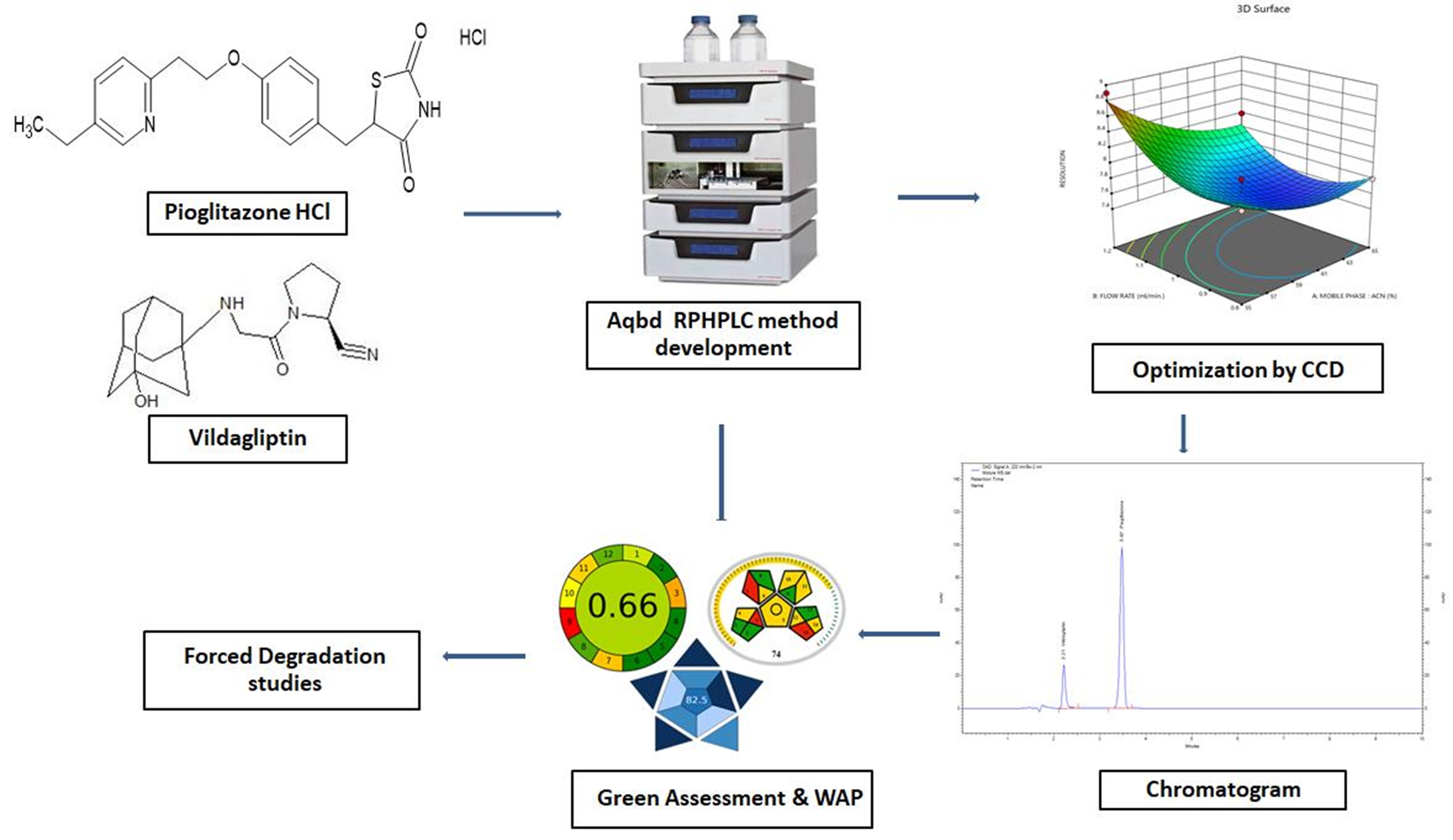
Background: Diabetes mellitus is a metabolic disorder that is managed with combination therapy. Pioglitazone improves insulin sensitivity by activating PPAR-γ, whereas vildagliptin increases incretin activity by inhibiting DPP-4. Their fixed-dose combination requires reliable analytical methods for quality control and stability assessment. This study aimed to develop a green, stability-indicating RP-HPLC method using the Analytical Quality by Design (AQbD) approach. Methodology: A systematic AQbD strategy employing Central Composite Design (CCD) with 13 experimental runs was used to optimize critical analytical parameters. Chromatographic separation was performed on an Agilent 1260 Infinity II HPLC system using a Phenomenex C18 column (150 × 4.6 mm, 5 µm). Detection was carried out at 220 nm with a flow rate of 0.8 mL/min. The method was validated in accordance with ICH guidelines, and greenness was evaluated using the AGREE, MoGAPI, and BAGI metrics. Results and Discussion: Vildagliptin and pioglitazone were well resolved with retention times of 2.21 min and 3.47 min, respectively. Validation results demonstrated excellent precision, accuracy, and reliability. The method exhibited acceptable greenness with a high BAGI score of 82.5, an AGREE score of 0.66, and a MoGAPI value of 74. Stress degradation studies confirmed its stability-indicating capability, with maximum degradation under alkaline and oxidative conditions, while acidic, thermal, and photolytic stresses showed minimal effects. Conclusion: The proposed AQbD-driven, eco-friendly RP-HPLC method is sensitive, stability-indicating, and regulatory-compliant, offering reduced analysis time, enhanced robustness, and improved environmental performance, making it a sustainable and efficient approach for routine estimation of pioglitazone and vildagliptin.
Downloads

References
Jagtap K, Chaudhari B, Redasani V. Quality by Design (QbD) concept review in pharmaceuticals. Asian J Res Chem., 15, 303-307 (2022) https://doi.org/10.52711/0974-4150.2022.00054
Bairagi A, Kothrukar R, Chikhale H, Kosanam S, Borse L. AQbD—novel strategy for analytical methods. Future J Pharm Sci., 10, 138 (2024) https://doi.org/10.1186/s43094-024-00706-1
Park G, Kim MK, Go SH, Choi M, Jang YP. Analytical Quality by Design (AQbD) Approach to the Development of Analytical Procedures for Medicinal Plants. Plants., 11(21), 2960 (2022) https://doi.org/10.3390/plants11212960
Tricht EV, Sänger-van de Griend CE. A Practical Approach to Implementing ICH Q14: Tools for Analytical Quality by Design in Capillary Electrophoresis Method Development. Electrophoresis., 46, 933-953 (2025) https://doi.org/10.1002/elps.8110.
Dewi MK, Pratama R, Arifka M, Chaerunisaa AY. Quality by design: approach to analytical method validation. Sci Pharm., 1(1), 27–33 (2022) https://doi.org/10.58920/sciphar01010033
Kaya SI, Ozcelikay-Akyildiz G, Ozkan SA. Green metrics and green analytical applications: a comprehensive outlook from developing countries to advanced applications. Green Anal Chem., 11, 100159 (2024) https://doi.org/10.1016/j.greeac.2024.100159
Fuente-Ballesteros A, Samanidou V, Ares AM, Bernal J. Ten principles for developing and implementing tools in the context of white analytical chemistry. Sustain Chem Pharm., 45, 102031 (2025) https://doi.org/10.1016/j.scp.2025.102031
González-Martín R, Gutiérrez-Serpa A, Pino V, Sajid M. A tool to assess analytical sample preparation procedures: sample preparation metric of sustainability. J Chromatogr A., 1707, 464291 (2023) https://doi.org/10.1016/j.chroma.2023.464291
Billiard KM, Dershem AR, Gionfriddo E. Implementing green analytical methodologies using solid-phase microextraction: a review. Molecules., 25, 5297 (2020) https://doi.org/10.3390/molecules25225297
Yin L, Yu L, Guo Y, Wang C, Ge Y, Zheng X, et al. Green analytical chemistry metrics for evaluating the greenness of analytical procedures. J Pharm Anal., 14, 101013 (2024) https://doi.org/10.1016/j.jpha.2024.101013
Koziarska M, Strzebońska M, Szalińska E. Development and validation of a green/blue UHPLC-MS/MS method for trace pharmaceutical monitoring. Sci Rep., 15, 30902 (2025) https://doi.org/10.1038/s41598-025-15614-4
Yoo H, Shin W, Lee B, Park J, Lee Y, Kim A. Pharmacokinetics and food effect between a 100-mg sustained-release tablet and a 50-mg immediate-release tablet of vildagliptin in healthy subjects. Clin Pharmacol Drug Dev., 13, 122–127 (2024) https://doi.org/10.1002/cpdd.1313
Malakar A, Bokshi B, Nasrin D. Development and validation of RP-HPLC method for estimation of vildagliptin from tablet dosage form. Int J Pharm Life Sci., 1, 1–5 (2012) http://dx.doi.org/10.3329/ijpls.v1i1.12947.
Salahuddin, Mazumder A, Ahsan MJ, Kumar R, Ullah Z, Shahar Yar M, Shabana K. Exploration of Glitazone/Thiazolidinedione Derivatives: Molecular Design and Therapeutic Potential. Bioengineering., 12, 1024 (2025) https://doi.org/10.3390/bioengineering12101024
AlThikrallah MKI, Idris AM, Elbashir AA, Elgorashe REE, Buzid A, Alnajjar AO. Development of Capillary Zone Electrophoresis Method for the Simultaneous Separation and Quantification of Metformin and Pioglitazone in Dosage Forms; and Comparison with HPLC Method. Molecules., 28, 1184 (2023) https://doi.org/10.3390/molecules28031184
Sen AK, Khatariya SB, Sen DB, Maheshwari RA, Zanwar AS, Velmurugan R. Various innovative UV spectroscopic methodologies for concurrent estimation of dapagliflozin and vildagliptin in combined tablet. J Appl Pharm Sci.,13, 213–223(2023) https://dx.doi.org/10.7324/JAPS.2023.151424
Patil AS, Rane NP, Khot SV, et al. Stability-indicating high-performance thin-layer chromatography method development and validation for pioglitazone hydrochloride and vildagliptin in active pharmaceutical ingredient and tablet dosage form. J Planar Chromatogr., 37, 451–461(2024) https://doi.org/10.1007/s00764-024-00324-w
Inamdar HP, Mhaske AA, Sahastrabudhe SP. A revised RP-HPLC method for simultaneous determination of vildagliptin and pioglitazone HCl-Application to commercially available drug products. Int J Pharm Sci Res., 4, 847–855 (2013) http://dx.doi.org/10.13040/IJPSR.0975-8232.4(2).847-55
Randive KH, Maste MM, Kempwade AA. Exploring analytical quality by design (AQbD) enabled RP-HPLC method for carvedilol. Indian J. Pharm. Educ. Res., 1, 651-60 (2024) https://doi.org/10.5530/ijper.58.2.73
Gandu S, Gandla K. Development of a quality by design-based ultra-performance liquid chromatography method for the simultaneous estimation of casirivimab and imdevimab with greenness metrics. Green Anal Chem., 13, 100248 (2025) https://doi.org/10.1016/j.greeac.2025.100248
Salamah M, Sipos B, Katona G, Volk B, Balogh GT, Csóka I. Development and validation of a novel isocratic RP-HPLC method using AQbD approach for the quantification of favipiravir. Eur J Pharm Sci., 107276 (2025) https://doi.org/10.1016/j.ejps.2025.107276
Published
How to Cite
Issue
Section
Copyright (c) 2026 P V Devi Swapna, G. Saravanan

This work is licensed under a Creative Commons Attribution-NonCommercial 4.0 International License.