Formulation and characterization of spray-dried clarithromycin microparticles with improved dissolution and potential for oral bioavailability
DOI:
https://doi.org/10.69857/joapr.v14i3.1761Keywords:
Clarithromycin, Hydroxypropyl-β-cyclodextrin (HP-β-CD), Kollicoat IR®, microparticles, Spray drying, Dissolution enhancementAbstract
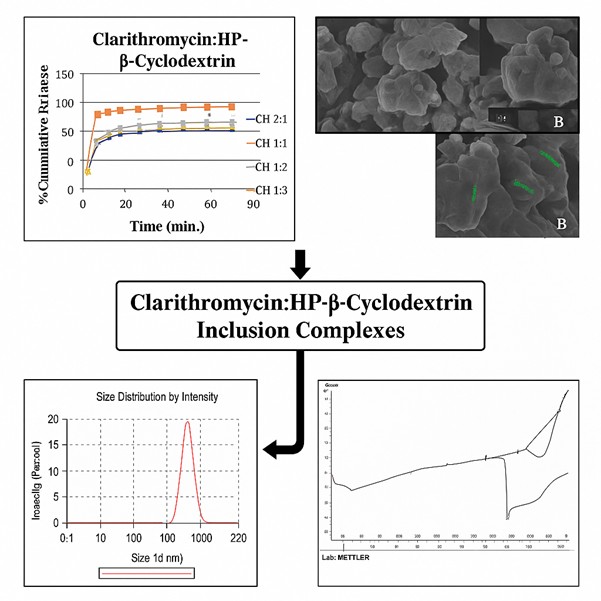
Background: Clarithromycin, a macrolide antibiotic, exhibits limited aqueous solubility, which restricts its dissolution and bioavailability. Enhancing its solubility through novel formulation strategies is essential to improve therapeutic efficacy. Spray drying with hydrophilic carriers is an effective approach for drug particle engineering to improve dissolution. Methodology: Clarithromycin microparticles were prepared by the spray drying technique using hydroxypropyl-β-cyclodextrin (HP-β-CD) and Kollicoat IR® as hydrophilic polymers. The formulations were prepared in different drug-to-polymer ratios. Physicochemical characterization was performed using differential scanning calorimetry (DSC) and powder X-ray diffractometry (XRD) to study the crystalline-to-amorphous transition. Scanning electron microscopy (SEM) was used to assess particle morphology. Dissolution studies were carried out and compared with the pure drug, physical mixtures, and marketed clarithromycin tablets. Results and Discussion: DSC and XRD analyses confirmed the transformation of clarithromycin from a crystalline to an amorphous state within the spray-dried microparticles. SEM images revealed uniform spherical particles with porous surfaces. The optimized spray-dried formulation (CH 1:1) achieved 85.42 ± 0.47% drug release within 10 min and 96.28 ± 1.13% at 60 min, compared to 57.54 ± 1.54% and 81.54 ± 1.87%, respectively, for the marketed tablet. This corresponds to an approximately 1.5-fold enhancement in early dissolution. Conclusion: Spray drying with HP-β-CD and Kollicoat IR® successfully enhanced the solubility and dissolution of clarithromycin. The approach demonstrates potential to develop effective immediate-release tablets, with markedly improved in-vitro dissolution compared with the marketed product, indicating potential for enhanced oral bioavailability.
Downloads

References
Mahama O, Songuigama CJ. Pharmacochemical aspects of the evolution from erythromycin to neomacrolides, ketolides and neoketolides. Org Med Chem, 10(3), 57–112 (2020) https://doi.org/10.4236/ojmc.2020.103005
Chavan AA, Shete AS, Janugade BU, Doijad RC. Formulation, solid state characterization and enhancement of dissolution rate of olmesartan medoxomil by PVA-PEG graft copolymer based nanoparticles. Int J Pharm Educ Res, 50(4) (2016) https://doi.org/10.5530/ijper.50.4.20
Wei T, Zhou BY, Wu XH, Liu XA, Huo MW, Huang XX, Shi LZ, Shi LL, Cao QR. Development of polyvinyl alcohol/polyethylene glycol copolymer-based orodispersible films loaded with entecavir: formulation and in vitro characterization. Curr Drug Deliv, 21(10), 1362–1374 (2024) https://doi.org/10.2174/0115672018261294231024093926
Kothawade SN, Chaudhari PD. Development of biodegradable porous starch foam for improving oral delivery of eprosartan mesylate. J Adv Sci Res, 12(3 Suppl 1), 120–126 (2021) https://doi.org/10.55218/JASR.s1202112314
Saokham P, Muankaew C, Jansook P, Loftsson T. Solubility of cyclodextrins and drug/cyclodextrin complexes. Molecules, 23(5), 1161 (2018) https://doi.org/10.3390/molecules23051161
Zhao B, Du J, Zhang Y, Gu Z, Li Z, Cheng L, Li C, Hong Y. Polysaccharide-coated porous starch-based oral carrier for paclitaxel: adsorption and sustained release in colon. Carbohydr Polym, 291, 119571 (2022) https://doi.org/10.1016/j.carbpol.2022.119571
Baghel S, Cathcart H, O’Reilly NJ. Solid-state properties and dissolution profile of spray-dried ternary amorphous solid dispersions. Mol Pharm, 15(9), 3796–3812 (2018) https://doi.org/10.1021/acs.molpharmaceut.8b00536
Mishra J, Rades T, Löbmann K, Grohganz H. Influence of solvent composition on spray-dried co-amorphous formulations. Pharmaceutics, 10(2), 47 (2018) https://doi.org/10.3390/pharmaceutics10020047
Arane PM, Ghanwat DA, Boyane V, Kothawade SN, Doshi P. Preparation and in vitro characterization of eprosartan mesylate solid dispersions using skimmed milk powder as carrier. Int J Adv Pharm Res, 2(12), 658–665 (2011) https://doi.org/10.5530/ijper.50.3.31
Patil P, Killedar SJ. Chitosan and glyceryl monooleate nanostructures containing gallic acid from amla: targeted delivery. Heliyon, 7(3), e06418 (2021) https://doi.org/10.1016/j.heliyon.2021.e06418
Wang B, Liu F, Xiang J, He Y, Zhang Z, Cheng Z, Liu W, Tan S. A critical review of spray-dried amorphous pharmaceuticals: synthesis, analysis and application. Int J Pharm, 594, 120165 (2021) https://doi.org/10.1016/j.ijpharm.2020.120165
Mahajan A, Sankar V, Ramaprabhu S, Nagar R. Template-free microwave-assisted growth of 3D ZnO rods. Mater Sci Eng B, 284, 115901 (2022) https://doi.org/10.1016/j.mseb.2022.115901
Patil P, Killedar SJ. Improving gallic acid and quercetin bioavailability by polymeric nanoparticles. Drug Dev Ind Pharm, 47(10), 1656–1663 (2021) https://doi.org/10.1080/03639045.2021.1963088
Smith T, Affram K, Nottingham EL. Application of smart solid lipid nanoparticles to enhance the efficacy of 5-fluorouracil in the treatment of colorectal cancer. Sci Rep, 10, 16989 (2020) https://doi.org/10.1038/s41598-020-73218-6
Kothawade SN, Avhad SR, Rngade RB, Kotkar RS, Sabale SS, Baviskar AK, Gawade MM. Aloe vera powder as a potent bioenhancer: a comprehensive review. Int J Pharm Phytopharmacol Res, 13(2), 37–44 (2023) https://doi.org/10.51847/ZFFtdBFaPt
Parhi R. Three-dimensional printing for pharmaceuticals: QC, risk assessment and perspectives. J Drug Deliv Sci Technol, 64, 102571 (2021) https://doi.org/10.1016/j.jddst.2021.102571
Hussein N, Omer H, Ismael A, Albed Alhnan M, Elhissi A, Ahmed W. Spray-dried alginate microparticles for intranasal delivery of ropinirole hydrochloride. Pharm Dev Technol, 25(3), 290–299 (2020) https://doi.org/10.1080/10837450.2019.1680956
Yang X, Shen J, Liu J, Yang Y, Hu A, Ren N, et al. Spray-drying of HP-β-cyclodextrin microcapsules for co-encapsulation of resveratrol and piperine. Molecules, 27(5), 1596 (2022) https://doi.org/10.3390/molecules27051596
Zhang J, Wang Y, Wang J, Yi T. Solid nanocrystals self-stabilized Pickering emulsion via spray-drying with HP-β-cyclodextrin. Molecules, 26(6), 1809 (2021) https://doi.org/10.3390/molecules26061809
Wagh PS, Naik JB. Mefenamic acid-loaded polymeric microparticles using solvent evaporation and spray-drying. Drug Dev Ind Pharm, 34(5), 608–617 (2016) https://doi.org/10.1080/10837450.2017.1286354
Loh YY, Enose AA, Garg V. Enteric-coated polymers past and present: a review. Drug Deliv Lett, 12(2), 85–95 (2022) https://doi.org/10.2174/2210303108666220512143415
Kállai-Szabó N, Farkas D, Lengyel M, Basa B, Fleck C, Antal I. Microparticles and multi-unit systems for advanced drug delivery. Eur J Pharm Sci, 196, 106704 (2024) https://doi.org/10.1016/j.ejps.2024.106704
Published
How to Cite
Issue
Section
Copyright (c) 2026 Sagar Kamble, Ajay Salvi, Shivaji Patil, Yogesh Borhade

This work is licensed under a Creative Commons Attribution-NonCommercial 4.0 International License.