Formulation and evaluation of metformin-loaded microspheres using modified double emulsion solvent evaporation technique
DOI:
https://doi.org/10.69857/joapr.v14i3.1752Keywords:
Metformin hydrochloride, sustained release, microspheres, solvent evaporation, drug release kinetics, W/O/W emulsionAbstract
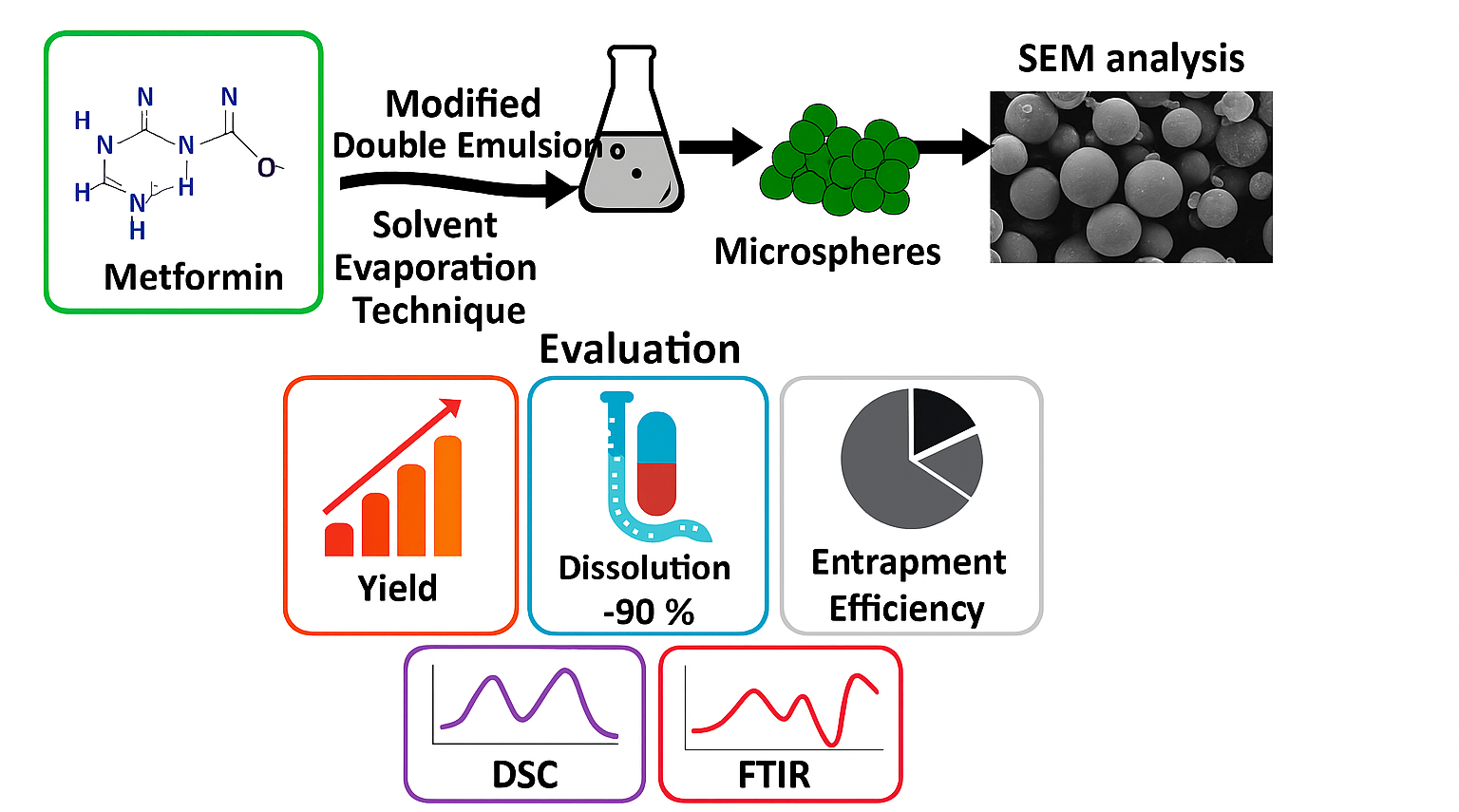
Background: Metformin hydrochloride is the first-line therapy for Type 2 diabetes mellitus; however, its short biological half-life, low oral bioavailability, and frequent dosing often compromise patient compliance and cause gastrointestinal side effects. Sustained-release delivery systems may overcome these limitations. This study aimed to develop and evaluate ethylcellulose-based sustained-release metformin-loaded microspheres using a modified W/O/W double-emulsion solvent evaporation technique. Methodology: Six formulations (MF-M1 to MF-M6) were prepared by varying ethylcellulose concentrations (1.0–3.5% w/v). Microspheres were evaluated for percentage yield, entrapment efficiency (EE%), particle size, swelling index, surface morphology (SEM), thermal behavior (DSC), drug–polymer compatibility (FTIR), in-vitro drug release, and release kinetics. Results and Discussion: Increasing ethylcellulose concentration significantly improved yield (65.4–88.2%) and EE% (58.2–85.6%) while increasing particle size (48.2–121.5 µm). MF-M5 (3% EC) demonstrated optimal performance with high yield (85.6%), EE% (82.1%), controlled initial burst (7.2%), and sustained release (91.6% over 24 h). MF-M6 exhibited the longest release but showed a larger particle size and processing challenges. Drug release followed first-order and Higuchi kinetics, with anomalous transport observed at higher polymer levels. Conclusion: The modified W/O/W technique successfully encapsulated hydrophilic metformin into sustained-release microspheres. MF-M5 is identified as the most balanced formulation, while MF-M6 may be suitable where maximum release retardation is required.
Downloads

References
Taylor SI, Bornfeldt KE, Goldfine ID, et al. Aetiology and management of type 2 diabetes. Nat Rev Endocrinol, 17(2), 67–87 (2021) https://doi.org/10.1038/s41574-020-00449-6
Zheng Y, Ley SH, Hu FB. Global aetiology and epidemiology of type 2 diabetes mellitus and its complications. Nat Rev Endocrinol, 17(2), 88–98 (2021) https://doi.org/10.1038/s41574-020-00475-4
Yaribeygi H, Sathyapalan T, Atkin SL, Sahebkar A. Molecular mechanisms linking oxidative stress and diabetes mellitus. Oxid Med Cell Longev, 2020, 8609213 (2020) https://doi.org/10.1155/2020/8609213
Galicia-Garcia U, Benito-Vicente A, Jebari S, et al. Pathophysiology of type 2 diabetes mellitus. Int J Mol Sci, 21(17), 6275 (2020) https://doi.org/10.3390/ijms21176275
Ezike TC, Ofoegbu U, Onyema C, et al. Advances in drug delivery systems, challenges and future directions. Heliyon, 9(3), e17488 (2023) https://doi.org/10.1016/j.heliyon.2023.e17488
Kommineni N, Chowdhury P, Amiji M. Preparation and evaluation of polymer-based injectable depots for sustained release drug delivery. Drug Deliv Transl Res, 11(5), 1715–1730 (2021) https://doi.org/10.1007/s13346-020-00877-8
Mofakhami S, Salahinejad E. Biphasic calcium phosphate microspheres in biomedical applications. J Control Release, 338, 527–536 (2021) https://doi.org/10.1016/j.jconrel.2021.09.004
Guo P, Chen X, Zhong G, et al. Advances in micro/nanoencapsulation technology for bioactive delivery systems. Front Bioeng Biotechnol, 9, 757063 (2021) https://doi.org/10.3389/fbioe.2021.757063
Elmowafy E, Shalaby K, Salama A, et al. Polymeric nanoparticles for anticancer therapy: recent advances and clinical prospects. Int J Pharm, 602, 120670 (2021) https://doi.org/10.1016/j.ijpharm.2021.120670
D’Souza SM, Shah NV, Bhor RJ, Patravale VB. Double-emulsion solvent evaporation technique for nanoparticle fabrication: advances, challenges, and future prospects. Mater Today Chem, 20, 100443 (2021) https://doi.org/10.1016/j.mtchem.2020.100443
Adeleke OA. Premium ethylcellulose polymer based architectures at work in drug delivery. Int J Pharm X, 1, 100023 (2019) https://doi.org/10.1016/j.ijpx.2019.100023
Thakkar A, Momin M, Nayak R. Formulation and optimization of metformin hydrochloride-loaded biodegradable microspheres using QbD approach. J Drug Deliv Sci Technol, 62, 102402 (2021) https://doi.org/10.1016/j.jddst.2021.102402
Shaikh S, Singh A. Development of sustained release formulations for metformin hydrochloride using advanced polymeric matrices. Curr Drug Deliv, 18(8), 1050–1060 (2021) https://doi.org/10.2174/1567201818666210226111934
Jordan A, Hall CGJ, Thorp LR, Sneddon HF. Replacement of less-preferred dipolar aprotic and ethereal solvents in synthetic organic chemistry with sustainable alternatives. Chem Rev, 122(11), 6749–6794 (2022) https://doi.org/10.1021/acs.chemrev.1c00672
Kotha AA, Vemula S, Kota K, et al. Metformin hydrochloride loaded mucoadhesive microspheres and nanoparticles for anti-hyperglycemic and anticancer effects using factorial design. Drug Des Devel Ther, 17, 3661–3677 (2023) https://doi.org/10.2147/DDDT.S432790
Islam M, Hasan M, Sultana F, et al. Optimization of polymeric microparticles using Box–Behnken design. Polymers, 13(24), 4564 (2021) https://doi.org/10.3390/polym13254564
Panigrahi D, Swain SK, Jena BR, Parida P, Sahu PK. Bosutinib-loaded lipid nanoparticles: cytotoxicity studies. J Appl Pharm Sci, 15(9), 137–155 (2025) https://doi.org/10.7324/JAPS.2025.228972
Al-Qaysi ZK, Al-Bakri A, Al-Qaysi A. Sustained release ocular drug delivery systems for glaucoma therapy: present and future prospects. Expert Opin Drug Deliv, 20(7), 927–945 (2023) https://doi.org/10.1080/17425247.2023.2227283
Tian Y, Zhou J, He C, He L, Li X, Sui H. Formation, stabilization and separation of oil–water emulsions: a review. Processes, 10(4), 738 (2022) https://doi.org/10.3390/pr10040738
Elsayed MM, Mostafa M, Abdel-Mageed AM. Ethylcellulose-based microparticles for sustained drug delivery. SN Appl Sci, 3, 112 (2021) https://doi.org/10.1007/s42452-020-04024-y
Mwita CS, Mushi NE, Ngowi EC, et al. Chitosan extracted from Tenebrio molitor larvae as sustainable packaging film. Materials, 17(15), 3670 (2024) https://doi.org/10.3390/ma17153670
Pokharel M, Jamil MF, Wilson JP, et al. Sustained release of salicylic acid from ethyl cellulose microspheres. Biomed Eng Adv, 6, 100095 (2023) https://doi.org/10.1016/j.bea.2023.100095
Singh D, Lindsay S, Gurbaxani S, Crawford A, Claeyssens F. Porous PGSm microspheres for 3D chondrocyte culture. Int J Mol Sci, 24(13), 10445 (2023) https://doi.org/10.3390/ijms241310445
Fritz M, Deutsch LF, Wijaya KP, et al. Image-processing tool for microparticle size/shape analysis. Microplastics, 3(1), 124–146 (2024) https://doi.org/10.3390/microplastics3010008
Li Y, Zhang H, Wu J, et al. Advanced techniques for particle size and morphology analysis. Adv Powder Technol, 33, 103349 (2022) https://doi.org/10.1016/j.apt.2022.103349
Gao P, Yang L, Wang J, et al. Advances in optical microscopy for nanomaterial characterization. Micron, 150, 103216 (2021) https://doi.org/10.1016/j.micron.2021.103216
Khalid M, Hussain A, Abbas K. Chitosan microspheres for sustained drug delivery. Mater Today Commun, 26, 102033 (2021) https://doi.org/10.1016/j.mtcomm.2020.102033
Oliveira MB, Mano JF. Polymer-based drug release systems: developments and challenges. Acta Biomater, 135, 68–91 (2021) https://doi.org/10.1016/j.actbio.2021.07.011
Philip AK, Samuel BA, Saleh YS, et al. pH-responsive agarose hydrogel for GI delivery. Next Mater, 8, 100790 (2025) https://doi.org/10.1016/j.nxmate.2025.100790
Liu X, Xu Y, Li W, et al. Gastroretentive drug delivery systems: bioavailability approaches. Pharmaceutics, 14(6), 1312 (2022) https://doi.org/10.3390/pharmaceutics14061312
Venkateshaiah A, Padil VVT, Nagalakshmaiah M, et al. Microscopic techniques for micro/nanostructures. Polymers, 12(3), 512 (2020) https://doi.org/10.3390/polym12030512
Siddaiah M, Kannan K, Prabu S. Applications of differential scanning calorimetry in pharmaceuticals. J Mol Struct, 1254, 132380 (2022) https://doi.org/10.1016/j.molstruc.2022.132380
Patil N, Chavan M, Deshmukh R, et al. Ethylcellulose-based microspheres of metformin HCl. J Drug Deliv Sci Technol, 74, 103572 (2022) https://doi.org/10.1016/j.jddst.2022.103572
Dash S, Murthy PN, Nath L, Chowdhury P. Drug–excipient compatibility studies. J Pharm Investig, 50, 309–321 (2020) https://doi.org/10.1007/s40005-019-00461-z
Varghese R, Rajan R, Thomas S. Floating microspheres for improved antidiabetic drug delivery. J Drug Deliv Sci Technol, 67, 102992 (2022) https://doi.org/10.1016/j.jddst.2022.102992
Zapata F, López-Fernández A, Ortega-Ojeda F, et al. ATR-FTIR spectroscopy in pharmaceutical analysis. J Chem Educ, 98(8), 2675–2686 (2021) https://doi.org/10.1021/acs.jchemed.0c01231
Huang S, Cheemarla VKR, Tiana D, Lawrence SE. Hydrogen-bonding interactions in cocrystals. Cryst Growth Des, 23(5), 2306–2320 (2023) https://doi.org/10.1021/acs.cgd.2c01337
Kim J, Park H, Lee S. Biopolymer-based microspheres for sustained oral drug delivery. Carbohydr Polym, 252, 117173 (2021) https://doi.org/10.1016/j.carbpol.2020.117173
Wójcik-Pastuszka D, Krzak J, Macikowski B, et al. Evaluation of release kinetics of active substance from implants. Materials, 12(8), 1202 (2019) https://doi.org/10.3390/ma12081202
Fu Y, Kao WJ. Drug release kinetics and transport mechanisms in delivery systems. Expert Opin Drug Deliv, 7(4), 429–444 (2010) https://doi.org/10.1517/17425241003602259
Zhang L, Li J, Wang Y, et al. Mathematical modeling of drug release kinetics from sustained-release formulations. Int J Pharm, 605, 120834 (2021) https://doi.org/10.1016/j.ijpharm.2021.120834
Zhu W, Long J, Shi M. Release kinetics model fitting of drugs with different structures. Materials, 16(8), 3282 (2023) https://doi.org/10.3390/ma16083282
Gadde S, Reddy N. Metformin-loaded PLGA microspheres for sustained release: formulation, characterization and in vitro evaluation. J Drug Deliv Sci Technol, 63, 102536 (2021) https://doi.org/10.1016/j.jddst.2021.102536
Abdelwahed W, Dordunoo SK, Wan LSC. Ethylcellulose based microspheres for sustained oral delivery of drugs: formulation and release mechanisms. Int J Pharm, 583, 119404 (2020) https://doi.org/10.1016/j.ijpharm.2020.119404
Ramachandran S, Paul Raj R, Ashok Kumar CK, Shanmugam S, Nethaji S. Eudragit S100 coated PLGA microspheres for colon targeted delivery of metformin HCl: formulation and evaluation. J Drug Deliv Sci Technol, 65, 102678 (2021) https://doi.org/10.1016/j.jddst.2021.102678
Patel K, Shah P, Amin A. Comparative evaluation of ethylcellulose and Eudragit microspheres for sustained release of model drugs. J Pharm Sci, 112(4), 1230–1242 (2023) https://doi.org/10.1016/j.xphs.2023.01.012
Published
How to Cite
Issue
Section
Copyright (c) 2026 Saikat Santra, Debraj Dey, Twinkle Pal, Abu Shoeb, Pinki Biswas

This work is licensed under a Creative Commons Attribution-NonCommercial 4.0 International License.