Therapeutic potential of mesalamine-probiotic combination in enteric-coated tablet for modulating gut inflammation in IBD
DOI:
https://doi.org/10.69857/joapr.v14i3.1748Keywords:
Mesalamine, Probiotics, Colon-targeted delivery, Enteric-coated tablets, Inflammatory bowel disease (IBD), Drug release kinetics, Probiotic viabilityAbstract
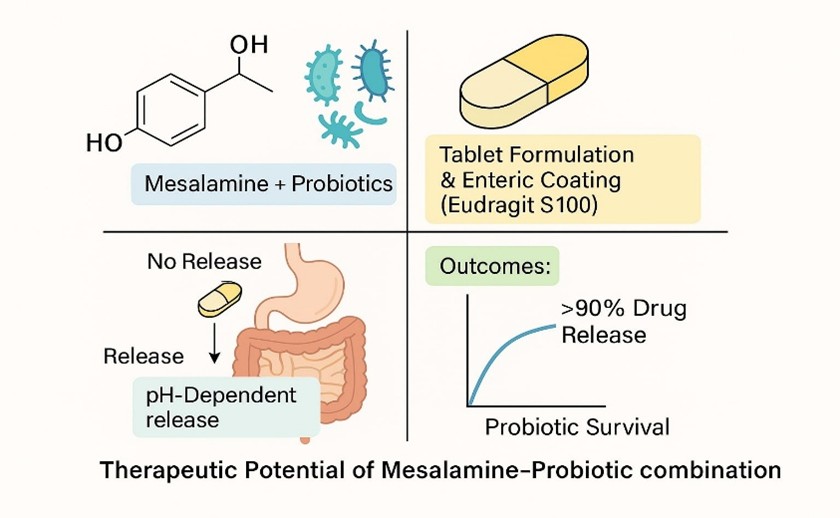
Background: Mesalamine is widely used for inflammatory bowel disease (IBD) due to its local anti-inflammatory action, while probiotics help restore intestinal microbiota and modulate immune responses. Combining both may offer synergistic benefits for IBD management. This study aimed to develop and evaluate colon-targeted enteric-coated tablets containing a mesalamine-probiotic combination. Methodology: Core tablets containing mesalamine, selected probiotics, and polymers were prepared by dry granulation. Pre- and post-compression parameters were evaluated. The optimized batch was coated with Eudragit® S100 (2–5%) to achieve pH-dependent release. In vitro dissolution and probiotic viability in simulated gastric conditions were assessed. Result and Discussion: The optimized formulation showed acceptable physical properties and negligible drug release in gastric pH, followed by targeted colonic release exceeding 90% at intestinal/colonic pH. Mesalamine release followed Higuchi kinetics, suggesting diffusion-controlled behavior. Swelling studies demonstrated gradual polymer hydration and matrix erosion. Probiotic viability studies demonstrated strain-dependent survival: Saccharomyces boulardii and Streptococcus thermophilus retained>90% viability after 150 min of simulated gastric exposure, whereas Lactobacillus acidophilus and Bifidobacterium bifidum exhibited approximately 1.2–1.3 log reductions, indicating greater acid sensitivity. The combination of enteric coating enabled efficient colon targeting and sustained release. Differential strain viability emphasized the importance of selecting acid-resistant probiotics or employing protective delivery systems. Conclusion: The developed mesalamine–probiotic enteric-coated tablets demonstrated colon-specific drug release and strain-dependent probiotic survival in vitro, indicating their potential as a candidate formulation requiring further optimization, particularly for acid-sensitive bacterial strains.
Downloads

References
Coward S, Benchimol EI, Bernstein CN, Avina-Zubieta A; Canadian Gastro-Intestinal Epidemiology Consortium (CanGIEC). Forecasting the incidence and prevalence of inflammatory bowel disease: A Canadian nationwide analysis. Am J Gastroenterol, 119, 1563–1570 (2024) https://doi.org/10.14309/ajg.0000000000002687
Kilic Y, Kamal S, Jaffar F, Sriranganathan D, Quraishi MN, Segal JP. Prevalence of extraintestinal manifestations in inflammatory bowel disease: A systematic review and meta-analysis. Inflamm Bowel Dis, 30, 230–239 (2024) https://doi.org/10.1093/ibd/izad061
Hetta HF, Ramadan YN, Alharbi AA, Alsharef S. Gut microbiome as a target of intervention in inflammatory bowel disease pathogenesis and therapy. Immuno, 4, 400–425 (2024) https://doi.org/10.3390/immuno4040026
Goodoory VC, Tuteja AK, Black CJ, Ford AC. Systematic review and meta-analysis: Efficacy of mesalamine in irritable bowel syndrome. Clin Gastroenterol Hepatol, 22, 243–251 (2024) https://doi.org/10.1016/j.cgh.2023.02.014
Sharifi-Azad M, Fathi M, Cho WC, Barzegari A, Dadashi H, Dadashpour M, Jahanban-Esfahlan R. Recent advances in targeted drug delivery systems for resistant colorectal cancer. Cancer Cell Int, 22, 196 (2022) https://doi.org/10.1186/s12935-022-02605-y
Gul S, Durante-Mangoni E. Unraveling the puzzle: Health benefits of probiotics—A comprehensive review. J Clin Med, 13, 1436 (2024) https://doi.org/10.3390/jcm13051436
Hijová E. Probiotics in IBD: Evidence and perspectives on patient health and disease management. Int J Mol Sci, 26, 9065 (2025) https://doi.org/10.3390/ijms26189065
Jiang F-L, Jeong D-H, Eom S-H, Lee H-M, Cha B-J, Park J-S, Kwon R, Nam J-Y, Yu H-S, Heo S-H, et al. Effects of enteric-coated formulation of sodium bicarbonate on bicarbonate absorption and gastrointestinal discomfort. Nutrients, 16, 744 (2024) https://doi.org/10.3390/nu16050744
Bhavani D, Gowtham C, Bhargava P, Dheeraj K, Jnanendra K. Development and validation of UV spectrophotometric method of mesalamine using hydrotropic solubilizing agents. Int J Res Pharm Sci, 12, 2291–2296 (2021) https://doi.org/10.26452/ijrps.v12i3.4856
Published
How to Cite
Issue
Section
Copyright (c) 2026 Pratiksha A. Thete, Milind P. Wagh, Vandana S. Nade

This work is licensed under a Creative Commons Attribution-NonCommercial 4.0 International License.