Formulation and characterization of risperidone nanocrystals for enhanced solubility and dissolution
DOI:
https://doi.org/10.69857/joapr.v14i3.1717Keywords:
Risperidone, Nanocrystal, Solubility, Bioavailability, NanosuspensionAbstract
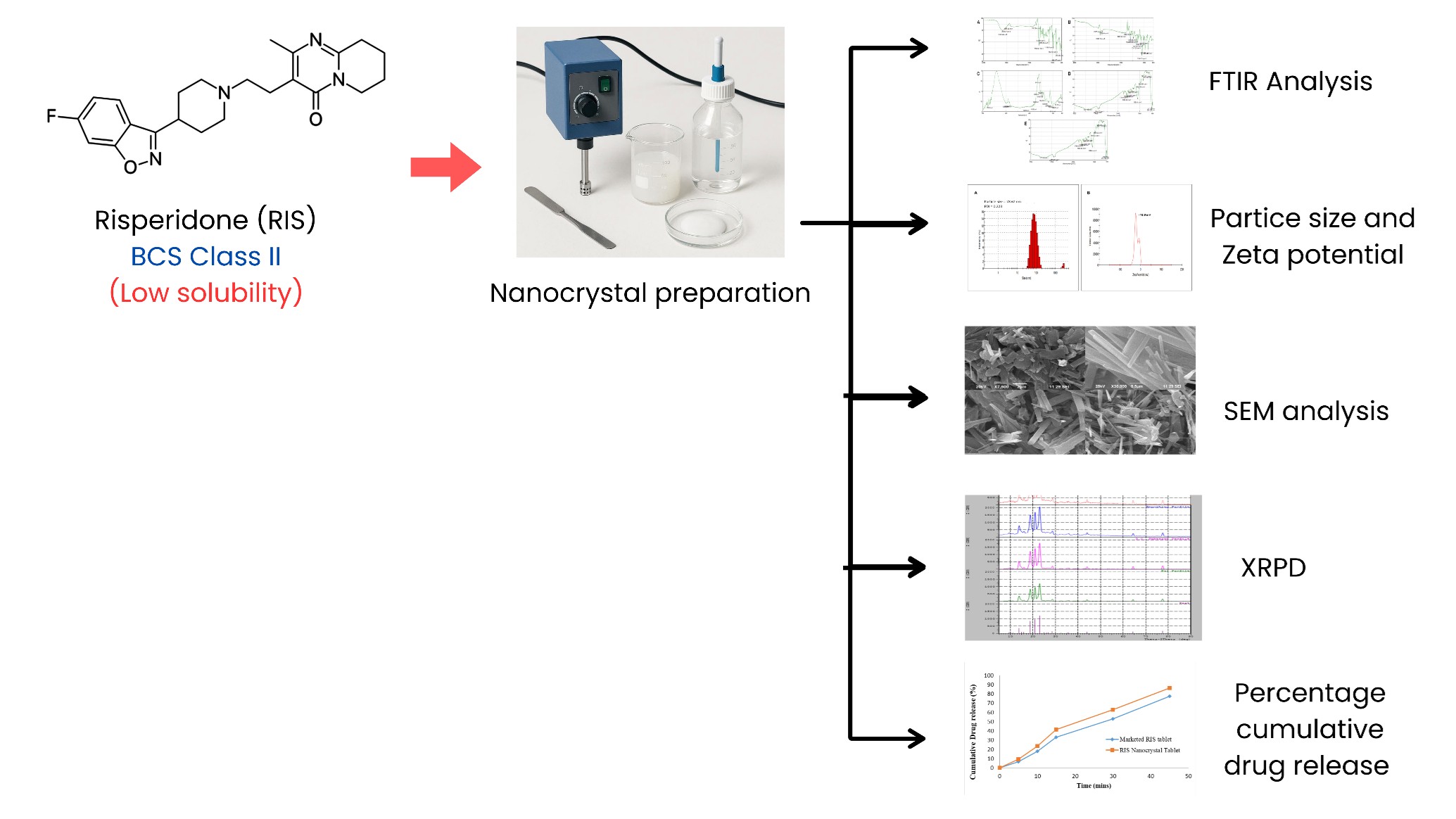
Background: Risperidone (RIS) is categorized as a BCS Class II antipsychotic and exhibits poor water solubility and a slow dissolution rate, which restricts its therapeutic effectiveness. The present study aims to formulate RIS nanocrystals to overcome pharmaceutical challenges and improve their solubility. Methodology: Nanosuspensions of RIS were prepared using high-speed homogenization, with different polymer ratios. The physicochemical properties were characterized using FTIR, SEM, particle size analysis, zeta potential measurement, X-ray powder diffraction, entrapment efficiency evaluation, drug content analysis, and in vitro release testing. Direct compression was used to manufacture tablets from the optimized nanocrystals, and their dissolution performance was assessed against conventional RIS tablets. Results and Discussion: The formulation F7, containing 0.1% Poloxamer 188 and prepared at 25,000 rpm, exhibited the optimal particle size (78.62 nm), PDI (0.223), and zeta potential (-18.9 mV), and the SEM images revealed needle-shaped crystals. Entrapment efficiency was 86.22±1.61% with a drug content of 67.885±2.02%. The F7 nanosuspension released 90.23±1.91% of the drug in phosphate buffer (pH 6.8) within 60 minutes. Reducing the size of nanoscale particles enhanced their surface area, hence increasing their solubility. The F7 nanocrystal tablets released 86.28±1.83% of the drug, whereas the conventional tablets released 77.51±2.15%. This data demonstrates that this method is more effective. Conclusion: RIS nanocrystals were developed to enhance solubility and accelerate dissolution rates. The F7 formulation exhibited enhanced stability and improved release, suggesting its potential to optimize oral medication delivery.
Downloads

References
Mahesha BS, Sheeba FR, Deepak HK. A comprehensive review of green approaches to drug solubility enhancement. Drug Dev. Ind. Pharm., 27, 1–1 (2025) https://doi.org/10.1080/03639045.2025.2496940.
Qelliny MR, Mustafa WW, Fatease AA, Alamri AH, Alany R, Abdelkader H. Biofunctional excipients: their emerging role in overcoming the inherent poor biopharmaceutical characteristics of drugs. Pharmaceutics, 17, 598 (2025) https://doi.org/10.3390/pharmaceutics17050598.
Priani SE, Chaerunisaa AY, Wilar G, Sopyan I. Formulation strategies for ezetimibe and its combinations: advancing biopharmaceutical and therapeutic potential. Drug Des. Dev. Ther., 2025, 8555–80. https://doi.org/10.2147/DDDT.S550340.
Cekić ND, Savić SM, Ilić TM, Savić SD. The reverse dialysis bag method for the assessment of in vitro drug release from parenteral nanoemulsions: A case study of risperidone. Adv. Technol., 9, 5–12 (2020). https://doi.org/10.5937/savteh2001005C.
Alqahtani SH, Aodah AH, Alshawakir YA, Alshehri BY, Alamer AA, Alfassam HA, Almughem FA, Alshehri AA, Tawfik EA. The development of risperidone-loaded microfibers via centrifugal spinning to enhance the palatability of a potential drug for autistic children. Pharmaceutics, 17, 1403 (2025). https://doi.org/10.3390/pharmaceutics17111403.
Tan T, Celebioglu A, Aboelkheir M, Uyar T. Risperidone/cyclodextrin inclusion complex electrospun nanofibers for fast-disintegrating antipsychotic drug delivery. J. Drug Deliv. Sci. Technol., 97, 105753 (2024) https://doi.org/10.1016/j.jddst.2024.105753.
Rathi R, Mehetre NM, Goyal S, Singh I, Huanbutta K, Sangnim T. Advanced drug delivery technologies for enhancing bioavailability and efficacy of risperidone. Int. J. Nanomedicine, 2024, 12871–87 https://doi.org/10.2147/IJN.S492684.
Bhatia M, Devi S. Co-crystallization: A green approach for the solubility enhancement of poorly soluble drugs. CrystEngComm, 26, 293–311 (2024) https://doi.org/10.1039/d3ce01047c.
Zingale E, Bonaccorso A, Carbone C, Musumeci T, Pignatello R. Drug nanocrystals: Focus on brain delivery from therapeutic to diagnostic applications. Pharmaceutics, 14, 691 (2022). https://doi.org/10.3390/pharmaceutics14040691.
Dumda AK, Tidke VN, Rawat S, Tigote RM. Cutting-edge approaches for addressing solubility challenges in BCS Class II and IV pharmaceuticals. Pexacy Int. J. Pharm. Sci., 2, 262–70 (2023). 10.5281/zenodo.14743590. https://doi.org/10.1016/j.seppur.2025.135225.
Wu K, Kwon SH, Zhou X, Fuller C, Wang X, Vadgama J, Wu Y. Overcoming challenges in small-molecule drug bioavailability: A review of key factors and approaches. Int. J. Mol. Sci., 25, 13121 (2024) https://doi.org/10.3390/ijms252313121.
Georgakopoulou VE, Papalexis P, Trakas N. Nanotechnology-based approaches for targeted drug delivery for the treatment of respiratory tract infections. J. Biol. Methods, 11, e99010032 (2024) https://doi.org/10.14440/jbm.2024.0065.
Liu Y, Liang Y, Yuhong J, Xin P, Han JL, Du Y, Yu X, Zhu R, Zhang M, Chen W, Ma Y. Advances in nanotechnology for enhancing the solubility and bioavailability of poorly soluble drugs. Drug Des. Dev. Ther., 31, 1469–95 (2024) https://doi.org/10.2147/dddt.s447496.
Lhaglham P, Jiramonai L, Jia Y, Huang B, Huang Y, Gao X, Zhang J, Liang XJ, Zhu M. Drug nanocrystals: Surface engineering and its applications in targeted delivery. iScience, 27, 111185 (2024) https://doi.org/10.1016/j.isci.2024.111185.
Xue F, Yang L, Ma S, Chang JH, Liu P, Liu XG, Wang RX. Preparation and evaluation of tetrandrine nanocrystals to improve bioavailability. Curr. Drug Deliv., 22, 648–57 (2025). https://doi.org/10.2174/0115672018341709241121092617.
Ding Y, Zhao T, Fang J, Song J, Dong H, Liu J, Wang Z, Sun J, He Z. Recent developments in the use of nanocrystals to improve bioavailability of APIs. Wiley Interdiscip. Rev. Nanomed. Nanobiotechnol., 16, e1958 (2024) https://doi.org/10.1002/wnan.1958.
Li J, Wang Z, Zhang H, Gao J, Zheng A. Progress in the development of stabilization strategies for nanocrystal preparations. Drug Deliv., 28, 19–36 (2021) https://doi.org/10.1080/10717544.2020.1856224.
Nguyen VT, Pham LH, Nguyen NT, Hoang D. Polyvinyl alcohol-based nanocomposite film reinforced with green nanocellulose and silver nanoparticles: Structure, properties, and potential applications in food preservation. Int. J. Biol. Macromol., 5, 144988 (2025) https://doi.org/10.1016/j.ijbiomac.2025.144988.
Yanamadala Y, Muthumula CM, Khare S, Gokulan K. Strategies to enhance nanocrystal formulations for overcoming physiological barriers across diverse routes of administration. Int. J. Nanomedicine, 2025, 367–402 https://doi.org/10.2147/ijn.s494224.
Shah N, Patel D, Gohil D, Seth AK, Parikh D. Enhancement in dissolution profile of cilnidipine by nanonization technique: Optimization by Box–Behnken design. Res. J. Pharm. Technol., 17, 1832–8 (2024) https://doi.org/10.52711/0974-360x.2024.00291.
Jacob S, Kather FS, Boddu SH, Attimarad M, Nair AB. Nanosuspension innovations: Expanding horizons in drug delivery techniques. Pharmaceutics, 17, 136 (2025) https://doi.org/10.3390/pharmaceutics17010136.
Shen G, Qiu X, Hou X, Li M, Zhou M, Liu X, Chen A, Zhang Z. Development of Zanthoxylum bungeanum essential oil Pickering emulsions using potato protein–chitosan nanoparticles and its application in mandarin preservation. Int. J. Biol. Macromol., 277, 134100 (2024) https://doi.org/10.1016/j.ijbiomac.2024.134100.
Anwer MK, Mirza MA, Aleemuddin M, Alshdefat R. Enhanced cytotoxicity of osimertinib nanocrystals against lung cancer: Preparation, characterization, and cytotoxicity studies against A549 cell lines. J. Drug Deliv. Sci. Technol., 107, 106805 (2025) https://doi.org/10.1016/j.jddst.2025.106805.
Subbiah D, Mani N, Arunagiri A, Kupusamy P. Tailoring mechanical properties of fiber metal laminates with BaSO₄ nanoparticle-infused epoxy systems. Matéria (Rio de Janeiro), 29, e20240614 (2024) https://doi.org/10.1590/1517-7076-rmat-2024-0614.
Hao C, Fan C, Gao L, Yin M, Jiang X, Wang C, Sun R, Guan Z, Gao Y, Wang F, Zhang N, Du G, Li M. Sustained dissolution and pharmacokinetics of risperidone microsuspensions via cocrystallization with kaempferol. J. Mol. Struct., 12, 143303 (2025) https://doi.org/10.1016/j.molstruc.2025.143303.
Anjomshoa M, Amirheidari B, Kordjamshidi A, Farsinejad A. Development and evaluation of a Cu(II) complex as nanosuspension for enhanced antitumor efficacy against glioblastoma cancer. Sci. Rep., 15, 27304 (2025) https://doi.org/10.1038/s41598-025-13081-5.
Ganguly D, Choudhury A, Majumdar S. Development of Satranidazole HCl-loaded oral nanoparticulate formulation for colon targeting and colon cancer therapy associated with inflammatory bowel disease. Curr. Pharm. Des. (2025) https://doi.org/10.2174/0113816128368738250414070421.
Alhamhoom Y, Kumaraswamy T, Kumar A, Nanjappa SH, Prakash SS, Rahamathulla M, Osmani RAM, Hani U, Ghazwani M, Begum MY, Ather H, Wahab S. Formulation and evaluation of pH-modulated amorphous solid dispersion-based orodispersible tablets of cefdinir. Pharmaceutics, 16, 866 (2024) https://doi.org/10.3390/pharmaceutics16070866.
Ashokbhai MK, Sanjay LR, Sah SK, Kaity S. Drug dissolution studies of pharmaceutical formulations. In: Physico-Chemical Aspects of Dosage Forms and Biopharmaceutics. (Academic Press ed.), Academic Press, pp. 61–84 (2024) https://doi.org/10.1016/b978-0-323-91818-3.00008-6.
Ran Q, Wang M, Kuang W, Ouyang J, Han D, Gao Z, Gong J. Advances of combinative nanocrystal preparation technology for improving the insoluble drug solubility and bioavailability. Crystals, 12, 1200 (2022). https://doi.org/10.3390/cryst12091200.
Koca M, Özakar RS, Ozakar E, Sade R, Pirimoğlu B, Özek NŞ, Aysin F. Preparation and characterization of nanosuspensions of a triiodoaniline derivative contrast agent and investigation into its cytotoxicity and contrast properties. Iran. J. Pharm. Res., 21, e123824 (2022) https://doi.org/10.5812/ijpr.123824.
Kumar R, Thakur AK, Chaudhari P, Banerjee N. Particle size reduction techniques of pharmaceutical compounds for enhancement of dissolution rate and bioavailability. J. Pharm. Innov., 17, 333–52 (2022) https://doi.org/10.1007/s12247-020-09530-5.
Published
How to Cite
Issue
Section
Copyright (c) 2026 M. Subramani, R. Arulkumar, P. Manikandan, P. K. Varshini, S. Mounisha

This work is licensed under a Creative Commons Attribution-NonCommercial 4.0 International License.