Acute toxicity evaluation and antidyslipidemic potential of Retama sphaerocarpa aerial parts in Triton WR-1339 induced hyperlipidemic rats
DOI:
https://doi.org/10.69857/joapr.v14i3.1685Keywords:
Retama sphaerocarpa, Triton WR-1339, dyslipidemia, Acute toxicity studyAbstract
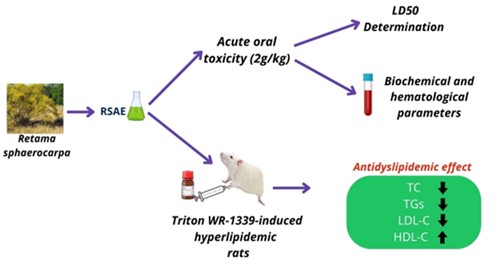
Background: Dyslipidemia constitutes a major risk factor for cardiovascular diseases. Although conventional lipid-lowering therapies are effective, their prolonged use is associated with adverse effects, highlighting the need for safer natural alternatives. Species of the genus Retama, including Retama sphaerocarpa, have been reported to possess various pharmacological properties, including antioxidant, hepatoprotective, anti-inflammatory, and hypoglycemic activities. However, no study to date has evaluated the antidyslipidemic potential of R. sphaerocarpa. This study was conducted to evaluate both the acute oral toxicity and the antidyslipidemic effect of the Retama sphaerocarpa aqueous extract (RSAE) in a Triton WR-1339-induced hyperlipidemic rat model. Methodology: The acute toxicity study of RSAE was conducted in accordance with OECD Guideline 423. RSAE was administered orally as a single dose of 2000 mg/kg, and the rats were monitored for any signs of toxicity or mortality. Hematological and biochemical parameters were assessed 24h post-administration of RSAE. The antidyslipidemic effect of RSAE (400 mg/kg) was studied in Triton WR-1339-induced dyslipidemia in Wistar albino rats. Results and discussion: Results showed no mortality or clinical signs of toxicity following RSAE administration; hematological and biochemical parameters remained unaltered after 24 hours post-treatment. The RSAE demonstrated antioxidant activity (IC₅₀ = 241.45 μg/mL). For the lipid-lowering assessment, RSAE pretreatment significantly reduced plasma TC levels by 51.1% (p<0.01), TGs by 60.2% (p<0.01), and LDL-c by 73.5% (p<0.01), while increasing HDL-c levels (p<0.01). Conclusion: Results from the present study highlight the potential of Retama sphaerocarpa in the prevention and management of dyslipidemia.
Downloads

References
Mehraban MSA, Tabatabaei-Malazy O, Rahimi R, Daniali M, Khashayar P, Larijani B. Targeting dyslipidemia by herbal medicines: a systematic review of meta-analyses. J Ethnopharmacol, 280, 114407 (2021) https://doi.org/10.1016/j.jep.2021.114407
Brunham LR, Lonn E, Mehta SR. Dyslipidemia and the current state of cardiovascular disease: epidemiology, risk factors, and effect of lipid lowering. Can J Cardiol, 40, S4–S12 (2024) https://doi.org/10.1016/j.cjca.2024.04.017
Yang L, Wu H, Jin X, Zheng P, Hu S, Xu X, et al. Study of cardiovascular disease prediction model based on random forest in eastern China. Sci Rep, 10, 5245 (2020) https://doi.org/10.1038/s41598-020-62133-5
Sunil C, Ignacimuthu S, Kumarappan C. Hypolipidemic activity of Symplocos cochinchinensis S. Moore leaves in hyperlipidemic rats. J Nat Med, 66, 32–38 (2012) https://doi.org/10.1007/s11418-011-0548-4
Mahamuni SP, Khose RD, Menaa F, Badole SL. Therapeutic approaches to drug targets in hyperlipidemia. BioMedicine, 2, 137–146 (2012) https://doi.org/10.1016/j.biomed.2012.08.002
Irudayaraj SS, Sunil C, Duraipandiyan V, Ignacimuthu S. In vitro antioxidant and antihyperlipidemic activities of Toddalia asiatica (L.) Lam. leaves in Triton WR-1339 and high fat diet induced hyperlipidemic rats. Food Chem Toxicol, 60, 135–140 (2013) https://doi.org/10.1016/j.fct.2013.07.035
Guerrouj K, Ruíz-Díez B, Chahboune R, Ramírez-Bahena MH, Abdelmoumen H, Quiñones MA, et al. Definition of a novel symbiovar (sv. retamae) within Bradyrhizobium retamae sp. nov., nodulating Retama sphaerocarpa and Retama monosperma. Syst Appl Microbiol, 36, 218–223 (2013) https://doi.org/10.1016/j.syapm.2013.03.001
Chakraborty A, Giri S, Shah AD, Adhikari T. Phytochemistry and pharmacological potential of Alocasia macrorrhiza: a comprehensive review. J Appl Pharm Res, 12(6), 73–87 (2024) https://doi.org/10.69857/joapr.v12i6.742
Tahraoui A, El-Hilaly J, Israili ZH, Lyoussi B. Ethnopharmacological survey of plants used in the traditional treatment of hypertension and diabetes in south-eastern Morocco (Errachidia province). J Ethnopharmacol, 110, 105–117 (2007) https://doi.org/10.1016/j.jep.2006.09.011
López-Lázaro M, Martín-Cordero C, Ayuso MJ. Flavonoids of Retama sphaerocarpa. Planta Med, 65, 777–778 (1999) https://doi.org/10.1055/s-2006-960869
Louaar S, Akkal S, Laouer H, Guilet D. Flavonoids of Retama sphaerocarpa leaves and their antimicrobial activities. Chem Nat Compd, 43, 616–617 (2007) https://doi.org/10.1007/s10600-007-0207-x
Hebi M, Farid O, Ajebli M, Eddouks M. Potent antihyperglycemic and hypoglycemic effect of Tamarix articulata Vahl. in normal and streptozotocin-induced diabetic rats. Biomed Pharmacother, 87, 230–239 (2017) https://doi.org/10.1016/j.biopha.2016.12.111
Bouhlali EDT, Alem C, Zegzouti YF. Antioxidant and anti-hemolytic activities of phenolic constituents of six Moroccan date fruit (Phoenix dactylifera L.) syrups. Biotechnol Indian J, 12, 45–52 (2016) https://doi.org/10.17957/JGIASS/3.2-3.709
Kim DO, Chun OK, Kim YJ, Moon HY, Lee CY. Quantification of polyphenolics and their antioxidant capacity in fresh plums. J Agric Food Chem, 51, 6509–6515 (2003) https://doi.org/10.1021/jf0343074
Broadhurst RB, Jones WT. Analysis of condensed tannins using acidified vanillin. J Sci Food Agric, 29, 788–794 (1978) https://doi.org/10.1002/jsfa.2740290908
Louli V, Ragoussis N, Magoulas K. Recovery of phenolic antioxidants from wine industry by-products. Bioresour Technol, 92, 201–208 (2004) https://doi.org/10.1016/j.biortech.2003.06.002
Organization for Economic Cooperation and Development (OECD). OECD guideline 423: oral toxicity study in rodents. OECD Guidelines for the Testing of Chemicals, 423, 18 p (2001) https://doi.org/10.1787/9789264071001-en
Qabouche A, Amssayef A, Bouadid I, Lahrach N, El-Haidani A, Eddouks M. Antidiabetic and antidyslipidemic effects of Artemisia mesatlantica, an endemic plant from Morocco. Cardiovasc Hematol Disord Drug Targets, 23, 50–63 (2023) https://doi.org/10.2174/1871529x23666230803113616
Schurr PE, Schultz JR, Parkinson AT. Triton-induced hyperlipidemia in rats as an animal model for screening hypolipidemic drugs. Lipids, 7, 68–74 (1972) https://doi.org/10.1007/bf02531272
Zeniya M, Reuben A. Triton WR-1339-induced changes in serum lipids and biliary lipid secretion. Am J Physiol Gastrointest Liver Physiol, 254, G346–G354 (1988) https://doi.org/10.1152/ajpgi.1988.254.3.G346
Levine S, Saltzman A. A procedure for inducing sustained hyperlipemia in rats by administration of a surfactant. J Pharmacol Toxicol Methods, 55, 224–226 (2007) https://doi.org/10.1016/j.vascn.2006.05.009
Huang CL, Sumpio BE. Olive oil, the Mediterranean diet, and cardiovascular health. J Am Coll Surg, 207, 407–416 (2008) https://doi.org/10.1016/j.jamcollsurg.2008.02.018
Brown MS, Goldstein JL. A receptor-mediated pathway for cholesterol homeostasis. Science, 232, 34–47 (1986) https://doi.org/10.1126/science.3513311
Zarzecki MS, Araujo SM, Bortolotto VC, de Paula MT, Jesse CR, Prigol M. Hypolipidemic action of chrysin on Triton WR-1339-induced hyperlipidemia in female C57BL/6 mice. Toxicol Rep, 1, 200–208 (2014) https://doi.org/10.1016/j.toxrep.2014.02.003
Rader DJ, Hovingh GK. HDL and cardiovascular disease. Lancet, 384, 618–625 (2014) https://doi.org/10.1016/S0140-6736(14)61217-4
Kosmas CE, Martinez I, Sourlas A, Bouza KV, Campos FN, Torres V, et al. High-density lipoprotein (HDL) functionality and its relevance to atherosclerotic cardiovascular disease. Drugs Context, 7, 212525 (2018) https://doi.org/10.7573/dic.212525
Krauss RM. Atherogenicity of triglyceride-rich lipoproteins. Am J Cardiol, 81, 13B–17B (1998) https://doi.org/10.1016/S0002-9149(98)00032-0
Jawed A, Singh G, Kohli S, Sumera A, Haque S, Prasad R, et al. Therapeutic role of lipases and lipase inhibitors derived from natural resources for remedies against metabolic disorders and lifestyle diseases. S Afr J Bot, 120, 25–32 (2019) https://doi.org/10.1016/j.sajb.2018.04.004
Goldberg IJ, Eckel RH, Abumrad NA. Regulation of fatty acid uptake into tissues: lipoprotein lipase- and CD36-mediated pathways. J Lipid Res, 50, S86–S90 (2009) https://doi.org/10.1194/jlr.R800085-JLR200
López-Lázaro M, Martín-Cordero C, Ayuso MJ. Flavonoids of Retama sphaerocarpa. Planta Med, 65, 777–778 (1999) https://doi.org/10.1055/s-2006-960869
Rizzo M, Kotur-Stevuljevic J, Berneis K, Spinas G, Rini GB, Jelic-Ivanovic Z, et al. Atherogenic dyslipidemia and oxidative stress: a new look. Transl Res, 153, 217–223 (2009) https://doi.org/10.1016/j.trsl.2009.01.008
Ji X, Shi S, Liu B, Shan M, Tang D, Zhang W, et al. Bioactive compounds from herbal medicines to manage dyslipidemia. Biomed Pharmacother, 118, 109338 (2019) https://doi.org/10.1016/j.biopha.2019.109338
Upadhyay RK. Antihyperlipidemic and cardioprotective effects of plant natural products: a review. Int J Green Pharm, 15 (2021) https://doi.org/10.22377/ijgp.v15i1.3011
Bjune K, Halvorsen PS, Wangensteen H, Leren TP, Bogsrud MP, Strøm TB. Flavonoids regulate LDLR through different mechanisms tied to their specific structures. J Lipid Res, 65, 100539 (2024) https://doi.org/10.1016/j.jlr.2024.100539
Sun P, Zhao L, Zhang N, Zhou J, Zhang L, Wu W. Bioactivity of dietary polyphenols: the role in LDL-C lowering. Foods, 10, 2666 (2021) https://doi.org/10.3390/foods10112666
Yugarani T, Tan BK, Teh M, Das NP. Effects of polyphenolic natural products on the lipid profiles of rats fed high fat diets. Lipids, 27, 181–186 (1992) https://doi.org/10.1007/BF02536175
Islam B, Sharma C, Adem A, Aburawi E, Ojha S. Insight into the mechanism of polyphenols on the activity of HMGR by molecular docking. Drug Des Devel Ther, 9, 4943–4951 (2015) https://doi.org/10.2147/DDDT.S86705
Chaachouay N, Douira A, Zidane L. Herbal medicine used in the treatment of human diseases in the Rif, Northern Morocco. Arab J Sci Eng, 47, 131–153 (2022) https://doi.org/10.1007/s13369-021-05501-1
Aamir K, Khan HU, Hossain CF, Afrin MR, Shaik I, Salleh N, et al. Oral toxicity of arjunolic acid on hematological, biochemical and histopathological investigations in female Sprague Dawley rats. PeerJ, 7, e8045 (2019) https://doi.org/10.7717/peerj.8045
Nfozon JN, Tume C, Kdjo N, Boyom FF, Leonard SF, Dzoyem JP, et al. Acute and sub-chronic toxicity evaluation of Triplotaxis stellulifera (Benth.) Hutch and Crassocephalum bougheyanum C.D. Adams methanol extract on mice. Biochem Anal Biochem, 8, 1–10 (2019) https://doi.org/10.35248/2161-1009.19.8.385
Belmimoun A, Belkhodja H, Side Larbi K, Said O, Sellam K, Mezoudj H, Meddah B. Acute and subacute toxicological evaluation and phytochemical analysis of aqueous extract of apricot (Prunus armeniaca) kernels in rats. J Appl Vet Sci, 11, 60–72 (2026) https://doi.org/10.21608/javs.2026.465813.1896
Moujane S, Bouadid I, Bouymajane A, Younes FZ, Benlyas M, Bouachrine M, et al. Assessment of hematological and biochemical effects of acute and subacute toxicity of the aqueous extract from Retama sphaerocarpa leaves in Wistar rats, and in silico investigation of phenolic compounds as potential inhibitors against HPV16 E6 oncoprotein. SSRN (2023) https://doi.org/10.2139/ssrn.4507917
Ibrahim MB, Sowemimo AA, Sofidiya MO, Badmos KB, Fageyinbo MS, Abdulkareem FB, et al. Sub-acute and chronic toxicity profiles of Markhamia tomentosa ethanolic leaf extract in rats. J Ethnopharmacol, 193, 68–75 (2016) https://doi.org/10.1016/j.jep.2016.07.036
Olson H, Betton G, Robinson D, Thomas K, Monro A, Kolaja G, et al. Concordance of the toxicity of pharmaceuticals in humans and in animals. Regul Toxicol Pharmacol, 32, 56–67 (2000) https://doi.org/10.1006/rtph.2000.1399
Olusola L, Matthew O, Oluwatosin A. Comparative study on the effects of aqueous extracts of Viscum album (mistletoe) from three host plants on hematological parameters in albino rats. Afr Health Sci, 15, 606–612 (2015) https://doi.org/10.4314/ahs.v15i2.38
Published
How to Cite
Issue
Section
Copyright (c) 2026 Adil Qabouche, Ismail Bouadid, Ayoub Amssayefa, Ahmed El-Haidani, Mohamed Eddouks

This work is licensed under a Creative Commons Attribution-NonCommercial 4.0 International License.