Vanillin as a cardioprotective agent against anthracycline-induced cardiotoxicity in Wistar rats via modulation of oxidative stress and molecular docking analysis
DOI:
https://doi.org/10.69857/joapr.v14i3.1670Keywords:
Anthracycline cardiotoxicity, molecular docking, oxidative stress, vanillinAbstract
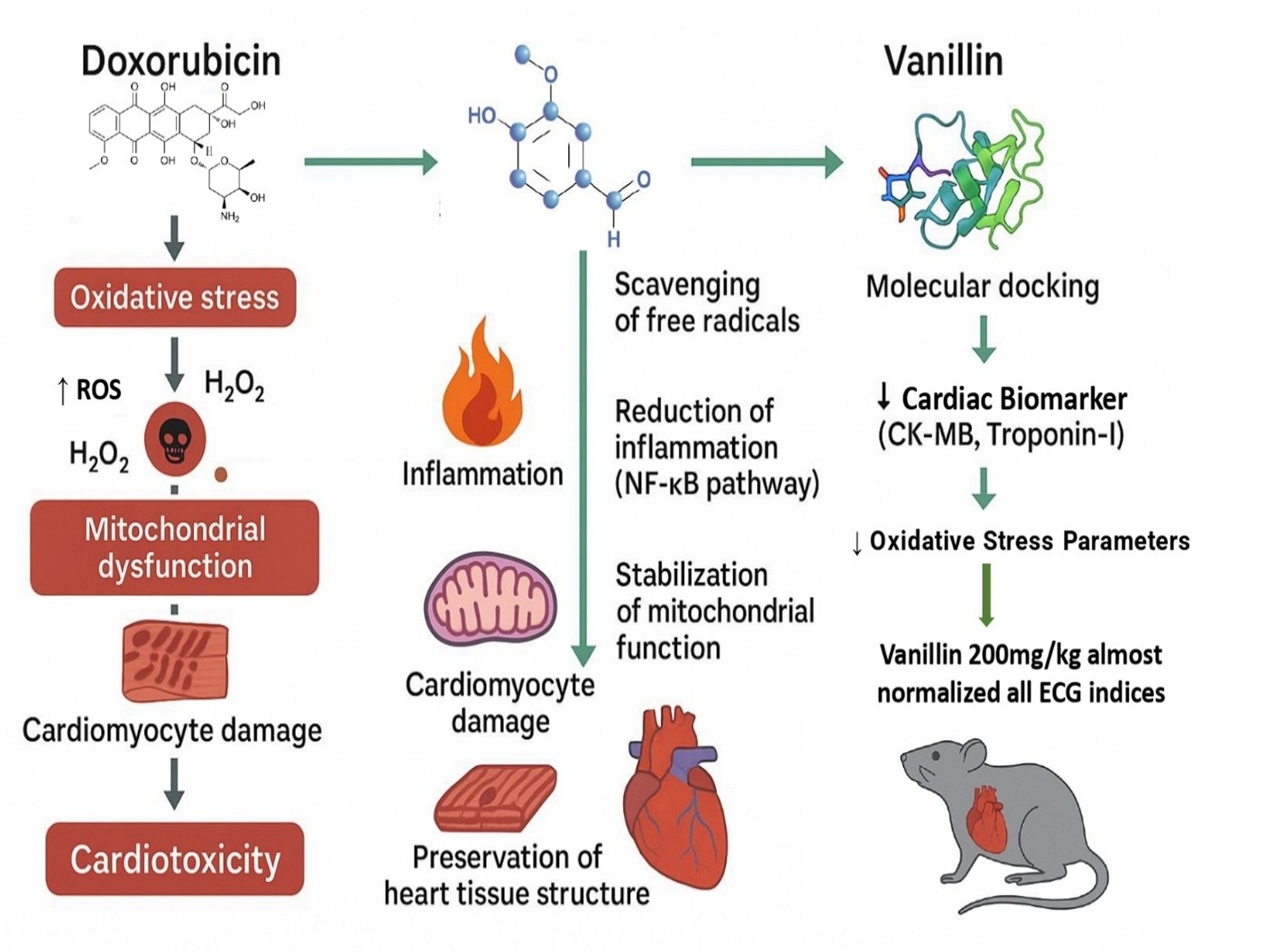
Background: Doxorubicin (DOX) is limited by dose-dependent cardiotoxicity mediated by reactive oxygen species (ROS) and oxidative stress. Natural phenolic compounds, such as vanillin, with antioxidant properties, are being explored as cardioprotective agents. This study evaluated vanillin using integrated in silico and in vivo approaches. Methodology: Molecular docking assessed vanillin–cardiac protein interactions, and ADMET profiling evaluated drug-likeness. In vivo, DOX-induced cardiomyopathy was established in male Wistar rats (n=6) via cumulative intraperitoneal dosing (16 mg/kg). Vanillin (50, 100, and 200 mg/kg) was administered orally 30 minutes post-DOX for 28 days. ECG parameters, cardiac biomarkers (CK-MB, AST, LDH, cTn-I), oxidative stress markers (MDA, SOD, GSH, catalase), and histopathology were analyzed. Results & Discussion: In silico analysis revealed that vanillin binds to the CK-MB active site, demonstrating a docking interaction comparable to that of doxorubicin. In vivo, Doxorubicin treatment caused significant cardiac dysfunction, characterized by QTc prolongation and ST-segment depression. Serum biomarkers of myocardial injury (CK-MB, Troponin-I, LDH, AST) were significantly elevated, while myocardial antioxidant levels (SOD, GSH, CAT) were depleted in the DOX group. Vanillin co-administration (200 mg/kg) significantly attenuated these alterations, restoring QTc intervals and reducing oxidative stress markers. Histopathological scoring confirmed improving myocardial architecture from severe damage in the DOX group to near-normal morphology in the high-dose Vanillin group. Conclusion: Vanillin exerts cardioprotective effects via antioxidant mechanisms, stabilization of cardiac biomarkers, and maintenance of myocardial integrity, indicating its promise as an adjunct strategy against anthracycline-induced cardiotoxicity.
Downloads

References
Xi Y, Xu P. Global colorectal cancer burden in 2020 and projections to 2040. Transl Oncol, 14, 101174 (2021) https://doi.org/10.1016/j.tranon.2021.101174
Ding W, Li Z, Wang C, Dai J, Ruan G, Tu C. Anthracycline versus nonanthracycline adjuvant therapy for early breast cancer: A systematic review and meta-analysis. Medicine (Baltimore), 97, e12908 (2018) https://doi.org/10.1097/MD.0000000000012908
Simůnek T, Stérba M, Popelová O, Adamcová M, Hrdina R, Gersl V. Anthracycline-induced cardiotoxicity: overview of studies examining the roles of oxidative stress and free cellular iron. Pharmacol Rep, 61, 154–171 (2009) https://doi.org/10.1016/S1734-1140(09)70018-0
Arcamone F. Adriamycin and its analogs. Tumori, 70, 113–119 (1984) https://doi.org/10.1177/030089168407000201
Fisher RS, Kenney AE, Fults MZ, Manring S, Rodriguez EM, Desjardins L, Rausch JR, Young-Saleme T, Ranalli MA, Vannatta K, Compas BE, Gerhardt CA. Longitudinal understanding of prognosis among adolescents with cancer. Pediatr Blood Cancer, 68, e28826 (2021) https://doi.org/10.1002/pbc.28826
Sayed A, Abdelfattah OM, Munir M, Shazly O, Awad AK, Ghaith HS, Moustafa K, Gerew M, Guha A, Barac A, Fradley MG, Abela GS, Addison D. Long-term effectiveness of empiric cardio-protection in patients receiving cardiotoxic chemotherapies: A systematic review and Bayesian network meta-analysis. Eur J Cancer, 169, 82–92 (2022) https://doi.org/10.1016/j.ejca.2022.03.024
Chow EJ, Aggarwal S, Doody DR, Aplenc R, Armenian SH, Baker KS, Bhatia S, Blythe N, Colan SD, Constine LS, Freyer DR, Kopp LM, Laverdière C, Leisenring WM, Sasaki N, Vrooman LM, Asselin BL, Schwartz CL, Lipshultz SE. Dexrazoxane and long-term heart function in survivors of childhood cancer. J Clin Oncol, 41, 2248–2257 (2023) https://doi.org/10.1200/JCO.22.02423
Upshaw JN, Parson SK, Buchsbaum RJ, Schlam I, Ruddy KJ, Durani U, Epperla N, Leong DP. Dexrazoxane to prevent cardiotoxicity in adults treated with anthracyclines. JACC CardioOncol, 6, 322–324 (2024) https://doi.org/10.1016/j.jaccao.2024.02.004
Brogi S. Computational approaches for drug discovery. Molecules, 24, 3061 (2019) https://doi.org/10.3390/molecules24173061
Baniahmad B, Safaeian L, Vaseghi G, Rabbani M, Mohammadi B. Cardioprotective effect of vanillic acid against doxorubicin-induced cardiotoxicity in rats. Res Pharm Sci, 15, 87–96 (2020) https://doi.org/10.4103/1735-5362.278718
Sang L, Zhou Z, Luo S, Zhang Y, Qian H, Zhou Y, He H, Hao K. An in silico platform to predict cardiotoxicity risk of anti-tumor drug combination with hiPSC-CMs based in vitro study. Pharm Res, 41, 247–262 (2024) https://doi.org/10.1007/s11095-023-03644-4
Olatunde A, Mohammed A, Ibrahim MA, Tajuddeen N, Shuaibu MN. Vanillin: A food additive with multiple biological activities. Eur J Med Chem Rep, 5, 100055 (2022) https://doi.org/10.1016/j.ejmcr.2022.100055
Tai A, Sawano T, Yazama F, Ito H. Evaluation of antioxidant activity of vanillin by using multiple antioxidant assays. Biochim Biophys Acta Gen Subj, 1810, 170–177 (2011) https://doi.org/10.1016/j.bbagen.2010.11.004
Arya SS, Rookes JE, Cahill DM, Lenka SK. Vanillin: a review on the therapeutic prospects of a popular flavouring molecule. Adv Tradit Med, 21, 1–17 (2021) https://doi.org/10.1007/s13596-020-00531-w
Iannuzzi C, Liccardo M, Sirangelo I. Overview of the role of vanillin in neurodegenerative diseases and neuropathophysiological conditions. Int J Mol Sci, 24, 1817 (2023) https://doi.org/10.3390/ijms24031817
Kumar SS, Priyadarsini KI, Sainis KB. Inhibition of peroxynitrite-mediated reactions by vanillin. J Agric Food Chem, 52, 139–145 (2004) https://doi.org/10.1021/jf030319d
Dhanalakshmi C, Manivasagam T, Nataraj J, Justin Thenmozhi A, Essa MM. Neurosupportive role of vanillin, a natural phenolic compound, on rotenone induced neurotoxicity in SH-SY5Y neuroblastoma cells. Evid Based Complement Alternat Med, 2015, 626028 (2015) https://doi.org/10.1155/2015/626028
Radmanesh E, Dianat M, Badavi M, Goudarzi G, Mard SA. The cardioprotective effect of vanillic acid on hemodynamic parameters, malondialdehyde, and infarct size in ischemia-reperfusion isolated rat heart exposed to PM10. Iran J Basic Med Sci, 20, 760–768 (2017) https://doi.org/10.22038/IJBMS.2017.9007
Lagunin A, Stepanchikova A, Filimonov D, Poroikov V. PASS: prediction of activity spectra for biologically active substances. Bioinformatics, 16, 747–748 (2000) https://doi.org/10.1093/bioinformatics/16.8.747
Hussein SA, Tolba MF, Michel HE, Albohy A, Azab SS. In silico and in vivo protective effect of biochanin-A mitigating doxorubicin-induced cognitive deficits and neuroinflammation: insights to the role of p-Tau and miR-132. NeuroToxicology, 107, 22–36 (2025) https://doi.org/10.1016/j.neuro.2025.01.003
Hasan MM, Khan Z, Chowdhury MS, Khan MA, Moni MA, Rahman MH. In silico molecular docking and ADME/T analysis of quercetin compound with its evaluation of broad-spectrum therapeutic potential against particular diseases. Inform Med Unlocked, 29, 100894 (2022) https://doi.org/10.1016/j.imu.2022.100894
Altın S, Işık M, Alp C, Dikici E, Köksal E, Kırboğa KK, Rudrapal M, Rakshit G, Beydemir Ş, Khan J. Therapeutic potential of Laurus nobilis extract by experimental and computational approaches: phenolic content and bioactivities for antioxidant, antidiabetic, and anticholinergic properties. Front Chem, 13 (2025) https://doi.org/10.3389/fchem.2025.1541250
Deka H, Choudhury A, Ganguly D, Sarmah J, Jimenez JRM. Evaluation of Allium sativum polysaccharides as an adjunct to metformin in streptozotocin induced diabetic rats. Journal of Applied Pharmaceutical Research, 13(6), 78–85 (2025) https://doi.org/10.69857/joapr.v13i6.1483
Ho K, Yazan LS, Ismail N, Ismail M. Toxicology study of vanillin on rats via oral and intra-peritoneal administration. Food Chem Toxicol, 49, 25–30 (2011) https://doi.org/10.1016/j.fct.2010.08.023
Sparrow MG, Roggendorf H, Vogel WH. Effect of ethanol on heart rate and blood pressure in nonstressed and stressed rats. Life Sci, 40, 2551–2559 (1987) https://doi.org/10.1016/0024-3205(87)90078-6
Patintingan CG, Louisa M, Juniantito V, Arozal W, Hanifah S, Wanandi SI, Thandavarayan R. Moringa oleifera leaves extract ameliorates doxorubicin-induced cardiotoxicity via its mitochondrial biogenesis modulatory activity in rats. J Exp Pharmacol, 15, 307–319 (2023) https://doi.org/10.2147/JEP.S413256
Razmaraii N, Babaei H, Mohajjel Nayebi A, Assadnassab G, Ashrafi Helan J, Azarmi Y. Cardioprotective effect of grape seed extract on chronic doxorubicin-induced cardiac toxicity in Wistar rats. Adv Pharm Bull, 6, 423–433 (2016) https://doi.org/10.15171/apb.2016.055
Sharma A, Fish BL, Moulder JE, Medhora M, Baker JE, Mader M, Cohen EP. Safety and blood sample volume and quality of a refined retro-orbital bleeding technique in rats using a lateral approach. Lab Anim, 43, 63–66 (2014) https://doi.org/10.1038/laban.432
Chen L, Wu X, Wang W, Wang X, Ma J. Quercetin with lycopene modulates enzymic antioxidant genes pathway in isoproterenol cardiotoxicity in rats. Libyan J Med, 16, 1943924 (2021) https://doi.org/10.1080/19932820.2021.1943924
Aydin S, Emre E, Ugur K, Aydin MA, Sahin İ, Cinar V, Akbulut T. An overview of ELISA: a review and update on best laboratory practices for quantifying peptides and proteins in biological fluids. J Int Med Res, 53 (2025) https://doi.org/10.1177/03000605251315913
Yang HI, Kim WS, Kim DH, Kang JS. Histopathological evaluation of heart toxicity of a novel selective PPAR-γ agonists CKD-501 in db/db mice. Biomol Ther, 21, 84–90 (2013) https://doi.org/10.4062/biomolther.2012.101
Vikhe S, Sukhadhane P, Vikhe R, Bornare SL, Dhavane SS. Antidiabetic effects of Semecarpus anacardium leaf extracts in streptozotocin-induced diabetes in rats. Journal of Applied Pharmaceutical Research, 12(6), 144–158 (2024) https://doi.org/10.69857/joapr.v12i6.736
Wang J, An W, Wang Z, Zhao Y, Han B, Tao H, Wang J, Wang X. Vanillin has potent antibacterial, antioxidant, and anti-inflammatory activities in vitro and in mouse colitis induced by multidrug-resistant Escherichia coli. Antioxidants, 13, 1544 (2024) https://doi.org/10.3390/antiox13121544
Sirangelo I, Sapio L, Ragone A, Naviglio S, Iannuzzi C, Barone D, Giordano A, Borriello M. Vanillin prevents doxorubicin-induced apoptosis and oxidative stress in rat H9c2 cardiomyocytes. Nutrients, 12, 2317 (2020) https://doi.org/10.3390/nu12082317
Perdih A. Topoisomerases as targets for novel drug discovery. Pharmaceuticals, 18, 1693 (2025) https://doi.org/10.3390/ph18111693
Published
How to Cite
Issue
Section
Copyright (c) 2026 N. G. Dighe, S. B. Dighe, S. B. Bhawar, R. D. Ghogare, V. A. Patole

This work is licensed under a Creative Commons Attribution-NonCommercial 4.0 International License.