Design, optimization and evaluation of an ion-triggered in situ nasal gel of selegiline for antidepressant therapy
DOI:
https://doi.org/10.69857/joapr.v14i4.2170Keywords:
In-situ gel, Selegiline, Nasal route, BBB, Sodium alginate, HPMCAbstract
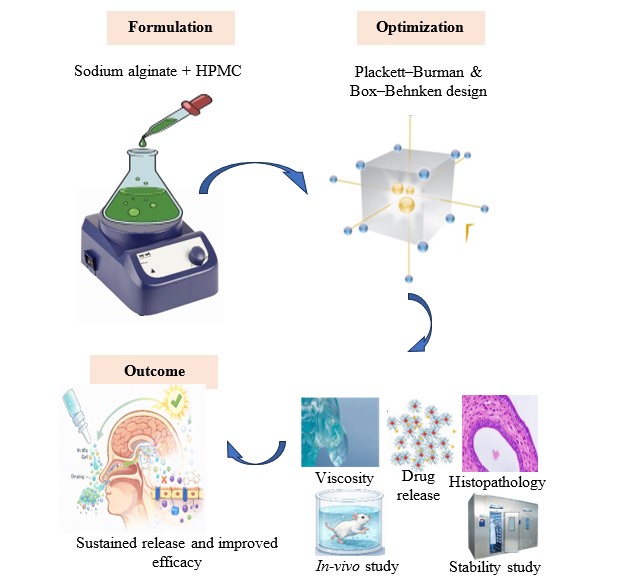
Background: Oral delivery of selegiline is limited by extensive first-pass metabolism, low and variable bioavailability, and restricted brain access due to the blood–brain barrier. Intranasal drug delivery offers a non-invasive strategy for direct nose-to-brain transport. The present study aimed to design, optimize, and evaluate an ion-triggered in situ nasal gel of selegiline using sodium alginate and HPMC to potentiate brain delivery and antidepressant efficacy. Methodology: Preliminary screening was performed using the Plackett–Burman design to identify critical formulation variables. Further optimization was carried out using the Box–Behnken design with sodium alginate (0.5–2% w/v), HPMC (0.5–1% w/v), and CaCl₂ (10–50 mM) as independent variables. The optimized formulation was evaluated for physicochemical properties, rheology, gelation time, gel strength, mucoadhesive strength, in vitro and ex vivo drug release, histopathology, in vivo antidepressant activity, and stability. Results and Discussion: The optimized formulation (1.25% sodium alginate, 0.75% HPMC, 30 mM CaCl₂) exhibited suitable sol viscosity (~150 mPa·s), rapid gelation (~34 s), adequate gel strength (~350 g), and good mucoadhesive strength (~3140 dyne/cm²). Sustained drug release (~98% in 8 h in vitro; ~94% in 6 h ex vivo) was achieved. The formulation was non-irritant to nasal mucosa, showed enhanced antidepressant activity in vivo, and remained stable for 3 months under stability studies. Conclusion: The optimized sodium alginate–HPMC ion-triggered in situ nasal gel of selegiline offers a safe, stable, and effective nose-to-brain delivery system with sustained release and improved antidepressant activity, making it a promising alternative to oral therapy.
Downloads

References
Zhang Y, Li Z, Feng Q, et al. Global, regional and national burdens of major depression disorders and its attributable risk factors in adolescents and young adults aged 10–24 years from 1990 to 2021. BMC Psychiatry, 25, 399 (2025) https://doi.org/10.1186/s12888-025-06772-w
Surya BN, Radhakrishnan A, Vijayalakshmi S, Narayanan AH, Kumar SM, Venkatesh BN, et al. Assessment of psychosocial morbidity among medical interns during COVID-19 pandemic in Chennai district, Tamil Nadu — a cross-sectional study. J Appl Pharm Res, 12(1), 108–115 (2024) https://doi.org/10.18231/j.joapr.2024.12.1.108.115
Upadhyay R, Ghosh P, Desavathu M. Advancement in the nose-to-brain drug delivery of FDA-approved drugs for the better management of depression and psychiatric disorders. Int J Pharm, 667(Pt B), 124866 (2024) https://doi.org/10.1016/j.ijpharm.2024.124866
Zhang X, Fu M, Wang Y, Wu T. Strategies for delivering drugs across the blood brain barrier for the treatment of neurodegenerative diseases. Front Drug Deliv, 5, 1644633 (2025) https://doi.org/10.3389/fddev.2025.1644633
Wu D, Chen Q, Chen X, et al. The blood–brain barrier: structure, regulation and drug delivery. Signal Transduct Target Ther, 8, 217 (2023) https://doi.org/10.1038/s41392-023-01481-w
Chen L, Guan Y, Wang S, Han X, Guo F, Wang Y. Engineered nanoplatforms for brain-targeted co-delivery of phytochemicals in Alzheimer's disease: rational design, blood-brain barrier penetration, and multi-target therapeutic synergy. Neurotherapeutics, 22(6), e00722 (2025) https://doi.org/10.1016/j.neurot.2025.e00722
Gandhi S, Shastri DH, Shah J, Nair AB, Jacob S. Nasal delivery to the brain: harnessing nanoparticles for effective drug transport. Pharmaceutics, 16(4), 481 (2024) https://doi.org/10.3390/pharmaceutics16040481
Qian L, Cook MT, Dreiss CA. In situ gels for nasal delivery: formulation, characterization and applications. Macromol Mater Eng, 310(6), 2400356 (2025) https://doi.org/10.1002/mame.202400356
Benalaya I, Alves G, Lopes J, Silva LR. A review of natural polysaccharides: sources, characteristics, properties, food, and pharmaceutical applications. Int J Mol Sci, 25(2), 1322 (2024) https://doi.org/10.3390/ijms25021322
Kothari S, Gupta A. Experimental evaluation of anxiolytic and antidepressant activities of methanolic extract of Triticum aestivum (wheatgrass) in albino mice. J Appl Pharm Res, 11(3), 41–47 (2023) https://doi.org/10.18231/j.joapr.2023.11.3.41.47
Wong WF, Ang KP, Sethi G, Looi CY. Recent advancement of medical patch for transdermal drug delivery. Medicina (Kaunas), 59(4), 778 (2023) https://doi.org/10.3390/medicina59040778
Chaerunisaa AY, Warya S, Putri LN, Haque RN. Formulation of chloramphenicol in situ ophthalmic gels using sodium alginate and HPMC. Int J Drug Deliv Technol, 6(3), 67–75 (2016) https://doi.org/10.25258/ijddt.6.3.4
Plackett RL, Burman JP. The design of optimum multifactorial experiments. Biometrika, 33(4), 305–325 (1946) https://doi.org/10.1093/biomet/33.4.305
Ghongade A, Barot S. Development and validation of stability indicating RP-HPLC method for nebivolol by using the DOE approach. J Appl Pharm Res, 13(3), 179–191 (2025) https://doi.org/10.69857/joapr.v13i3.1062
Box GEP, Behnken DW. Some new three-level designs for the study of quantitative variables. Technometrics, 2(4), 455–475 (1960) https://doi.org/10.2307/1266454
Ranch KM, Maulvi FA, Naik MJ, Koli AR, Parikh RK, Shah DO. Optimization of a novel in situ gel for sustained ocular drug delivery using Box-Behnken design: in vitro, ex vivo, in vivo and human studies. Int J Pharm, 554, 264–275 (2019) https://doi.org/10.1016/j.ijpharm.2018.11.016
Destruel PL, Zeng N, Brignole-Baudouin F, Douat S, Seguin J, Olivier E, et al. In situ gelling ophthalmic drug delivery system for the optimization of diagnostic and preoperative mydriasis: in vitro drug release, cytotoxicity and mydriasis pharmacodynamics. Pharmaceutics, 12(4), 360 (2020) https://doi.org/10.3390/pharmaceutics12040360
Khan BA, Ahmad S, Khan MK, Hosny KM, Bukhary DM, Iqbal H, et al. Fabrication and characterizations of pharmaceutical emulgel co-loaded with naproxen-eugenol for improved analgesic and anti-inflammatory effects. Gels, 8(10), 608 (2022) https://doi.org/10.3390/gels8100608
Shawky S, Makled S, Awaad A, Boraie N. Quercetin loaded cationic solid lipid nanoparticles in a mucoadhesive in situ gel: a novel intravesical therapy tackling bladder cancer. Pharmaceutics, 14(11), 2527 (2022) https://doi.org/10.3390/pharmaceutics14112527
Srivastava SK, Prasad M, Jha AK. Development and evaluation of thermo-triggered in situ nasal gel of selegiline for depressive disorders: in vitro, in vivo and ex vivo characterization. Res J Pharm Technol, 15(4), 1424–1430 (2022) https://doi.org/10.52711/0974-360X.2022.00236
Kolawole O, Lau WM, Khutoryanskiy V. Chitosan/β-glycerophosphate in situ gelling mucoadhesive systems for intravesical delivery of mitomycin-C. Int J Pharm X, 1, 100007 (2019) https://doi.org/10.1016/j.ijpx.2019.100007
Koirala S, Nepal P, Ghimire G, Basnet R, Rawat I, Dahal A, et al. Formulation and evaluation of mucoadhesive buccal tablets of aceclofenac. Heliyon, 7(3), e06439 (2021) https://doi.org/10.1016/j.heliyon.2021.e06439
Jagdale S, Shewale N, Kuchekar BS. Optimization of thermoreversible in situ nasal gel of timolol maleate. Scientifica (Cairo), 2016, 6401267 (2016) https://doi.org/10.1155/2016/6401267
Hard SAAA, Shivakumar HN, Bafail DA, Moqbel Redhwan MA. Development of in vitro and in vivo evaluation of mucoadhesive in-situ gel for intranasal delivery of vinpocetine. J Drug Target, 33(4), 528–545 (2025) https://doi.org/10.1080/1061186X.2024.2433557
Pund S, Rasve G, Borade G. Ex vivo permeation characteristics of venlafaxine through sheep nasal mucosa. Eur J Pharm Sci, 48(1–2), 195–201 (2013) https://doi.org/10.1016/j.ejps.2012.10.029
Alamri HS, Mufti R, Sabir DK, Abuderman AA, Dawood AF, ShamsEldeen AM, et al. Forced swimming-induced depressive-like behavior and anxiety are reduced by chlorpheniramine via suppression of oxidative and inflammatory mediators and activation of the Nrf2-BDNF signaling pathway. Curr Issues Mol Biol, 45, 6449–6465 (2023) https://doi.org/10.3390/cimb45080407
Chang HT, Chang ML, Chen YT, Chang ST, Hsu FL, Wu CC, et al. Evaluation of motor coordination and antidepressant activities of Cinnamomum osmophloeum ct. linalool leaf oil in rodent model. Molecules, 26(10), 3037 (2021) https://doi.org/10.3390/molecules26103037
Galgatte UC, Kumbhar AB, Chaudhari PD. Development of in situ gel for nasal delivery: design, optimization, in vitro and in vivo evaluation. Drug Deliv, 21(1), 62–73 (2014) https://doi.org/10.3109/10717544.2013.849778
Malektaj H, Drozdov AD, deClaville Christiansen J. Mechanical properties of alginate hydrogels cross-linked with multivalent cations. Polymers, 15(14), 3012 (2023) https://doi.org/10.3390/polym15143012
Liu Z, Li J, Nie S, Liu H, Ding P, Pan W. Study of an alginate/HPMC-based in situ gelling ophthalmic delivery system for gatifloxacin. Int J Pharm, 315, 12–17 (2006) https://doi.org/10.1016/j.ijpharm.2006.01.029
Dodam JR, Cohn LA, Durham HE, Szladovits B. Cardiopulmonary effects of medetomidine, oxymorphone, or butorphanol in selegiline-treated dogs. Vet Anaesth Analg, 31(2), 129–137 (2004) https://doi.org/10.1111/j.1467-2987.2004.00164.x
Published
How to Cite
Issue
Section
Copyright (c) 2026 Antesh Kumar Jha, Shiv Kumar Srivastava, Mahesh Prasad, Shashi Shankar , Abhishek Kumar Singh

This work is licensed under a Creative Commons Attribution-NonCommercial 4.0 International License.