Formulation and evaluation of factorial design based sulfasalazine-loaded ethosomal gel for rheumatoid arthritis
DOI:
https://doi.org/10.69857/joapr.v14i4.1973Keywords:
Sulfasalazine, Rheumatoid Arthritis, Ethosomes, Full Factorial Design, Transdermal Delivery, Anti-inflammatory ActivityAbstract
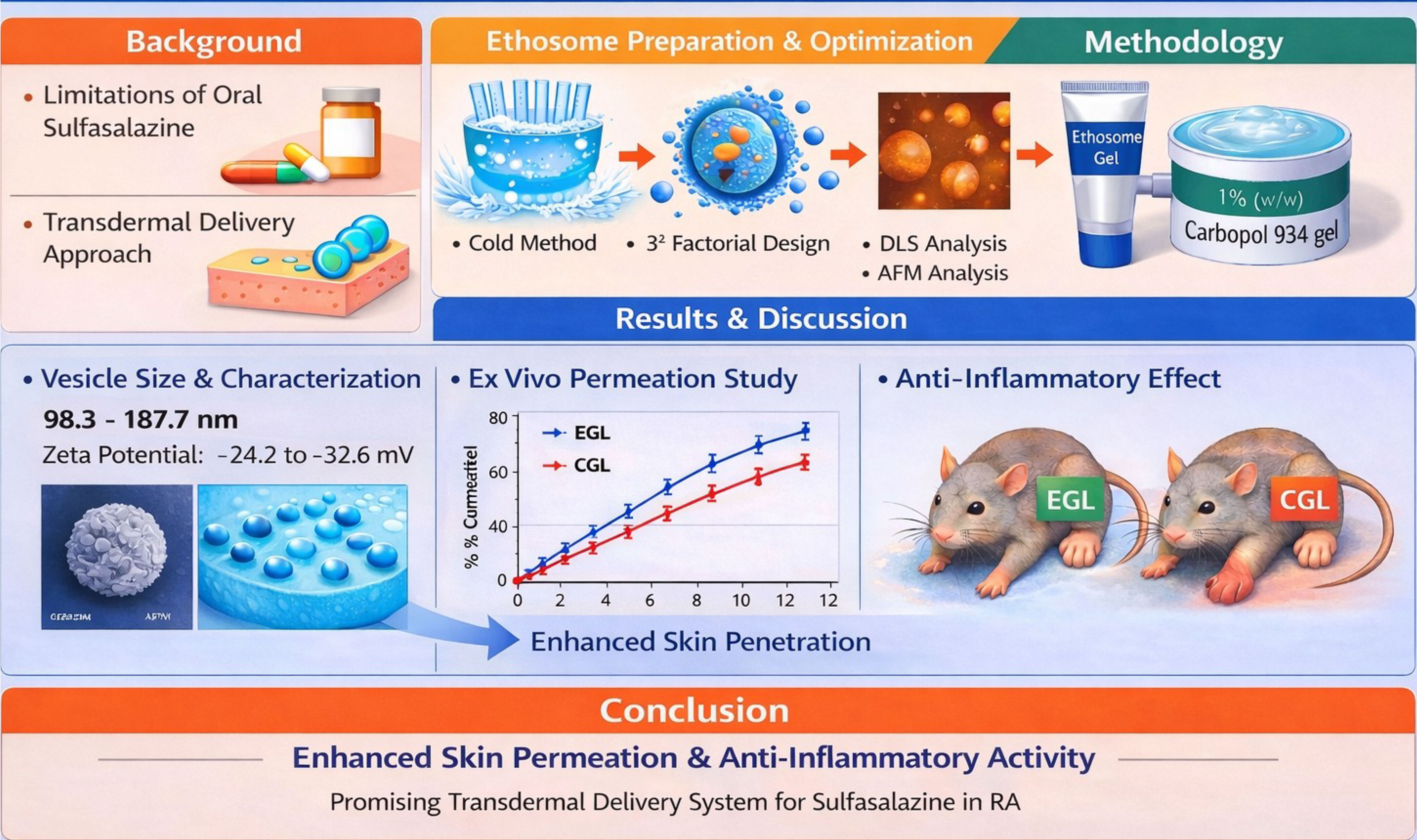
Background: Oral administration of sulfasalazine for rheumatoid arthritis is associated with limitations that reduce therapeutic effectiveness. Transdermal delivery using ethosomal vesicles offers a promising strategy to enhance skin penetration and provide localized therapeutic effects. Methodology: Sulfasalazine-loaded ethosomes were formulated using the cold method and optimized using a 3² full factorial design across nine experimental trials. The formulations were characterized for vesicle size, polydispersity index (PDI), zeta potential, entrapment efficiency, and morphology using atomic force microscopy (AFM). The optimized ethosomal formulation was incorporated into a 1% Carbopol 934 gel to prepare the ethosomal gel (EGL). Ex vivo permeation studies were performed using rat skin to compare EGL with a conventional gel (CGL), and flux and permeability coefficients were calculated. Anti-inflammatory activity was assessed in Sprague–Dawley rats. Results and Discussion: Particle sizes ranged from 98.3 ± 2.37 nm to 187.7 ± 3.12 nm, with a negative zeta potential ranging between –24.2 ± 2.56 mV and –32.6 ± 1.35 mV. The entrapment efficiency ranged from 85.33 ± 3.84% to 94.62 ± 1.34%. Vesicles displayed smooth and spherical surfaces. In vitro drug release studies of the ethosomal gel formulations lasted 12 hours, revealing controlled release of sulfasalazine and enhanced ex vivo permeation in the optimized formulation. In vivo studies showed that EGL produced a greater reduction in inflammation compared to CGL. Conclusion: The developed ethosomal gel demonstrated enhanced skin permeation and anti-inflammatory efficacy, making it a promising transdermal delivery system for sulfasalazine in the management of rheumatoid arthritis.
Downloads

References
Di Matteo A, Bathon JM, Emery P. Rheumatoid arthritis. Lancet, 402(10416), 2019–2033 (2023) https://doi.org/10.1016/S0140-6736(23)01525-8
Radu AF, Bungau SG. Management of rheumatoid arthritis: an overview. Cells, 10(11), 2857 (2021) https://doi.org/10.3390/cells10112857
Chabib L, Ikawati Z, Martien R, Ismail H, Wahyudi MDP, Arimurni DA, et al. Rheumatoid arthritis and the challenge of using nanoparticles for its treatment. MATEC Web Conf, 154, 04005 (2018) https://doi.org/10.1051/matecconf/201815404005
Chauhan N, Vasava P, Khan SL, Siddiqui FA, Islam F, Chopra H, et al. Ethosomes: a novel drug carrier. Ann Med Surg (Lond), 82, 104595 (2022) https://doi.org/10.1016/j.amsu.2022.104595
Dik B, Sonmez G, Faki HE, Bahcivan E. Sulfasalazine treatment can cause a positive effect on LPS-induced endotoxic rats. Exp Anim, 67(4), 403–412 (2018) https://doi.org/10.1538/expanim.18-0029
Azizah N, Ghifari AA, Adikusuma W, Darmawi, Hamidy MY. Exploring the diverse therapeutic benefits of metformin: from anti-cancer to anti-inflammation and PCOS management. J Appl Pharm Res, 12(4), 1–10 (2024) https://doi.org/10.69857/joapr.v12i4.573
Soltani A, Erfani Moghadam V, Yahyazadeh A, Mahmoodi NO. Synthesis, spectroscopic characterization, molecular docking, and in vitro cytotoxicity of calcium(II) sulfasalazine complex. J Mol Struct, 1267, 133568 (2022) https://doi.org/10.1016/j.molstruc.2022.133568
Cai J, Mar JS, Kapili B, Storek KM, Uzunovic J, et al. Spatiotemporal characterization of sulfasalazine and 5-ASA pharmacokinetics using a noninvasive intestinal sampling device. Clin Pharmacol Ther, 118(6), 1437–1442 (2025) https://doi.org/10.1002/cpt.70035
Muteeb G, Rehman MT, Shahwan M, Aatif M. Origin of antibiotics and antibiotic resistance, and their impacts on drug development: a narrative review. Pharmaceuticals, 16(11), 1615 (2023) https://doi.org/10.3390/ph16111615
Dolinger M, Torres J, Vermeire S. Crohn's disease. Lancet, 403(10432), 1177–1191 (2024) https://doi.org/10.1016/S0140-6736(23)02586-2
Huang S, Cheemarla VKR, Tiana D, Lawrence SE. Exploring the crystal structure landscape of sulfasalazine through various multicomponent crystals. Cryst Growth Des, 23(8), 5446–5461 (2023) https://doi.org/10.1021/acs.cgd.2c01403
Anwar DM, Khattab SN, Helmy MW, Kamal MK, Bekhit AA, Elkhodairy KA, et al. Lactobionic/folate dual-targeted amphiphilic maltodextrin-based micelles for targeted codelivery of sulfasalazine and resveratrol to hepatocellular carcinoma. Bioconjug Chem, 29(9), 3026–3041 (2018) https://doi.org/10.1021/acs.bioconjchem.8b00428
Zeng T, Ye JZ, Qin H, Xu QQ. Systematic review and network meta-analysis of different non-steroidal anti-inflammatory drugs for juvenile idiopathic arthritis. World J Clin Cases, 12(12), 2056–2064 (2024) https://doi.org/10.12998/wjcc.v12.i12.2056
Al Muqbil R, Aldhubiab B. Ethosome-based transdermal drug delivery: structural components, preparation techniques, and therapeutic applications across metabolic, chronic, and oncological conditions. Pharmaceutics, 17(5), 583 (2025) https://doi.org/10.3390/pharmaceutics17050583
Manpreet M, Sachdeva S, Kaur H, Garg R, Singh J. Ethosomes: a revolutionary approach in advanced drug delivery systems. J Drug Deliv Ther, 15(2), 186–192 (2025) https://doi.org/10.22270/jddt.v15i2.6993
Kumar S, Verma D, Yadav R, Singh S, Sharma P. In vitro release, ex vivo penetration, and in vivo dermatokinetics of ketoconazole loaded solid lipid nanoparticles for topical delivery. Eur J Pharm Biopharm, 158, 152–164 (2021) https://doi.org/10.1016/j.ejpb.2020.11.009
Ahsan MU, Ambreen U, Javed H, Noor N, Jan M, Khan MN. NSAID associated renal injury: mechanisms, risks, and safer strategies. Arch Nephrol Ren Stud, 5(1), 1–5 (2025) https://doi.org/10.33696/nephrology.5.013
Rancan F. Drug delivery to skin by nanotechnology-based drug delivery systems. J Pharm Drug Deliv Res, 7, 1–6 (2018) https://doi.org/10.4172/2325-9604.1000183
Devaki J, Pavuluri S, Suma N. Ethosomes: a vesicular carrier as a novel tool for transdermal drug delivery system. J Drug Deliv Ther, 13(4), 159–164 (2023) https://doi.org/10.22270/jddt.v13i4.5796
Singh V, Chaubey N. Design and evaluation of topical hydrogel formulation of aceclofenac for improved therapy. J Drug Deliv Ther, 9(5), 118–122 (2019) https://doi.org/10.22270/jddt.v9i5.3605
El-Mahdy MM, Hassan AS, El-Badry M, El-Gindy GE. Performance of curcumin in nanosized carriers niosomes and ethosomes as potential anti-inflammatory delivery system for topical application. Bull Pharm Sci Assiut, 43(1), 105–122 (2020) https://doi.org/10.21608/bfsa.2020.93599
Digkas T, Tefas LR, Porfire AS, Tomuta I, De Beer T. Continuous manufacturing of a topical hydrogel with clobetasol propionate loaded liposomes using QbD methodology. Int J Pharm, 682, 125964 (2025) https://doi.org/10.1016/j.ijpharm.2025.125964
Wilson V, Siram K, Rajendran S, Sankar V. Development and evaluation of finasteride loaded ethosomes for targeting to the pilosebaceous unit. Artif Cells Nanomed Biotechnol, 46(8), 1892–1901 (2018) https://doi.org/10.1080/21691401.2017.1396221
Hajare A, Dol H, Patil K. Design and development of terbinafine hydrochloride ethosomal gel for enhancement of transdermal delivery: in vitro, in vivo, molecular docking, and stability study. J Drug Deliv Sci Technol, 61, 102280 (2021) https://doi.org/10.1016/j.jddst.2020.102280
Schreiner TB, Santamaria Echart A, Ribeiro A, Peres AM, Dias MM, Pinho SP, et al. Formulation and optimization of nanoemulsions using the natural surfactant saponin from Quillaja bark. Molecules, 25(7), 1538 (2020) https://doi.org/10.3390/molecules25071538
Shen G, Li Z, Wang J, Yang H, Zhang X. Enhanced transdermal delivery of apremilast loaded ethosomes: optimization, characterization and in vivo evaluation. J Drug Deliv Sci Technol, 91, 105211 (2024) https://doi.org/10.1016/j.jddst.2023.105211
Dhas N, Preetha HS, Dubey A, Ravi G, Govindan I, Rama A, et al. Factorial design based fabrication of biopolymer functionalized Asiatic acid embedded liposomes: in vitro characterization and evaluation. J Appl Pharm Sci, 12(11), 71–81 (2022) https://doi.org/10.7324/JAPS.2022.121108
Mazzotta E, Marazioti A, Mourtas S, Muzzalupo R, Antimisiaris SG. Liposomes coated with novel synthetic bifunctional chitosan derivatives as potential carriers of anticancer drugs. Pharmaceutics, 16(3), 319 (2024) https://doi.org/10.3390/pharmaceutics16030319
Supraja R, Sailaja AK. Formulation of mefenamic acid loaded ethosomal gel by hot and cold methods. Nano Biomed Eng, 9(1), 27–35 (2017) https://doi.org/10.5101/nbe.v9i1.p27-35
Amarachinta PR, Sharma G, Samed N, Chettupalli AK, Alle M, Kim JC. Central composite design for the development of carvedilol loaded transdermal ethosomal hydrogel for extended and enhanced antihypertensive effect. J Nanobiotechnol, 19, 100 (2021) https://doi.org/10.1186/s12951-021-00833-4
Sakran W, Abdel Rashid RS, Saleh F, Abdel Monem R. Ethosomal gel for rectal transmucosal delivery of domperidone: design of experiment, in vitro, and in vivo evaluation. Drug Deliv, 29(1), 1477–1491 (2022) https://doi.org/10.1080/10717544.2022.2072542
Adepu S, Ramakrishna S. Controlled drug delivery systems: current status and future directions. Molecules, 26(19), 5905 (2021) https://doi.org/10.3390/molecules26195905
Harun SN, Nordin SA, Gani SSA, Shamsuddin AF, Basri M, Basri HB. Development of nanoemulsion for efficient brain parenteral delivery of cefuroxime: designs, characterizations, and pharmacokinetics. Int J Nanomedicine, 13, 2571–2584 (2018) https://doi.org/10.2147/IJN.S151788
Kumar J, Bhardwaj M, Bisht D, Bisht M. Advances in topical antiviral drug delivery: role of liposomes and nanotechnology based strategies. J Neonatal Surg, 14(30S), 963–974 (2025) https://doi.org/10.63682/jns.v14i30S.7504
Batur E, Özdemir S, Durgun ME, Özsoy Y. Vesicular drug delivery systems: promising approaches in ocular drug delivery. Pharmaceuticals, 17(4), 511 (2024) https://doi.org/10.3390/ph17040511
Chen JG, Liu YF, Gao TW. Preparation and anti-inflammatory activity of triptolide ethosomes in an erythema model. J Liposome Res, 20(4), 297–303 (2010) https://doi.org/10.3109/08982100903544144
Gupta M, Tiwari P. Formulation and in-vitro evaluation of oxaprozin transdermal patches for sustained anti-inflammatory therapy. J Appl Pharm Res, 13(6), 22–32 (2025) https://doi.org/10.69857/joapr.v13i6.1203
Al Ghoush WH, Al Baz AA, Al Bassam MA, Al Dulaimi TH, Al Hashimi AR. A DoE based development and characterization of Nadifloxacin loaded transethosomal gel for the treatment of acne vulgaris. Future J Pharm Sci, 10, 46 (2024) https://doi.org/10.1186/s43094-024-00616-2
Kang Y, Zhang S, Wang G, Yan Z, Wu G, Tang L, et al. Nanocarrier based transdermal drug delivery systems for dermatological therapy. Pharmaceutics, 16(11), 1384 (2024) https://doi.org/10.3390/pharmaceutics16111384
Emanet M, Ciofani G. Liposomes and ethosomes: comparative potential in enhancing skin permeability for therapeutic and cosmetic applications. Cosmetics, 11(6), 191 (2024) https://doi.org/10.3390/cosmetics11060191
Ismail TA, Shehata TM, Mohamed DI, Elsewedy HS, Soliman WE. Quality by design for development, optimization and characterization of brucine ethosomal gel for skin cancer delivery. Molecules, 26(11), 3454 (2021) https://doi.org/10.3390/molecules26113454
Yılmaz Usta D, Teksin ZS, Tugcu-Demiroz F. Evaluation of emulgel and nanostructured lipid carrier-based gel formulations for transdermal administration of ibuprofen: characterization, mechanical properties, and ex-vivo skin permeation. AAPS PharmSciTech, 25, 124 (2024) https://doi.org/10.1208/s12249-024-02831-9
Ansari SA, Qadir A, Warsi MH, Mujeeb M, Aqil M, Mir SR, et al. Ethosomes-based gel formulation of karanjin for treatment of acne vulgaris: in vitro investigations and preclinical assessment. 3 Biotech, 11(11), 456 (2021) https://doi.org/10.1007/s13205-021-02978-3
Sanjana A, Ahmed MG, Gowda BHJ. Preparation and evaluation of in-situ gels containing hydrocortisone for the treatment of aphthous ulcer. J Oral Biol Craniofac Res, 11(2), 269–276 (2021) https://doi.org/10.1016/j.jobcr.2021.02.001
Daood NM, Jassim ZE, Ghareeb MM, Zeki H. Studying the effect of different gelling agents on the preparation and characterization of metronidazole as topical emulgel. Asian J Pharm Clin Res, 12(3), 571–577 (2019) https://doi.org/10.22159/ajpcr.2019.v12i3.31504
Anju K, Priya S, Sandeep DS, Nayak P, Kumar P, Kumar A, et al. Formulation and optimization of zaltoprofen loaded ethosomal gel by using 2³ full factorial designs. J Pharm Res Int, 33(24B), 30–44 (2021) https://doi.org/10.9734/jpri/2021/v33i24B31439
Peram MR, Jalalpure SS, Kumbar VM, Patil SR, Joshi SA, Bhat KG, et al. Factorial design-based curcumin ethosomal nanocarriers for skin cancer delivery: in vitro evaluation. J Liposome Res, 29(3), 291–311 (2019) https://doi.org/10.1080/08982104.2018.1556292
Published
How to Cite
Issue
Section
Copyright (c) 2026 Sanjaikumar D, Anasuya Patil, Hemanth G

This work is licensed under a Creative Commons Attribution-NonCommercial 4.0 International License.