In vitro antioxidant and antidiabetic potential of Cinnamomum tamala and Cinnamomum verum extracts
DOI:
https://doi.org/10.69857/joapr.v14i1.1619Keywords:
Diabetes Mellitus, Cinnamomum tamala (Buch.-Ham.) T.Nees and C.H.Eberm., Cinnamomum verum J. Presl, quantitative analysis, antioxidant assay, antidiabetic assayAbstract
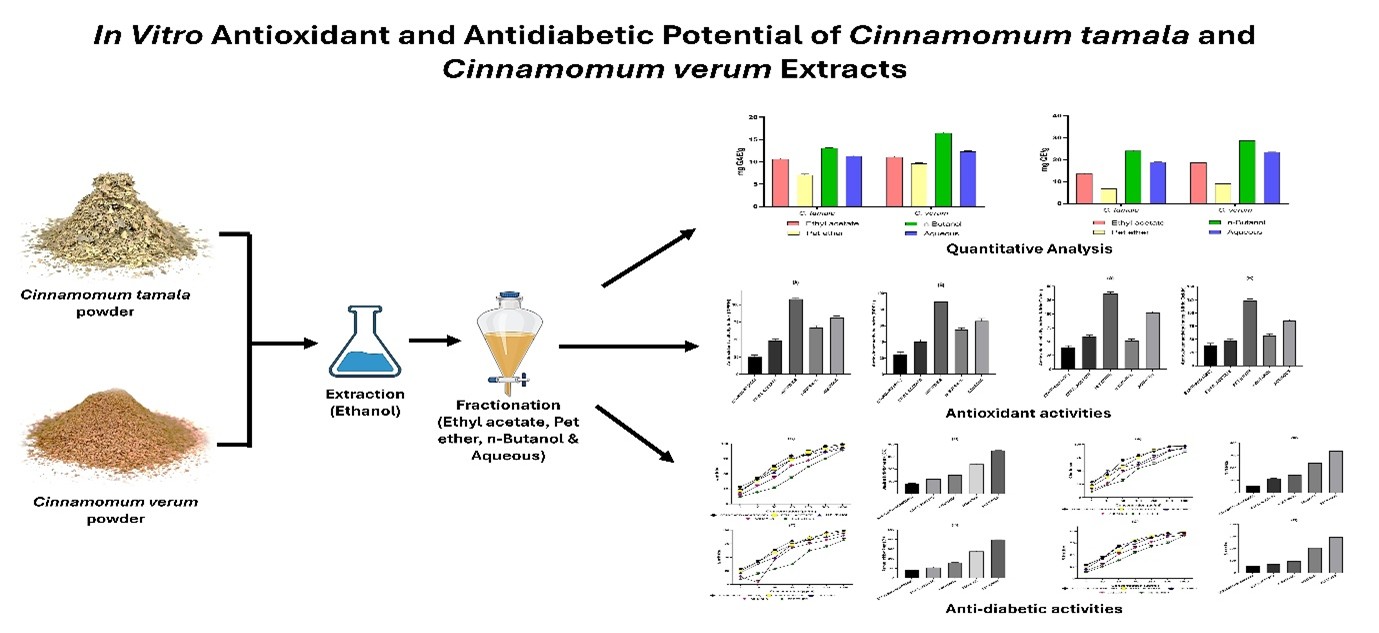
Background: Diabetes is a chronic disorder characterized by oxidative stress, insulin resistance, and β-cell dysfunction. Bioactive substances found in plants, such as phenolics and flavonoids, restore redox balance and inhibit enzymes that degrade carbohydrates. Cinnamomum tamala (Buch.-Ham.) T.Nees and C.H.Eberm. and Cinnamomum verum J. Presl were used in the treatment of metabolic diseases, although less is known about their antioxidant and antidiabetic effects. Methodology: Ethanolic extracts of C. tamala leaves and C. verum bark were prepared and fractionated with polar and non-polar solvents. Phytochemical screening, total phenolic content (TPC, mg GAE/g), and total flavonoid content (TFC, mg QE/g) were measured, along with the antioxidant activity using DPPH and NO radical scavenging assays, and antidiabetic potential using α-amylase and α-glucosidase inhibition assays, using acarbose as the benchmark. Result and Discussion: Alkaloids, phenols, tannins, flavonoids, and saponins were present in both species. The n-butanol fraction had the highest TPC (16.48 mg GAE/g) and TFC (28.74 mg QE/g) in C. verum. In antioxidant assays, the ethyl acetate fraction exhibited higher radical-scavenging activity than the other solvent fractions. In C. verum, ethyl acetate fractions exhibited the strongest antidiabetic effects, with α-glucosidase inhibition comparable to that of acarbose. Both plant species exhibited significant in vitro antioxidant and antidiabetic activities. Conclusion: This study supports the use of C. tamala and C. verum in diabetes care and suggests that the ethyl acetate fraction exhibits higher in vitro antioxidant and antidiabetic activity; however, further in vivo studies, mechanistic studies, and formulation development are required to validate these findings.
Downloads

References
Naghavi M, Ong KL, Aali A, Ababneh HS, Abate YH, Abbafati C. Global burden of 288 causes of death and life expectancy decomposition in 204 countries and territories and 811 subnational locations, 1990–2021: a systematic analysis for the Global Burden of Disease Study 2021. Lancet, 403(10440), 2100–32 (2024) https://doi.org/10.1016/S0140-6736(24)00367-2
Huang X, Wu Y, Ni Y, Xu H, He Y. Global, regional, and national burden of type 2 diabetes mellitus caused by high BMI from 1990 to 2021, and forecasts to 2045: analysis from the global burden of disease study 2021. Front Public Health, 13, 1515797 (2025) https://doi.org/10.3389/fpubh.2025.1515797
Bhatti JS, Sehrawat A, Mishra J, Sidhu IS, Navik U, Khullar N. Oxidative stress in the pathophysiology of type 2 diabetes and related complications: Current therapeutics strategies and future perspectives. Free Radic Biol Med, 184, 114–34 (2022) https://doi.org/10.1016/j.freeradbiomed.2022.03.019
Chen X, Liu Z, Liu W, Wang S, Jiang R, Hu K. NF-κB-Inducing Kinase Provokes Insulin Resistance in Skeletal Muscle of Obese Mice. Inflammation, 46(4), 1445–57 (2023) https://doi.org/10.1007/s10753-023-01820-7
Singh A, Kukreti R, Saso L, Kukreti S. Mechanistic Insight into Oxidative Stress-Triggered Signaling Pathways and Type 2 Diabetes. Molecules, 27(3), 950 (2022) https://doi.org/10.3390/molecules27030950
El-Saadony MT, Saad AM, Mohammed DM, Korma SA, Alshahrani MY, Ahmed AE. Medicinal plants: bioactive compounds, biological activities, combating multidrug-resistant microorganisms, and human health benefits - a comprehensive review. Front Immunol, 16, 1491777 (2025) https://doi.org/10.3389/fimmu.2025.1491777
Ansari P, Khan JT, Chowdhury S, Reberio AD, Kumar S, Seidel V. Plant-Based Diets and Phytochemicals in the Management of Diabetes Mellitus and Prevention of Its Complications: A Review. Nutrients, 16(21), 3709 (2024) https://doi.org/10.3390/nu16213709
Hilles AR, Waly MI, Mahmood S. Chapter 7- The most common Indian antidiabetic plants. Antidiabet Med Plants, 255-269 (2024) https://doi.org/10.1016/B978-0-323-95719-9.00011-2
Alkandahri MY, Sujana D, Hasyim DM, Shafirany MZ, Sulastri L, Arfania M. Antidiabetic Activity of Extract and Fractions of Castanopsis costata Leaves on Alloxan-induced Diabetic Mice. Pharmacogn J, 13(6s), 1589–93 (2021) https://doi.org/10.5530/pj.2021.13.204
Sulaimon LA, Anise EO, Obuotor EM, Samuel TA, Moshood AI, Olajide M. In vitro antidiabetic potentials, antioxidant activities and phytochemical profile of african black pepper (Piper guineense). Clin Phytosci, 6(1), 90 (2020) https://doi.org/10.1186/s40816-020-00236-2
Dubale S, Kebebe D, Zeynudin A, Abdissa N, Suleman S. Phytochemical Screening and Antimicrobial Activity Evaluation of Selected Medicinal Plants in Ethiopia. J Exp Pharmacol, 15, 51–62 (2023) https://doi.org/10.2147/JEP.S379805
Agidew MG. Phytochemical analysis of some selected traditional medicinal plants in Ethiopia. Bull Natl Res Cent, 46(1), 87 (2022) https://doi.org/10.1186/s42269-022-00770-8
Folin O, Ciocalteu V. On tyrosine and tryptophane determinations in proteins. J Biol Chem, 73(2), 627-650 (1927) https://doi.org/10.1016/S0021-9258(18)84277-6
Nguyen VT, Nguyen MT, Tran QT, Thinh PV, Bui LM, Le THN. Effect of extraction solvent on total polyphenol content, total flavonoid content, and antioxidant activity of soursop seeds (Annona muricata L.). IOP Conf Ser Mater Sci Eng, 736(2), 022063 (2020) https://doi.org/10.1088/1757-899X/736/2/022063
Chang CC, Yang MH, Wen HM, Chern JC. Estimation of total flavonoid content in propolis by two complementary colorimetric methods. J Food Drug Anal, 10(3), 178-182 (2002) https://doi.org/10.38212/2224-6614.2748
Hussain A, Kausar T, Din A, Murtaza MA, Jamil MA, Noreen S. Determination of total phenolic, flavonoid, carotenoid, and mineral contents in peel, flesh, and seeds of pumpkin (Cucurbita maxima). J Food Process Preserv, 45(6), e15542 (2021) https://doi.org/10.1111/jfpp.15542
Blois MS. Antioxidant determinations by the use of a stable free radical. Nature, 181(4617), 1199-1200 (1958) https://doi.org/10.1038/1811199a0
Baliyan S, Mukherjee R, Priyadarshini A, Vibhuti A, Gupta A, Pandey RP. Determination of Antioxidants by DPPH Radical Scavenging Activity and Quantitative Phytochemical Analysis of Ficus religiosa. Molecules, 27(4), 1326 (2022) https://doi.org/10.3390/molecules27041326
Green LC, Wagner DA, Glogowski J, Skipper PL, Wishnok JS, Tannenbaum SR. Analysis of nitrate, nitrite, and [15N] nitrate in biological fluids. Anal Biochem, 126(1), 131-138 (1982) https://doi.org/10.1016/0003-2697(82)90118-X
Mueed A, Shibli S, Al-Quwaie DA, Ashkan MF, Alharbi M, Alanazi H. Extraction, characterization of polyphenols from certain medicinal plants and evaluation of their antioxidant, antitumor, antidiabetic, antimicrobial properties, and potential use in human nutrition. Front Nutr, 10, 1125106 (2023) https://doi.org/10.3389/fnut.2023.1125106
Zhang M, Ma X, Xiao Z, Sun A, Zhao M, Wang Y. Polyphenols in twenty cultivars of blue honeysuckle (Lonicera caerulea L.): Profiling, antioxidant capacity, and α-amylase inhibitory activity. Food Chem, 421, 136148 (2023) https://doi.org/10.1016/j.foodchem.2023.136148
Siegień J, Buchholz T, Popowski D, Granica S, Osińska E, Melzig MF. Pancreatic lipase and α-amylase inhibitory activity of extracts from selected plant materials after gastrointestinal digestion in vitro. Food Chem, 355, 129414 (2021) https://doi.org/10.1016/j.foodchem.2021.129414
Mechchate H, Es-safi I, Louba A, Alqahtani AS, Nasr FA, Noman OM. In Vitro Alpha-Amylase and Alpha-Glucosidase Inhibitory Activity and In Vivo Antidiabetic Activity of Withania frutescens L. Foliar Extract. Molecules, 26(2), 293 (2021) https://doi.org/10.3390/molecules26020293
Daou M, Elnaker NA, Ochsenkühn MA, Amin SA, Yousef AF, Yousef LF. In vitro α-glucosidase inhibitory activity of Tamarix nilotica shoot extracts and fractions. PLoS One, 17(3), e0264969 (2022) https://doi.org/10.1371/journal.pone.0264969
Published
How to Cite
Issue
Section
Copyright (c) 2026 Dhiraj Baishya, Ananta Choudhury

This work is licensed under a Creative Commons Attribution-NonCommercial 4.0 International License.