Formulation, physicochemical characterizations, and stability profiling of palbociclib-loaded polymeric nanoparticle with antioxidant and anti-inflammatory investigation for breast cancer treatment
DOI:
https://doi.org/10.69857/joapr.v14i1.1593Keywords:
Anti-oxidant;, Anti-inflammatory;, Nanoparticles;, Palbociclib;, Stability;, Protein denaturation;Abstract
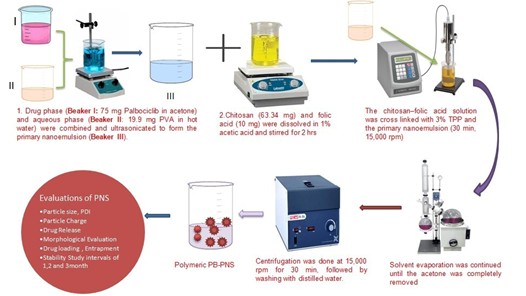
Background: Breast cancer is a highly prevalent malignancy worldwide with significant mortality, and conventional chemotherapy is often constrained by poor solubility, non-targeted distribution, and systemic toxicity, necessitating improved therapeutic approaches. Methodology: Palbociclib-loaded nanoparticles were formulated using chitosan, PVA, and sodium tripolyphosphate, characterized physicochemically, and evaluated for compatibility, bioactivity, stability, and MCF-7 cytotoxicity via MTT assay. Results and Discussion: PNs loaded with Palbociclib showed λmax at 342 nm, which was significantly linear between the range of 5−40 µg/ml (R² = 0.997). The particle size was 237.8 ± 1.76 nm, the PDI was 0.221, and the zeta potential was +34.09 ± 3.38 mV. The encapsulation efficiency and drug loading were 81.21 ± 1.80% and 43.0 ± 1.64%, respectively. The release was more sustained at pH 5.4 (93.25 ± 0.95%) than at pH 7.4 (80.78 ± 1.51%) after 24 h (p < 0.0001). The antioxidant activity (DPPH IC₅₀ = 0.52 µg/ml) and anti-inflammatory activity (IC₅₀ = 38.9 µg/ml) were better than free palbociclib (2.041 and 137.87 µg/ml). There was no significant change in the size (240.14 ± 1.91 nm), the PDI 0.283, the zeta potential +30.01 ± 2.68 mV, the loading of the drug (40.1 ± 1.58%), and the entrapment efficiency (79.02 ± 2.69%) after three months. PB-PNs resulted in a more pronounced proliferation inhibition effect in MCF-7 cells (IC₅₀ = 5.85 µg/ml) as compared to the free palbociclib (18.15 µg/ml).Conclusion: The developed PB-PNs constitute a stable, pH-responsive, and enhanced anticancer therapy, meriting further in vivo investigation.
Downloads

References
Waks AG, Winer EP. Breast Cancer Treatment. JAMA, 321, 288 (2019) https://doi.org/10.1001/jama.2018.19323
Britt KL, Cuzick J, Phillips K-A. Key steps for effective breast cancer prevention. Nat Rev Cancer, 20, 417–36 (2020) https://doi.org/10.1038/s41568-020-0266-x
Vemuri SK, Banala RR, Mukherjee S, Uppula P, S GPV, GR AV, M T. Novel biosynthesized gold nanoparticles as anti-cancer agents against breast cancer: Synthesis, biological evaluation, molecular modelling studies. Mater Sci Eng C, 99, 417–29 (2019) https://doi.org/10.1016/j.msec.2019.01.123
Gomathi AC, Xavier Rajarathinam SR, Mohammed Sadiq A, Rajeshkumar S. Anticancer activity of silver nanoparticles synthesized using aqueous fruit shell extract of Tamarindus indica on MCF-7 human breast cancer cell line. J Drug Deliv Sci Technol, 55, 101376 (2020) https://doi.org/10.1016/j.jddst.2019.101376
Mirza Z, Karim S. Nanoparticles-based drug delivery and gene therapy for breast cancer: Recent advancements and future challenges. Semin Cancer Biol, 69, 226–37 (2021) https://doi.org/10.1016/j.semcancer.2019.10.020
Zhang W, Hong C, Pan C. Polymerization-induced self-assembly of functionalized block copolymer nanoparticles and their application in drug delivery. Macromol Rapid Commun, 40, (2019) https://doi.org/10.1002/marc.201800279
Sur S, Rathore A, Dave V, Reddy KR, Chouhan RS, Sadhu V. Recent developments in functionalized polymer nanoparticles for efficient drug delivery systems. Nano-Struct Nano-Objects, 20, 100397 (2019) https://doi.org/10.1016/j.nanoso.2019.100397
Rajan M, Murugan M, Ponnamma D, Sadasivuni KK, Munusamy MA. Poly-carboxylic acids functionalized chitosan nanocarriers for controlled and targeted anti-cancer drug delivery. Biomed Pharmacother, 83, 201–11 (2016) https://doi.org/10.1016/j.biopha.2016.06.026
Rocca A, Schirone A, Maltoni R, Bravaccini S, Cecconetto L, Farolfi A, Bronte G, Andreis D. Progress with palbociclib in breast cancer: latest evidence and clinical considerations. Ther Adv Med Oncol, 9, 83–105 (2017) https://doi.org/10.1177/1758834016677961
Chen T, Xing F, Sun Y. Facile fabrication of TPGS-PCL polymeric nanoparticles for paclitaxel delivery to breast cancer: investigation of antiproliferation and apoptosis induction. J Exp Nanoscience, 19, (2024) https://doi.org/10.1080/17458080.2023.2281938
Farhat F, Tarabaih M, Kanj A, Aoun M, Kattan J, Assi T, Awada A. Palbociclib safety and efficacy beyond ribociclib-induced liver toxicity in metastatic hormone-receptor positive breast cancer patient. Anti-Cancer Drugs, 31, 85–89 (2020) https://doi.org/10.1097/CAD.0000000000000845
Niehemann K, Schneider SW, Luger TA, Godin B, Ferrari M, Fuchs H. Nanomedicine—challenge and perspectives. Angew Chem Int Ed, 48, 872–97 (2009) https://doi.org/10.1002/anie.200802585
Dikpati A, Di Maio V, Ates E, Greffard K, Bertrand N. Studying the stability of polymer nanoparticles by size exclusion chromatography of radioactive polymers. J Control Release, 369, 394–403 (2024) https://doi.org/10.1016/j.jconrel.2024.03.053
Presas E, Sultan E, Gervasi V, Crean AM, Werner U, Bazile D, O’Driscoll CM. Long-term stability of insulin glulisine loaded nanoparticles formulated using an amphiphilic cyclodextrin and designed for intestinal delivery. Drug Dev Ind Pharm, 46, 1073–9 (2020) https://doi.org/10.1080/03639045.2020.1775631
Bott RF, Oliveira WP. Storage conditions for stability testing of pharmaceuticals in hot and humid regions. Drug Dev Ind Pharm, 33, 393–401 (2007) https://doi.org/10.1080/03639045.2020.1775631
Muthu MS, Feng S-S. Pharmaceutical stability aspects of nanomedicines. Nanomedicine, 4, 857–60 (2009) https://doi.org/10.2217/nnm.09.75
Krishnakumar N, Sulfikkarali N, RajendraPrasad N, Karthikeyan S. Enhanced anticancer activity of naringenin-loaded nanoparticles in human cervical (HeLa) cancer cells. Biomed Prev Nutr, 1(4), 223–231 (2011) https://doi.org/10.1016/j.bionut.2011.09.003
Schaffazick SR, Pohlmann AR, Dalla-Costa T, Guterres SS. Freeze-drying polymeric colloidal suspensions: nanocapsules, nanospheres and nanodispersion. A comparative study. Eur J Pharm Biopharm, 56, 501–5 (2003) https://doi.org/10.1016/S0939-6411(03)00139-5
Yang C-R, Zhao X-L, Hu H-Y, Li K-X, Sun X, Li L, Chen D-W. Preparation, optimization and characteristic of huperzine A loaded nanostructured lipid carriers. Chem Pharm Bull, 58, 656–61 (2010) https://doi.org/10.1248/cpb.58.656
Mandal B, Bhattacharjee H, Mittal N, Sah H, Balabathula P, Thoma LA, Wood GC. Core–shell-type lipid–polymer hybrid nanoparticles as a drug delivery platform. Nanomedicine, 9, 474–91 (2013) https://doi.org/10.1016/j.nano.2012.11.010
Lemoine D, Francois C, Kedzierewicz F, Preat V, Hoffman M, Maincent P. Stability study of nanoparticles of poly(ɛ-caprolactone), poly(d,l-lactide) and poly(d,l-lactide-co-glycolide). Biomaterials, 17, 2191–7 (1996) https://doi.org/10.13040/IJPSR.0975-8232.13(3).1241-50
Valko M, Leibfritz D, Moncol J, Cronin MTD, Mazur M, Telser J. Free radicals and antioxidants in normal physiological functions and human disease. Int J Biochem Cell Biol, 39, 44–84 (2007) https://doi.org/10.1016/0142-9612(96)00049-X
Yadav R, Mahalwal DVS. In-vitro anti-inflammatory activity of oral poly herbal formulations. Pharma Innov J, 7, 272–6 (2018) http://dx.doi.org/10.1016/j.biocel.2006.07.001
Hoque N, Choudhury A, Datta D. Formulation, central composite design optimization and in vitro evaluation of folic acid conjugated palbociclib loaded polymeric nanoparticles. J Young Pharm, 17, 877–86 (2025) https://dx.doi.org/10.5530/jyp.20250155
Published
How to Cite
Issue
Section
Copyright (c) 2026 Nurjamal Hoque, Ananta Choudhury

This work is licensed under a Creative Commons Attribution-NonCommercial 4.0 International License.